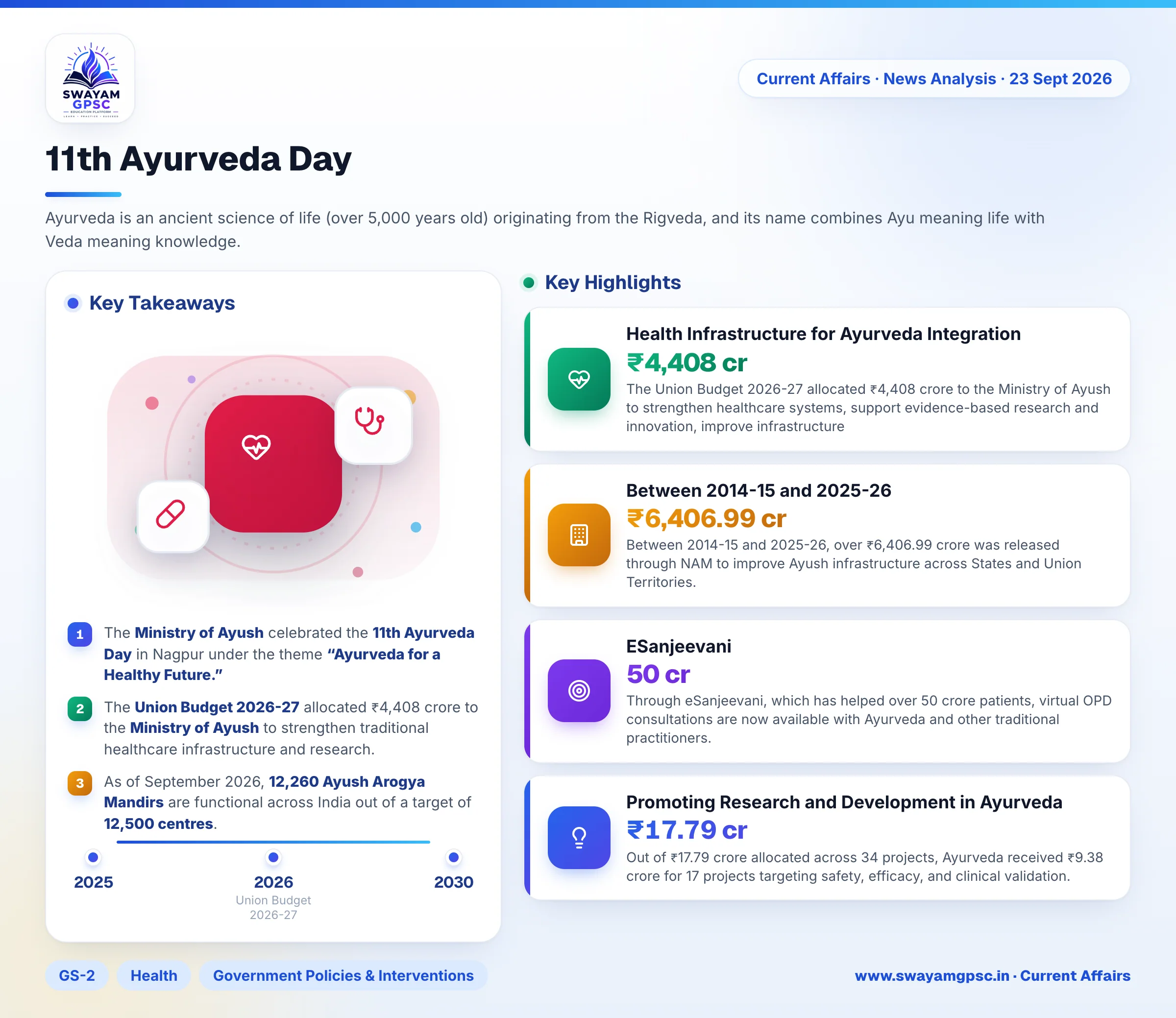
11th Ayurveda Day
#GS-2 #Health #Government Policies & Interventions #Economy #Science & Technology #Current Events #National #International #Infrastructure
Key takeaways
- The Ministry of Ayush celebrated the 11th Ayurveda Day in Nagpur under the theme “Ayurveda for a Healthy Future.”
- The Union Budget 2026-27 allocated ₹4,408 crore to the Ministry of Ayush to strengthen traditional healthcare infrastructure and research.
- As of September 2026, 12,260 Ayush Arogya Mandirs are functional across India out of a target of 12,500 centres.
- India has established international cooperation through 27 country-to-country MoUs and secured global recognition via the WHO International Classification of Diseases (ICD-11) Module.
Why in News
- The Ministry of Ayush recently celebrated the 11th Ayurveda Day in Nagpur under the theme “Ayurveda for a Healthy Future.”
- The event featured the launch of Safety Dossiers on Gokshura (Tribulus terrestris) and Chandrashura (Lepidium sativum) along with Standard Treatment Guidelines for skin conditions.
- Officials also released the “From Traditional Wisdom to Global Leadership: Ayush Vision 2030” Report during the celebrations.
Key Facts About Ayurveda Day
- Ayurveda is an ancient science of life (over 5,000 years old) originating from the Rigveda, and its name combines Ayu meaning life with Veda meaning knowledge.
- The primary goal of Ayurveda is to maintain health in the healthy and treat illness in the diseased.
- Ayurveda defines health as a delicate balance between doshas (bio-energies), agni (metabolic fire), dhatus (body tissues), malas (waste elimination), and overall harmony of the body, mind, and spirit.
- Therapeutic treatments utilize the medicinal properties of plants, animal products, and minerals, relying on classical texts such as the Charaka Samhita and Sushruta Samhita.
- Ayurveda Day is observed every year on 23 September to promote this traditional Indian medical system and increase its global recognition.
- The Ministry of Ayush notified a fixed date for Ayurveda Day in March 2025 to create a consistent calendar identity and boost participation across the world.
- In the past, Ayurveda Day was celebrated on Dhanvantari Jayanti (Dhanteras), but the shift to 23 September aligns with the autumn equinox to emphasize the balance of mind, body, and spirit.
- The government is building a strong Ayurveda ecosystem through improved education, evidence-based research and development, drug standardisation, global outreach, and integration with modern medical systems.
- Traditional medicine is promoted comprehensively alongside other systems such as Yoga & Naturopathy, Unani, Siddha, and Homoeopathy to broaden holistic healthcare options.
Health Infrastructure for Ayurveda Integration
- The Union Budget 2026-27 allocated ₹4,408 crore to the Ministry of Ayush to strengthen healthcare systems, support evidence-based research and innovation, improve infrastructure, and expand global reach.
- The government uses the National Ayush Mission (NAM) to expand traditional care and integrate it with the National Health Mission (NHM).
- Between 2014-15 and 2025-26, over ₹6,406.99 crore was released through NAM to improve Ayush infrastructure across States and Union Territories.
- Existing dispensaries are being upgraded into wellness centers, and by September 2026, 12,260 Ayush Arogya Mandirs became operational out of a target of 12,500 centres.
- Ayush services are co-located in 13,249 public health facilities alongside modern medicine, supported by 25,322 Ayush doctors and 5,666 Ayush paramedics.
- Institutions like VMMC & Safdarjung Hospital and Lady Hardinge Medical College are establishing Departments of Integrative Medicine to offer preventive and therapeutic services including Panchakarma.
- Through eSanjeevani, which has helped over 50 crore patients, virtual OPD consultations are now available with Ayurveda and other traditional practitioners.
- The Insurance Regulatory and Development Authority of India (IRDAI) requires insurance providers to cover all medical systems including Ayurveda, while the All India Institute of Ayurveda (AIIA) has signed cashless empanelment agreements with general insurers.
Development of Ayurveda Educational Infrastructure
- The National Ayush Mission (NAM) supports the creation and upgrade of undergraduate and postgraduate Ayush institutions, along with pharmacy and paramedical programs.
- The Union Budget 2026-27 announced the creation of three new All India Institutes of Ayurveda (AIIA) to boost education, clinical services, and research.
- Under NAM, 17 new Ayush colleges received approval nationwide, with 12 focusing specifically on Ayurveda education.
- Alongside educational expansion, greater focus is placed on evidence-based research and scientific validation to increase the modern credibility of Ayurveda.
Government Initiatives for Strengthening Regulatory Standards
- Ayurvedic medicines are strictly regulated under the Drugs and Cosmetics Act, 1940 and Drugs Rules, 1945.
- Manufacturers must follow Good Manufacturing Practices (GMP), meet pharmacopoeia standards, and guarantee safety and efficacy through regular inspections.
- The government launched the e-Aushadhi portal to allow paperless processing and real-time tracking of manufacturing license applications for better regulatory control.
- The FSSAI worked with the Ministry of Ayush to introduce standards for Ayurveda Aahara to regulate traditional food products based on classical texts.
- The Union Budget 2026-27 proposed upgrading Ayush pharmacies and Drug Testing Laboratories to improve quality control and standardization.
Promoting Research and Development in Ayurveda
- Launched in 2021-22 by the Ministry of Ayush, the AYURGYAN scheme provides financial backing for Ayurveda research and development.
- Out of ₹17.79 crore allocated across 34 projects, Ayurveda received ₹9.38 crore for 17 projects targeting safety, efficacy, and clinical validation.
- The AYUR SWASTHYA Yojana (2021-2026) helps organizations conduct clinical research and upgrade facilities into Centres of Excellence, supporting Ayurveda in 22 out of 25 projects.
- The Central Council for Research in Ayurvedic Sciences (CCRAS) operates through a network of 30 national and regional institutes to promote scientific studies, fellowships, and training.
- The Studentship Programme for Ayurveda Research Ken (SPARK) encourages undergraduate students to take up short-term research, benefiting 289 Ayurveda colleges between 2022-23 and 2024-25.
- CCRAS partnered with Anuvadini AI from AICTE to translate research findings, journals, and study materials into 13 Indian languages.
- The government supports the conservation, cultivation and processing of medicinal plants to ensure a steady supply of quality raw materials for Ayurveda.
International Partnerships and Global Recognition of Ayurveda
- India has built international cooperation through 27 country-to-country MoUs, 16 MoUs for Ayush Academic Chairs, and 57 institute-to-institute agreements.
- During 2025-26, India signed country-level pacts with Angola, Kazakhstan, and Tanzania, alongside agreements with institutions in Ghana, South Africa, Réunion Island, Germany, Malaysia, and Mongolia.
- Global outreach is further supported by 46 Ayush Information Cells across 43 countries and 104 scholarships for foreign nationals.
- Ayurveda achieved major global recognition by being included in the WHO International Classification of Diseases (ICD-11) Module for standardized diagnosis coding.
- New Delhi hosted the Second WHO Global Summit on Traditional Medicine in 2025, drawing representatives from over 100 countries and 22 health ministers to adopt the Delhi Declaration.
- The WHO Global Traditional Medicine Centre at Jamnagar, Gujarat acts as a worldwide hub for research, policy, and standard training guidelines.
- The 11th International Day of Yoga (2025) saw about 2,000 events across 191 countries, while Yoga sessions at the World Expo 2025, Osaka, Japan showcased Indian wellness systems.
- The 16th BRICS Health Ministers’ Meeting in Chandigarh established an Expert Working Group on Traditional, Complementary and Integrative Medicine.
- India introduced special Ayush Visa categories, including M-3 for patients and M-4 for caregivers, to boost medical value travel and international patient care.
Conclusion
- The growth of Ayurveda demonstrates India's successful strategy of blending civilisational wisdom with modern scientific methods.
- Through digital healthcare, research investments, quality checks, and international partnerships, Ayurveda is emerging as a vital pillar of preventive healthcare and holistic well-being.