10 Years of Real Estate Regulation Act
#GS-2 #Governance & Social Justice #Regulatory Bodies #Good Governance #GS-3 #Economy #Infrastructure #Quick Facts For Prelims #Government Policies & Interventions #Statutory Bodies
Key takeaways
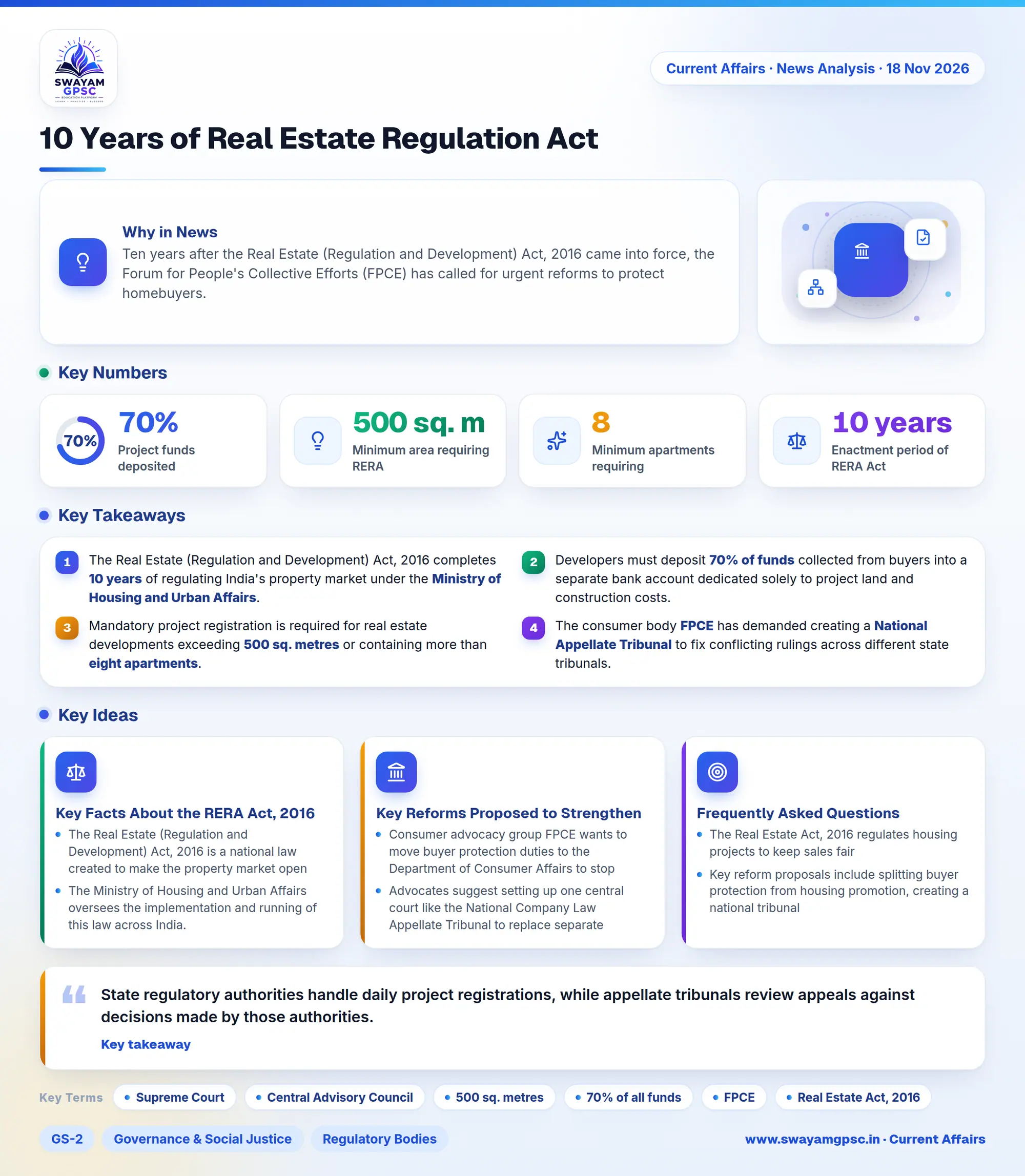
- The Real Estate (Regulation and Development) Act, 2016 completes 10 years of regulating India's property market under the Ministry of Housing and Urban Affairs.
- Developers must deposit 70% of funds collected from buyers into a separate bank account dedicated solely to project land and construction costs.
- Mandatory project registration is required for real estate developments exceeding 500 sq. metres or containing more than eight apartments.
- The consumer body FPCE has demanded creating a National Appellate Tribunal to fix conflicting rulings across different state tribunals.
- The Central Government has approached the Supreme Court to enforce a uniform builder-buyer agreement across all states.
Why in News
- Ten years after the Real Estate (Regulation and Development) Act, 2016 came into force, the Forum for People's Collective Efforts (FPCE) has called for urgent reforms to protect homebuyers.
- At the same time, the Central Government asked the Supreme Court to speed up a case regarding a standard builder-buyer contract across the country.
- This legal move highlights growing worries about different state regulations and unfair terms forced on homebuyers by property developers.
Key Facts About the RERA Act, 2016
- The Real Estate (Regulation and Development) Act, 2016 is a national law created to make the property market open, honest, and efficient.
- The Ministry of Housing and Urban Affairs oversees the implementation and running of this law across India.
- State governments set up Real Estate Regulatory Authorities to monitor local builders, enforce rules, and protect buyer interests.
- States also created Real Estate Appellate Tribunals to handle legal appeals against decisions made by state authorities.
- A national body named the Central Advisory Council gives recommendations to the Central Government on fixing sector issues and helping buyers.
- Every housing project bigger than 500 sq. metres or having more than eight apartments must register with the regulatory authority before selling.
- Builders must deposit 70% of all funds collected from buyers into a dedicated project bank account used only for land and construction costs.
- If a developer delays handing over a home, buyers have a legal right to claim a complete refund with interest and extra financial compensation.
- The law clearly defines carpet area as the actual usable floor area inside internal partition walls, leaving out external walls and open balconies.
Key Reforms Proposed to Strengthen RERA
- Consumer advocacy group FPCE wants to move buyer protection duties to the Department of Consumer Affairs to stop conflicts of interest within the housing ministry.
- Advocates suggest setting up one central court like the National Company Law Appellate Tribunal to replace separate state tribunal bodies.
- Experts recommend adding a standardized model agreement directly into the main law to stop builders from using one-sided contracts.
- Proposed updates would allow buyers facing sudden personal financial problems to cancel bookings and get refunds even if the builder made no mistake.
- New proposals ask for automatic money compensation for all affected buyers in delayed projects without forcing each buyer to file individual cases.
Frequently Asked Questions
- The Real Estate Act, 2016 regulates housing projects to keep sales fair, and the Ministry of Housing and Urban Affairs manages its rules.
- Key reform proposals include splitting buyer protection from housing promotion, creating a national tribunal, and making compensation automatic.
- State regulatory authorities handle daily project registrations, while appellate tribunals review appeals against decisions made by those authorities.
- Carpet area means the actual net space you can walk on inside an apartment, including inner walls but excluding shared shafts and outer balconies.
- A single national appellate tribunal would ensure every state interprets housing safety laws in the exact same way, reducing legal confusion.