Youth Unemployment and Quality Jobs in India
#GS-3 #GS-2 #Economy #Governance & Social Justice #Employment #Youth Unemployment #Skill Development #Demographic Dividend
Key takeaways
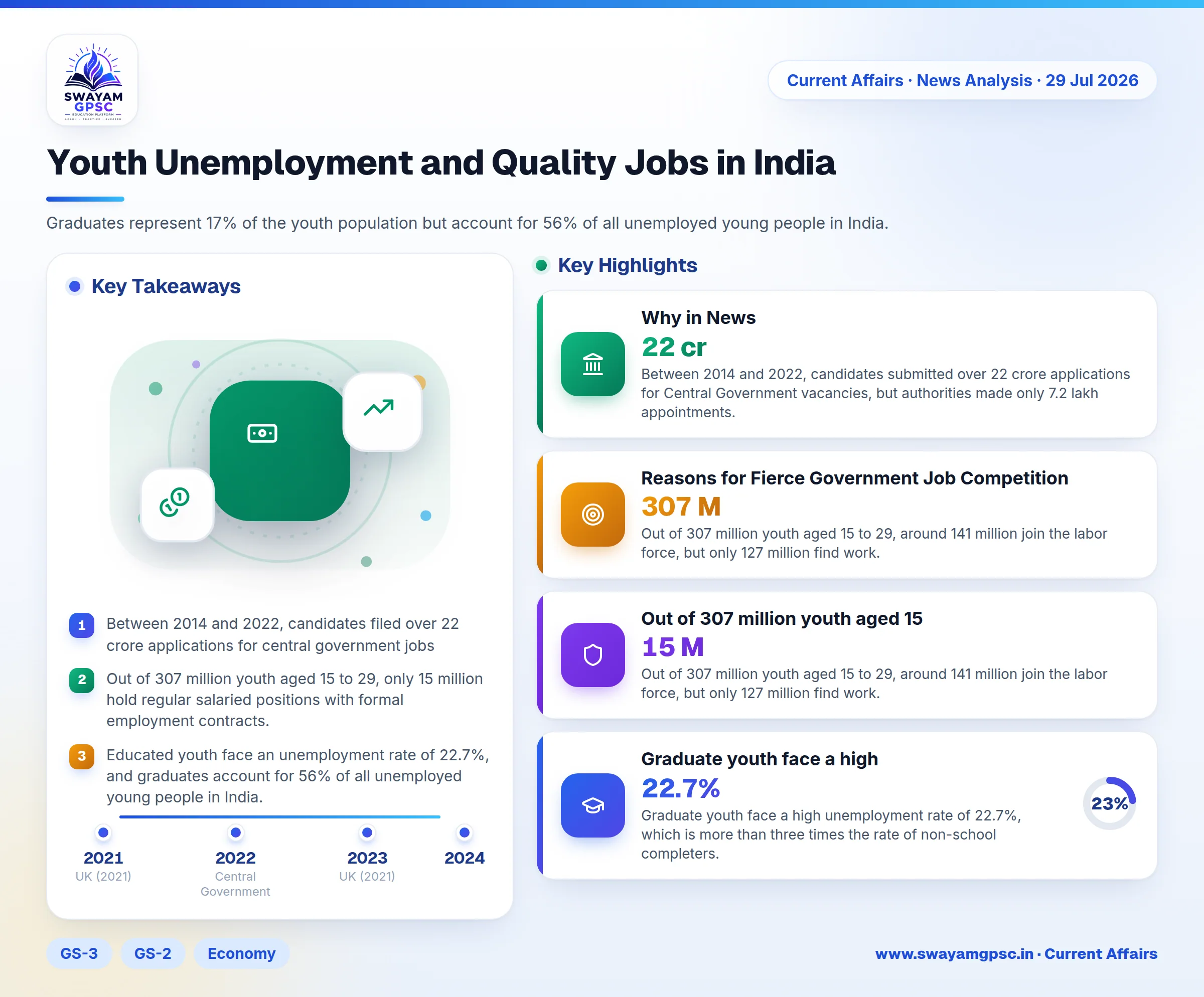
- Between 2014 and 2022, candidates filed over 22 crore applications for central government jobs, but authorities made only 7.2 lakh appointments.
- Out of 307 million youth aged 15 to 29, only 15 million hold regular salaried positions with formal employment contracts.
- Educated youth face an unemployment rate of 22.7%, and graduates account for 56% of all unemployed young people in India.
- Manufacturing contributes only 13% to India's Gross Domestic Product, while public education spending remains low at 2.7% of Gross Domestic Product.
Why in News
- Between 2014 and 2022, candidates submitted over 22 crore applications for Central Government vacancies, but authorities made only 7.2 lakh appointments.
- This massive gap highlights severe youth unemployment and the growing struggle to find secure, high-quality jobs across India.
Summary of the Issue
- High graduate unemployment and skill mismatches drive intense competition for government positions during periods of rapid economic growth.
- Transforming India's demographic dividend requires labor-intensive growth, industry-led skilling, transparent recruitment, and private sector expansion.
Reasons for Fierce Government Job Competition
- Out of 307 million youth aged 15 to 29, around 141 million join the labor force, but only 127 million find work.
- Only about 15 million young workers hold regular salaried jobs with formal contracts and social security benefits.
- Graduate youth face a high unemployment rate of 22.7%, which is more than three times the rate of non-school completers.
- Graduates represent 17% of the youth population but account for 56% of all unemployed young people in India.
- Government recruitment exams like UPSC, SSC, and Railway boards offer a transparent, merit-based path for candidates from marginalized backgrounds.
- In 2024, around 30 lakh applicants competed for just 17,700 central government positions, averaging 170 applicants per open post.
- Entry-level private jobs in small towns pay Rs 10,000 to Rs 15,000 monthly, well below the Rs 20,000 to Rs 25,000 needed for basic living expenses.
Economic Drivers of Government Job Reliance
- The Indian economy produces rapid Gross Domestic Product growth while failing to create adequate formal employment opportunities across key sectors.
- Heavy capital investments favor automation and technology-driven industries over labor-intensive manufacturing sectors that absorb large numbers of workers.
- Manufacturing accounts for only 13% of India's Gross Domestic Product, forcing educated workers into low-productivity farming or informal gig work.
- India allocates only 2.7% of Gross Domestic Product to education against a 6% target, and 1.9% to healthcare against a 2.5% target.
- Educational expansion creates widespread degree distribution without matching skill requirements, leaving nearly 50% of graduates unemployable without retraining.
Implications of Competitive Exam Culture
- Aspirants spend 3 to 6 years preparing for exams like UPSC and SSC, delaying labor participation and wasting demographic dividend benefits.
- Candidates with advanced degrees compete for lower-level posts, resulting in severe skill underutilization and long-term workforce inefficiency.
- Rote learning for exams causes career gaps and lowers graduate employability in the private job market.
- Relentless focus on government jobs diverts creative talent away from innovation, research, and startup entrepreneurship.
- High exam competition fuels a multi-billion-dollar coaching industry, shifting household spending away from higher education and healthcare.
- Extended preparation cycles and repeated exam failures cause severe mental stress, burnout, and rising student suicide rates in coaching hubs.
- Expensive coaching classes create dynamic inequalities that put financially weaker candidates at a major disadvantage during preparation.
- Social pressure and domestic responsibilities limit study time for women, lowering female labor force participation rates.
- Recruitment drives and job quotas turn public sector employment into a heavily politicized election issue.
- Paper leaks and recruitment delays spark widespread student protests and create serious public order issues across multiple states.
Government Initiatives for Skilling and Employment
- Skilling initiatives like the Prime Minister's Internship Scheme (PMIS), Skill India Programme, Pradhan Mantri Kaushal Vikas Yojana (PMKVY 4.0), National Apprenticeship Promotion Scheme (NAPS), Jan Shikshan Sansthan (JSS), and SAMARTH 2.0 boost youth employability.
- Job creation measures include the Employment Linked Incentive (ELI) Scheme, Production-Linked Incentive (PLI) Scheme, PM MUDRA Yojana, and Stand-Up India Scheme.
Way Forward
- India must complement GDP growth by expanding labor-intensive sectors like manufacturing, MSMEs, green energy, care services, tourism, and the blue economy.
- Educational institutions must align training with market needs through PMKVY 4.0, apprenticeships, on-the-job training, and industry-led curriculum updates.
- Following the Dr. Radhakrishnan Committee (2024) recommendations will help secure exams using AI-driven testing and encrypted architecture.
- Strict enforcement of the Public Examinations (Prevention of Unfair Means) Act, 2024 along with fast-track courts will curb paper leaks.
- Expanding incentives under ELI, PLI, and PMIS schemes will boost private sector hiring and support startup ecosystems.
- Linking high-performing candidates from preliminary competitive exams to the National Career Service (NCS) Portal and PMIS will utilize untapped talent.
- Implementing a National Gig Worker Protection Framework will ensure basic social security, fair wages, and worker rights in platform jobs.
- Creating manufacturing and technology hubs in Tier-2 and Tier-3 cities using ELI incentives will promote balanced regional growth.
- Expanding Migration and Mobility Partnership Agreements (MMPAs) with nations like the UK (2021), Germany (2022), Australia (2023), Italy (2023), Denmark (2024), and Japan (2021) will open global skill corridors.
Conclusion
- Over-reliance on public sector recruitment stems from an economic model where GDP growth moves faster than formal job creation.
- Harnessing the demographic dividend requires democratizing private-sector jobs so economic growth meets youth aspirations.