India’s Economic Growth and the Middle-Income Trap Risk
#GS-3 #Economy #Growth #Employment #Infrastructure #GS-2 #Governance & Social Justice #Growth & Development #Government Policies & Interventions #Middle-Income Trap #Production Linked Incentive scheme #National Skills Qualifications Framework
Key takeaways
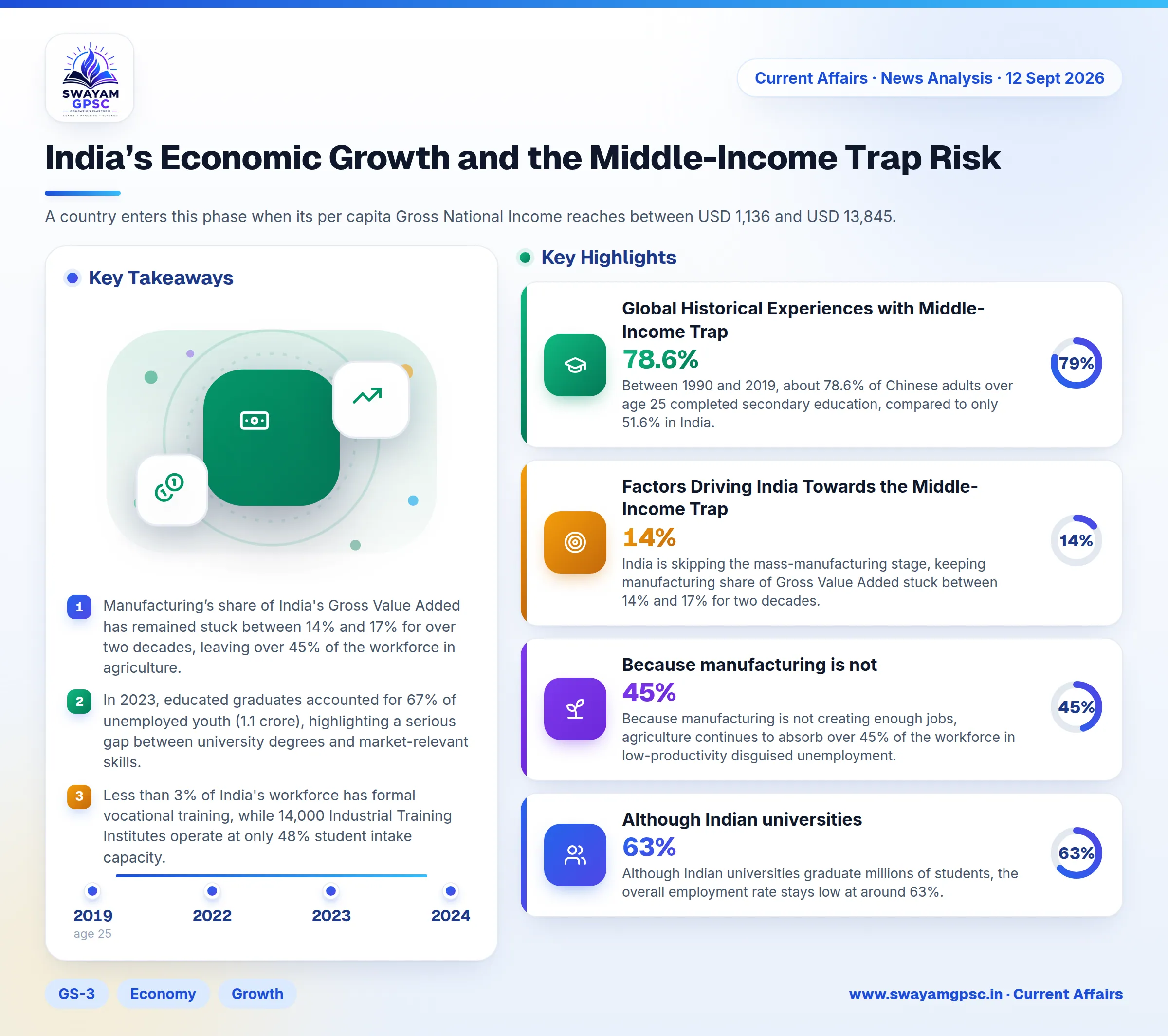
- Manufacturing’s share of India's Gross Value Added has remained stuck between 14% and 17% for over two decades, leaving over 45% of the workforce in agriculture.
- In 2023, educated graduates accounted for 67% of unemployed youth (1.1 crore), highlighting a serious gap between university degrees and market-relevant skills.
- Less than 3% of India's workforce has formal vocational training, while 14,000 Industrial Training Institutes operate at only 48% student intake capacity.
- India's total R&D expenditure remains low at 0.64% of GDP, well below advanced economies like South Korea and Israel which spend over 2% to 3% of GDP.
- To escape the middle-income trap, the World Bank recommends the 3i Strategy of Investment, Infusion, and Innovation alongside job-linked industrial policies.
Why in News
- India is currently the fastest-growing major economy and ranks as the fourth-largest globally.
- Despite rapid economic expansion, concerns persist regarding youth protests, weak private investment, flat real wages, and slow consumer spending.
- These ongoing structural issues raise fears that India might fall into a middle-income, low-productivity trap.
Summary
- India faces the risk of a middle-income trap because rapid growth occurs alongside weak manufacturing, jobless growth, low real wages, poor skill levels, and insufficient R&D.
- Escaping this economic trap requires shifting focus toward employment-intensive manufacturing, stronger vocational training, higher R&D spending, technology diffusion, and human capital investments under the 3i strategy of Investment, Infusion, and Innovation.
What is the Middle-Income Trap?
- World Bank economists introduced the term middle-income trap in 2007 to describe economies that reach middle-income status but fail to become high-income, innovation-driven economies.
- A country enters this phase when its per capita Gross National Income reaches between USD 1,136 and USD 13,845.
- Developing nations face a dual squeeze as rising domestic wages reduce competitiveness against lower-cost economies.
- At the same time, these nations lack the technological depth, institutional strength, and high productivity needed to compete with advanced knowledge economies.
- Over the last 60 years, only a few nations like South Korea, Taiwan, and Singapore successfully escaped this trap, while many others in Latin America and Southeast Asia remain stuck.
Global Historical Experiences with Middle-Income Trap
- Argentina experienced rapid agricultural growth until the 1930s, but failed to transition into an innovation-led industrial economy.
- Over-reliance on primary farm exports made Argentina vulnerable to international shocks, causing a continuous drop in per capita GDP relative to the US.
- China built a highly capable workforce by prioritizing mass education alongside state-backed manufacturing growth.
- Between 1990 and 2019, about 78.6% of Chinese adults over age 25 completed secondary education, compared to only 51.6% in India.
- South Korea avoided the trap by protecting national industrial conglomerates called chaebols before opening its market to global competition.
- Developing countries often used targeted tariffs and government subsidies during their growth phase instead of relying purely on free-market rules.
Factors Driving India Towards the Middle-Income Trap
- India is skipping the mass-manufacturing stage, keeping manufacturing share of Gross Value Added stuck between 14% and 17% for two decades.
- Because manufacturing is not creating enough jobs, agriculture continues to absorb over 45% of the workforce in low-productivity disguised unemployment.
- India's expansion in high-end service sectors like IT uses high capital but creates very few mass jobs for the broader workforce.
- Although Indian universities graduate millions of students, the overall employment rate stays low at around 63%.
- High youth unemployment stems from a lack of formal quality jobs rather than an oversupply of educated workers.
- In 2023, educated graduates made up 67% of unemployed youth (1.1 crore), up from 32% in 2004 (30 lakh), showing a wide gap between degrees and practical market skills.
- The ILO India Employment Report 2024 notes that real wages for regular and casual workers remained flat or dropped between 2012 and 2022.
- Lower purchasing power limits household Private Final Consumption Expenditure, which reduces overall domestic demand and slows private business investment.
- Less than 3% of India's workforce holds formal vocational training qualifications.
- Out of 25 lakh training seats across 14,000 Industrial Training Institutes, actual student intake remains low at around 48%.
- Outdated study courses and a social preference for college degrees over technical trades create severe skill shortages for industrial units.
- According to the World Development Report 2024, an Indian firm operating for 40 years doubles in size, whereas a similar US firm grows sevenfold.
- Most Indian enterprises remain tiny informal units due to weak management skills, family-centered leadership, and limited access to formal credit.
- The Economic Survey 2018-19 pointed out that small Indian firms stay small even as they age, preventing productivity growth and scale economies.
- Government policies that make capital cheaper than labor encourage companies to adopt automation, reducing job creation in a labor-rich country.
- India spends only 0.64% of GDP on Gross Expenditure on R&D, which limits technological progress and local innovation.
- In FY 2023-24, private industry contributed 51.8% of total R&D spending, outscoring government expenditure for the first time.
- India still lags behind nations like the US, South Korea, and Israel, where R&D spending exceeds 2% to 3% of GDP and private industry provides 70% to 80% of funds.
- Economic recovery after the pandemic has remained K-shaped, favoring large corporations while 90% of informal sector workers lag behind.
- Deep social prejudice against physical labor and skilled trades prevents blue-collar work from gaining formal status and dignity.
- An IIM Ahmedabad study revealed that 68% of white-collar workers fear losing their jobs to artificial intelligence within 5 years.
Measures Needed to Avoid the Middle-Income Trap
- India must adopt Productivism, an approach prioritizing real manufacturing and services over financial speculation.
- Under this model, the government takes active steps to create mass jobs rather than focusing only on post-tax wealth redistribution.
- Creating widespread opportunities protects the dignity of labor and removes social bias against technical manual work.
- The government should link industrial reward programs like the Production Linked Incentive scheme to verified net job creation instead of capital investments alone.
- India needs to upgrade Industrial Training Institutes through public-private partnerships and adopt dual-apprenticeship models used in Germany and Switzerland.
- Authorities must evaluate vocational training programs based on post-training job placement rates and wage levels rather than enrollment counts.
- Public campaigns should elevate the status of technical trades while certifying skills under the National Skills Qualifications Framework.
- Total public and private spending on R&D should rise toward 1.5% to 2% of GDP, helping transfer practical technology to small businesses.
- India must strengthen foundational literacy, early childhood education, and basic healthcare to build high workforce productivity for the future.
Conclusion
- To avoid getting stuck in middle-income status, India should implement the World Bank 3i Strategy focusing on Investment, Infusion, and Innovation.
- Policy focus must shift from subsidizing capital investments to rewarding companies that generate large-scale employment.
- India needs to scale up R&D investments while modernizing its vocational training system to prepare workers for advanced manufacturing and artificial intelligence.
Frequently Asked Questions
- The middle-income trap describes a state where a country reaches middle-income levels but fails to transition into a high-income, innovation-based economy.
- Premature de-industrialisation is a concern because manufacturing GVA stays low at 14% to 17% while agriculture supports over 45% of workers in low-productivity jobs.
- India's main vocational challenge is that under 3% of workers have formal skill training, while training institutes face low enrollment and outdated courses.
- The 3i strategy framed by the World Bank relies on Investment, Infusion, and Innovation to guide developing nations toward tech-driven growth.
- India can avoid this trap by adopting job-linked industrial policies, modernizing skill training, raising R&D spending, and supporting labor-intensive manufacturing.