World Development Report 2026: The Promise of Artificial Intelligence
#GS-3 #Science & Technology #Artificial Intelligence #Economy #Growth #Current Events #National #International #Prelims
Key takeaways
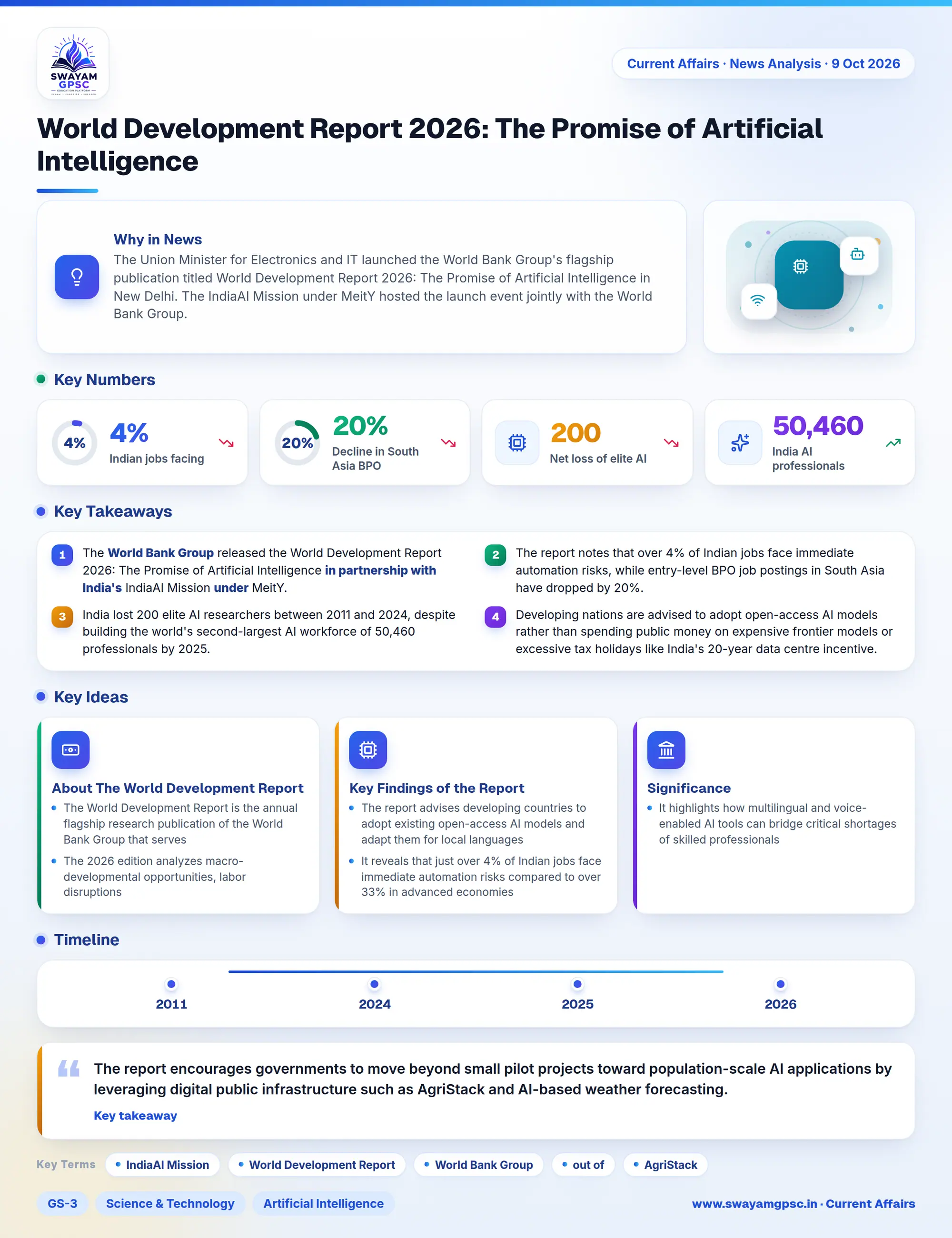
- The World Bank Group released the World Development Report 2026: The Promise of Artificial Intelligence in partnership with India's IndiaAI Mission under MeitY.
- The report notes that over 4% of Indian jobs face immediate automation risks, while entry-level BPO job postings in South Asia have dropped by 20%.
- India lost 200 elite AI researchers between 2011 and 2024, despite building the world's second-largest AI workforce of 50,460 professionals by 2025.
- Developing nations are advised to adopt open-access AI models rather than spending public money on expensive frontier models or excessive tax holidays like India's 20-year data centre incentive.
Why in News
- The Union Minister for Electronics and IT launched the World Bank Group's flagship publication titled World Development Report 2026: The Promise of Artificial Intelligence in New Delhi.
- The IndiaAI Mission under MeitY hosted the launch event jointly with the World Bank Group.
About The World Development Report (WDR) 2026
- The World Development Report is the annual flagship research publication of the World Bank Group that serves as an authoritative global guide on key development policy issues.
- The 2026 edition analyzes macro-developmental opportunities, labor disruptions, and structural prerequisites of AI specifically for low- and middle-income countries.
- The World Bank Group publishes this flagship report annually.
- The IndiaAI Mission under the Ministry of Electronics and Information Technology (MeitY) served as the official India launch partner.
Key Findings of the Report
- The report advises developing countries to adopt existing open-access AI models and adapt them for local languages and developmental needs instead of spending heavily on expensive frontier models.
- It reveals that just over 4% of Indian jobs face immediate automation risks compared to over 33% in advanced economies, though entry-level BPO job postings in South Asia have already dropped by about 20%.
- It warns that generous incentives, such as India's 20-year tax holiday for foreign data centres, could strain public finances, increase electricity costs, and mostly benefit multinational corporations.
- It emphasizes that building domestic data centres alone cannot guarantee technological independence because countries still rely heavily on imported advanced semiconductors, specialized cloud infrastructure, and global supply chains.
- It highlights that India suffered a net loss of 200 elite AI researchers and inventors between 2011 and 2024, even though the country possessed the world's second-largest AI talent pool of about 50,460 professionals in 2025.
- It reveals a massive global preparedness gap where only 1 out of 25 low-income economies currently has an active national AI strategy.
- It shows that only 18.8% of Indians express concern about AI compared to 50.5% in the US, reflecting greater optimism and a preference for flexible regulatory guidelines.
Significance
- The report encourages governments to move beyond small pilot projects toward population-scale AI applications by leveraging digital public infrastructure such as AgriStack and AI-based weather forecasting.
- It highlights how multilingual and voice-enabled AI tools can bridge critical shortages of skilled professionals in healthcare, agriculture, and education across digitally underserved communities.