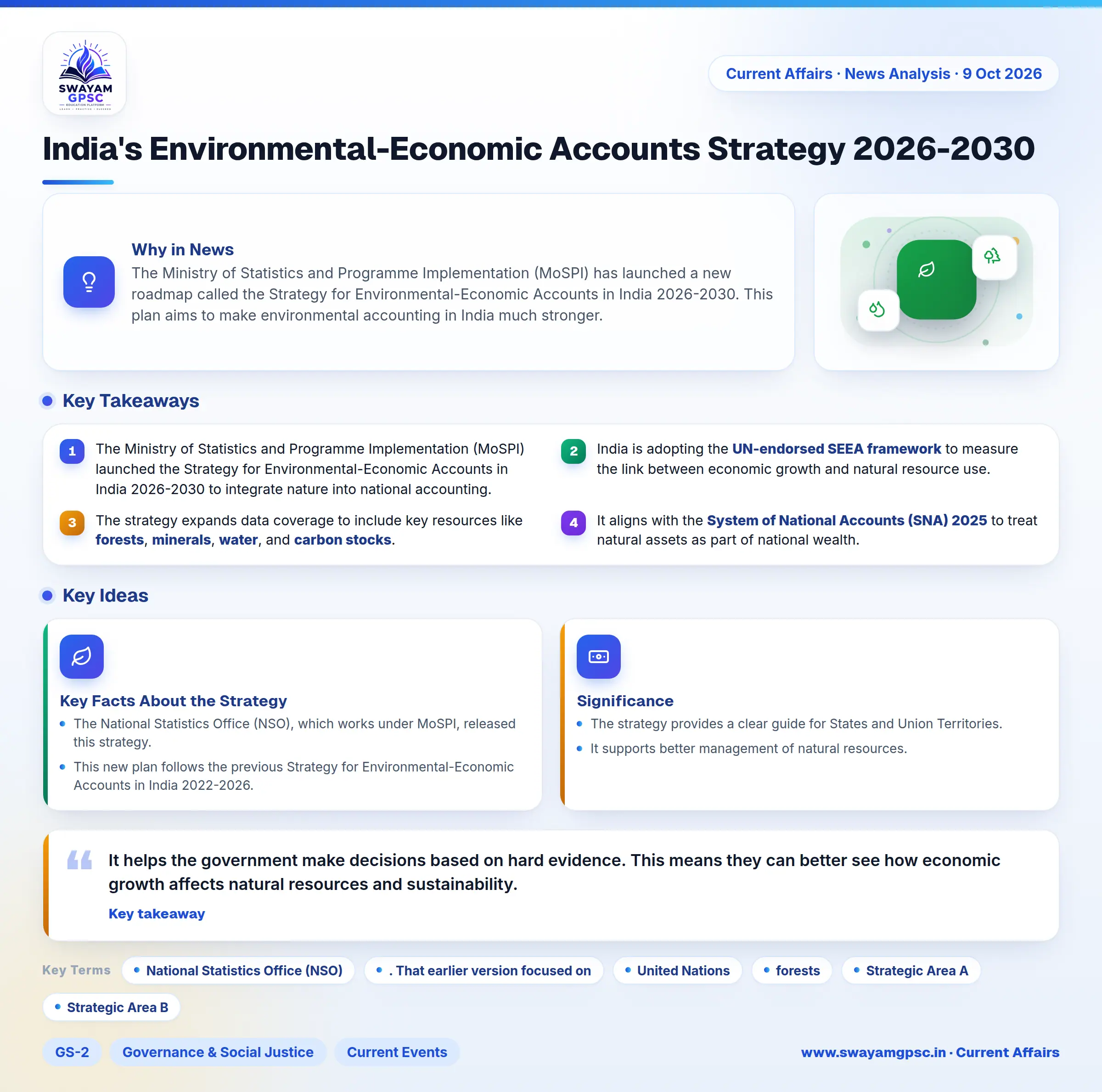
India's Environmental-Economic Accounts Strategy 2026-2030
#GS-2 #Governance & Social Justice #Current Events #National #GS-3 #Economy #Infrastructure #Environment #Sustainable Development
Key takeaways
- The Ministry of Statistics and Programme Implementation (MoSPI) launched the Strategy for Environmental-Economic Accounts in India 2026-2030 to integrate nature into national accounting.
- India is adopting the UN-endorsed SEEA framework to measure the link between economic growth and natural resource use.
- The strategy expands data coverage to include key resources like forests, minerals, water, and carbon stocks.
- It aligns with the System of National Accounts (SNA) 2025 to treat natural assets as part of national wealth.
Why in News
- The Ministry of Statistics and Programme Implementation (MoSPI) has launched a new roadmap called the Strategy for Environmental-Economic Accounts in India 2026-2030. This plan aims to make environmental accounting in India much stronger.
Key Facts About the Strategy
- The National Statistics Office (NSO), which works under MoSPI, released this strategy. Its main goals are to improve the quality of data, fill in missing information, and cover more environmental areas.
- This new plan follows the previous Strategy for Environmental-Economic Accounts in India 2022-2026. That earlier version focused on Material Flow Accounts (MFAs), Ocean Accounts, Energy Accounts, and specific data for urban areas and biodiversity.
- The government designed this as a flexible framework that can evolve over time. It lists priority areas and milestones to help the country develop and track environmental accounts systematically.
- India is using the System of Environmental-Economic Accounting (SEEA) framework. This system is endorsed by the United Nations and helps link economic activities with the use of natural resources and ecosystems.
- The strategy focuses on expanding data for several key areas. These include forests, minerals, soil resources, land, water, carbon stocks, biodiversity, and general environmental statistics.
- The guidelines for these priority areas come from the SEEA Central Framework (SEEA-CF) and the Green National Accounts in India - A Framework.
- The roadmap divides its goals into two main strategic areas. Strategic Area A focuses on improving data quality, expanding coverage, and filling gaps by standardizing how data is collected.
- Strategic Area B focuses on communication. It aims to make sure that policymakers and other stakeholders are aware of these accounts and know how to use the data.
- This plan works alongside the System of National Accounts (SNA) 2025. This helps the government recognize natural resources as part of the nation's total wealth.
Significance
- It helps the government make decisions based on hard evidence. This means they can better see how economic growth affects natural resources and sustainability.
- The strategy provides a clear guide for States and Union Territories. This encourages them to start or improve their own environmental accounting systems.
- It supports better management of natural resources. By finding data gaps, the government can better monitor its commitments to sustainable development.