WHO Pandemic Agreement and India's Role in Global Health Governance
#GS-2 #Governance & Social Justice #Health #Current Events #International #GS-3 #Economy #Infrastructure #Science & Technology #Biotechnology
Key takeaways
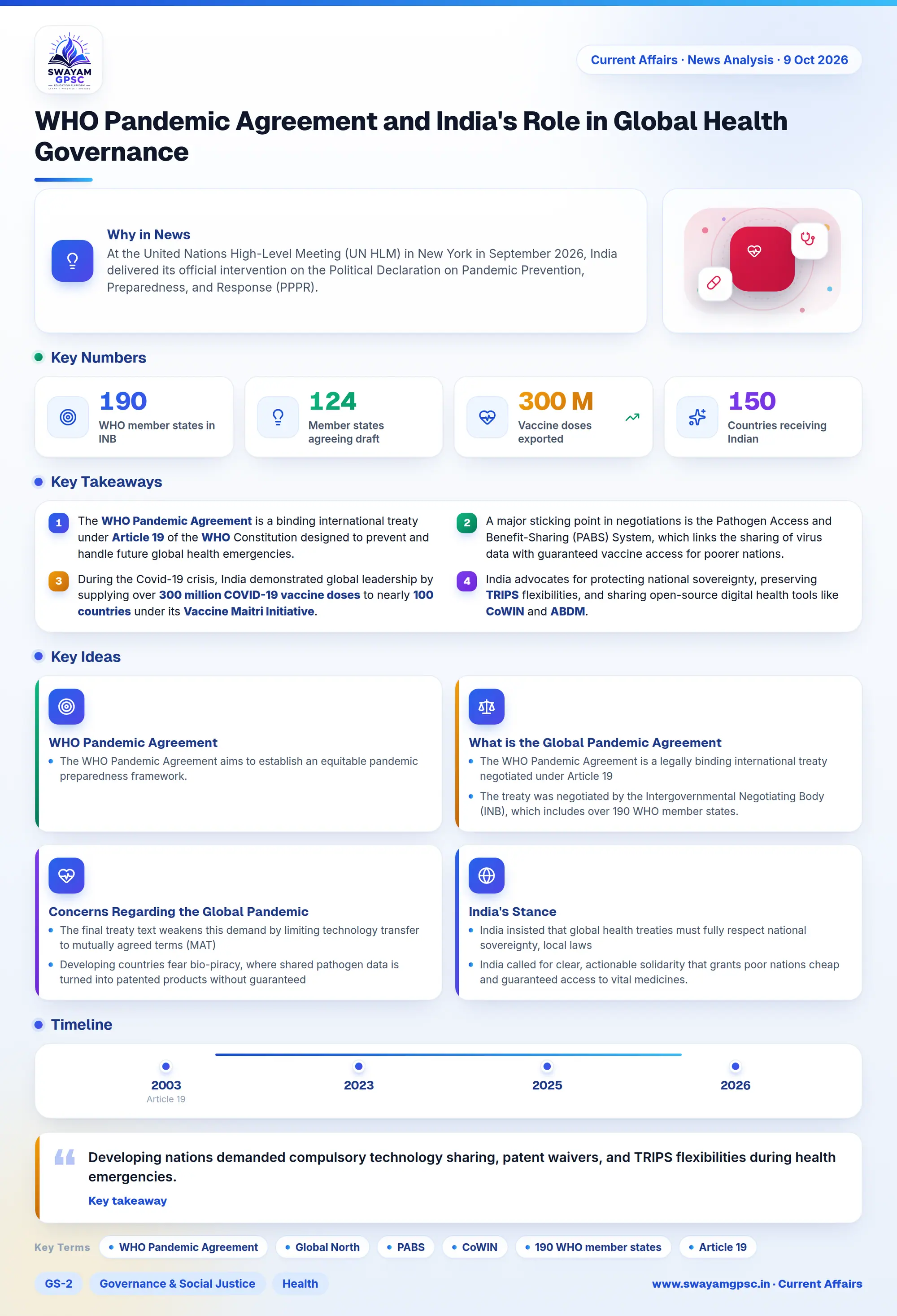
- The WHO Pandemic Agreement is a binding international treaty under Article 19 of the WHO Constitution designed to prevent and handle future global health emergencies.
- A major sticking point in negotiations is the Pathogen Access and Benefit-Sharing (PABS) System, which links the sharing of virus data with guaranteed vaccine access for poorer nations.
- During the Covid-19 crisis, India demonstrated global leadership by supplying over 300 million COVID-19 vaccine doses to nearly 100 countries under its Vaccine Maitri Initiative.
- India advocates for protecting national sovereignty, preserving TRIPS flexibilities, and sharing open-source digital health tools like CoWIN and ABDM.
Why in News
- At the United Nations High-Level Meeting (UN HLM) in New York in September 2026, India delivered its official intervention on the Political Declaration on Pandemic Prevention, Preparedness, and Response (PPPR).
- This declaration aligns closely with the emerging global framework being crafted under the WHO Pandemic Agreement.
- Unresolved negotiations surround the Pathogen Access and Benefit-Sharing (PABS) System under the Pandemic Agreement.
- India has stepped into a central leadership role to bridge the sharp geopolitical divide between the Global North and the Global South.
Summary
- The WHO Pandemic Agreement aims to establish an equitable pandemic preparedness framework.
- Key elements of the treaty include the PABS system, One Health approaches, technology transfer, resilient supply chains, and sustainable financing.
- These measures address severe global inequalities that were exposed during the Covid-19 crisis.
- India can bridge the divide between rich and developing nations by using its massive vaccine manufacturing capacity.
- India can also share its Digital Public Infrastructure (DPI) platforms like CoWIN, eSanjeevani, and Ayushman Bharat Digital Mission (ABDM).
- India continues to champion national sovereignty while advocating for equitable access to life-saving medical resources.
What is the Global Pandemic Agreement
- The WHO Pandemic Agreement is a legally binding international treaty negotiated under Article 19 of the WHO Constitution.
- The treaty was negotiated by the Intergovernmental Negotiating Body (INB), which includes over 190 WHO member states.
- It was adopted in May 2025 but has not yet officially entered into force.
- It represents only the second binding health convention under Article 19 in WHO history, following the 2003 WHO Framework Convention on Tobacco Control (FCTC).
- The agreement creates a standardized global structure to govern disease surveillance, crisis response, and resource sharing during a Public Health Emergency of International Concern (PHEIC).
- Severe inequalities during Covid-19, often called vaccine apartheid, forced world leaders to seek a binding treaty.
- During Covid-19, rich nations stockpiled vaccines, treatments, and protective gear, leaving low- and middle-income countries with long delays.
- Ad-hoc voluntary programs like the COVAX Facility and the ACT-Accelerator failed because of underfunding, export bans, and private supply contracts.
- Developing countries shared pathogen genetic data through platforms like GISAID, but drug companies used this data to sell expensive products without guaranteeing access to originating nations.
- The threat of emerging animal-to-human viruses like Avian Influenza (H5N1), Mpox, Marburg virus, and Ebola requires an automated global response system.
- The treaty rests on key pillars including the PABS System, One Health, technology transfer, resilient supply chains, and dedicated funding.
- The PABS System requires that rapid sharing of viral samples automatically triggers a reserved supply of vaccines and tests for global distribution.
- The One Health approach combines human, animal, and environmental monitoring to catch animal-origin threats early.
- Technology transfer provisions encourage sharing manufacturing blueprints to create production hubs across Africa, Asia, and Latin America.
- The Global Supply Chain and Logistics Network will work to block export restrictions and clear bottlenecks for raw materials like bioreactors and glass vials.
- Sustainable financing mechanisms will build laboratory capacity, cold-chain storage, and clinical facilities in resource-limited nations.
- The draft treaty reached consensus among 124 member states at the World Health Assembly, with 0 negative votes and 11 abstentions.
- Formal ratification remains paused because countries must still finalize the PABS Annex, which sets exact percentage quotas for emergency supplies and monetary fees from drug companies.
Concerns Regarding the Global Pandemic Agreement
- Developing nations demanded compulsory technology sharing, patent waivers, and TRIPS flexibilities during health emergencies.
- The final treaty text weakens this demand by limiting technology transfer to mutually agreed terms (MAT), making sharing largely voluntary.
- Developing countries fear bio-piracy, where shared pathogen data is turned into patented products without guaranteed access for origin countries.
- Negotiators remain split over the PABS technical annex regarding what percentage of production drug makers must reserve for WHO distribution.
- The One Health approach requires big investments in animal surveillance and wildlife monitoring, creating an unfunded financial burden for poor nations.
- Several countries worry that treaty rules could limit national sovereignty over public health choices, border controls, and medical rules.
- The United States has opposed stronger WHO oversight due to concerns over the PABS structure and potential conflicts with domestic commercial interests.
- Pharmaceutical corporations argue that forced patent sharing and compulsory benefit-sharing could destroy economic incentives for new medical research.
India's Stance
- India insisted that global health treaties must fully respect national sovereignty, local laws, and national regulatory choices.
- India called for clear, actionable solidarity that grants poor nations cheap and guaranteed access to vital medicines.
- India offered its Digital Public Infrastructure (DPI) as a global public good, highlighting platforms like CoWIN, eSanjeevani, and ABDM.
- Despite its label as the Pharmacy of the World, India remains reliant on imported Active Pharmaceutical Ingredients (APIs) and key raw materials.
- India strongly supports building resilient and geographically diverse global drug supply lines.
- Through its Vaccine Maitri Initiative, India shipped over 300 million COVID-19 vaccine doses to nearly 100 countries and UN agencies.
- India exported generic drugs, test kits, and active ingredients to over 150 nations during critical global shortages.
- Indian companies like the Serum Institute of India and Bharat Biotech served as global manufacturing hubs for programs like COVAX and Gavi.
Measures India Can Pursue to Bridge Global Divides
- India can negotiate a pragmatic PABS compromise that gives fair commercial returns to manufacturers while securing low-cost vaccine quotas for poor nations.
- India can build technical partnerships across Africa, ASEAN, and Latin America for One Health monitoring and genomic testing using networks like INSACOG.
- India can share open-source digital tools like CoWIN, Aarogya Setu, and ABDM for free with developing countries.
- India can use the upcoming H20 Summit to lead global pandemic planning.
- India can expand the Global Initiative on Digital Health (GIDH), launched during its 2023 G20 Presidency, to connect health databases globally.
- India can coordinate joint policy positions within the Partners for Multilateralism coalition alongside the EU, Kenya, Brazil, Canada, Australia, and Barbados.
- India can update its domestic health laws and safety rules under the Biological Diversity Act to set strong examples for benefit-sharing.
- India can speed up its Production Linked Incentive (PLI) schemes for APIs and medical devices to secure its own pharmaceutical supply chains.
- India can defend the Doha Declaration on TRIPS and Public Health to safeguard the legal right of nations to issue compulsory manufacturing licenses during crises.
Conclusion
- The WHO Pandemic Agreement offers a critical opportunity to build a fairer global health framework after the Covid-19 pandemic.
- India can lead this transformation by combining its digital systems, massive drug manufacturing capacity, and diplomatic leadership in the G20 and BRICS.