Understanding Indian Rupee Valuation and REER Index
#GS-3 #Economy #Exchange Rate #Current Events #National
Key takeaways
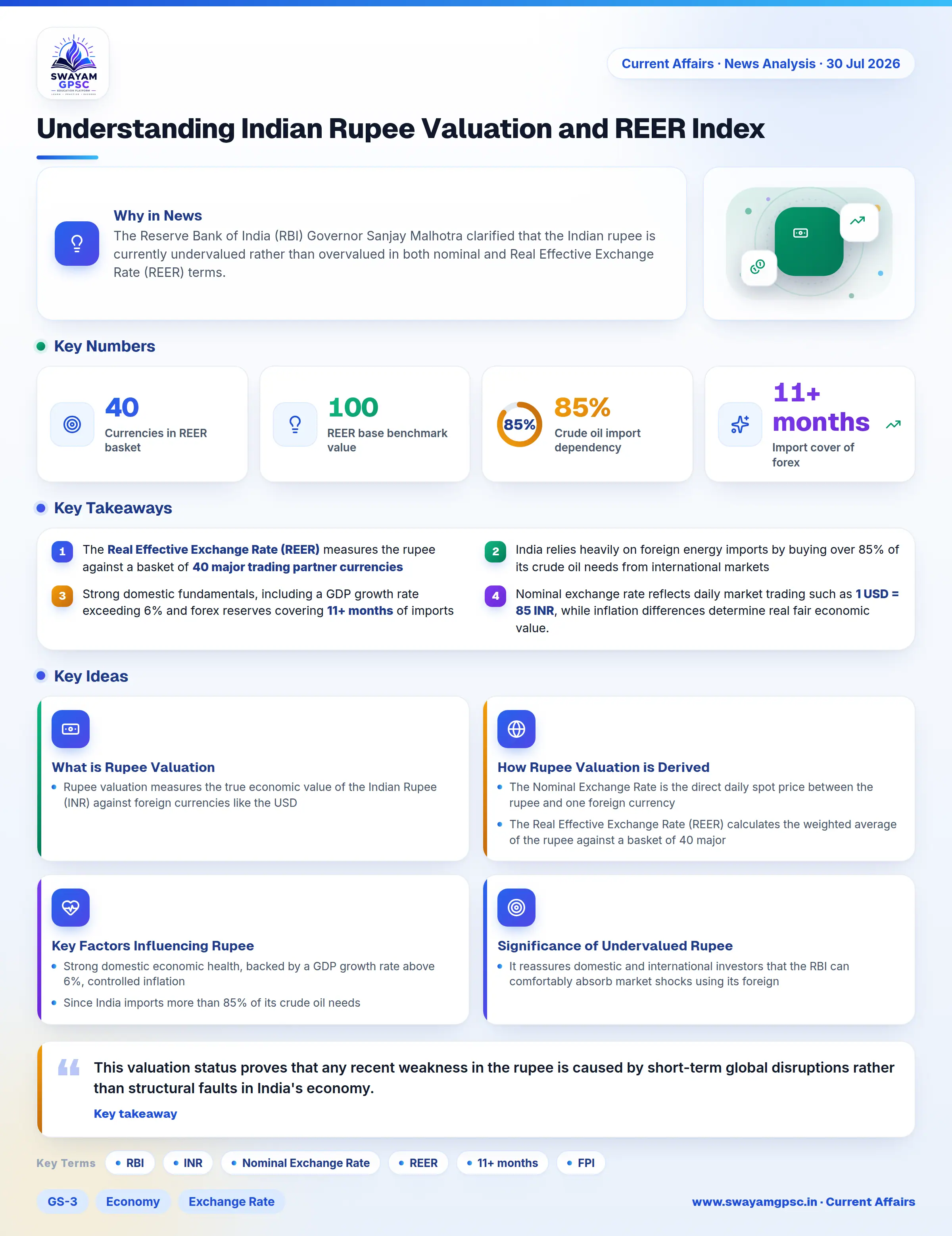
- The Real Effective Exchange Rate (REER) measures the rupee against a basket of 40 major trading partner currencies, where a value below 100 indicates undervaluation.
- India relies heavily on foreign energy imports by buying over 85% of its crude oil needs from international markets, making the rupee vulnerable to global price spikes.
- Strong domestic fundamentals, including a GDP growth rate exceeding 6% and forex reserves covering 11+ months of imports, protect the rupee against structural weakness.
- Nominal exchange rate reflects daily market trading such as 1 USD = 85 INR, while inflation differences determine real fair economic value.
Why in News
- The Reserve Bank of India (RBI) Governor Sanjay Malhotra clarified that the Indian rupee is currently undervalued rather than overvalued in both nominal and Real Effective Exchange Rate (REER) terms.
What is Rupee Valuation
- Rupee valuation measures the true economic value of the Indian Rupee (INR) against foreign currencies like the USD to test whether the market price aligns with India's domestic purchasing power and trade balance.
How Rupee Valuation is Derived
- The Nominal Exchange Rate is the direct daily spot price between the rupee and one foreign currency, such as 1 USD = 85 INR, driven purely by market supply and demand.
- The Real Effective Exchange Rate (REER) calculates the weighted average of the rupee against a basket of 40 major trading partner currencies, while adjusting for inflation differences between countries.
- A REER index benchmark of 100 sets the baseline, where a score above 100 means the currency is overvalued, and a score below 100 shows undervaluation.
Key Factors Influencing Rupee Valuation
- Strong domestic economic health, backed by a GDP growth rate above 6%, controlled inflation, and forex reserves covering 11+ months of imports, gives intrinsic stability to the rupee.
- Since India imports more than 85% of its crude oil needs, sudden jumps in international energy prices raise dollar demand and cause short-term pressure on the rupee.
- Rapid capital outflow or stock market sell-offs by Foreign Portfolio Investments (FPI) reduce foreign currency inflows and weaken the nominal value of the rupee.
- Higher interest rates set by the US Federal Reserve push up the Dollar Index (DXY), drawing global funds toward safe American assets and lowering emerging market currencies.
Significance of Undervalued Rupee
- This valuation status proves that any recent weakness in the rupee is caused by short-term global disruptions rather than structural faults in India's economy.
- It reassures domestic and international investors that the RBI can comfortably absorb market shocks using its foreign exchange reserves while maintaining a flexible exchange rate.