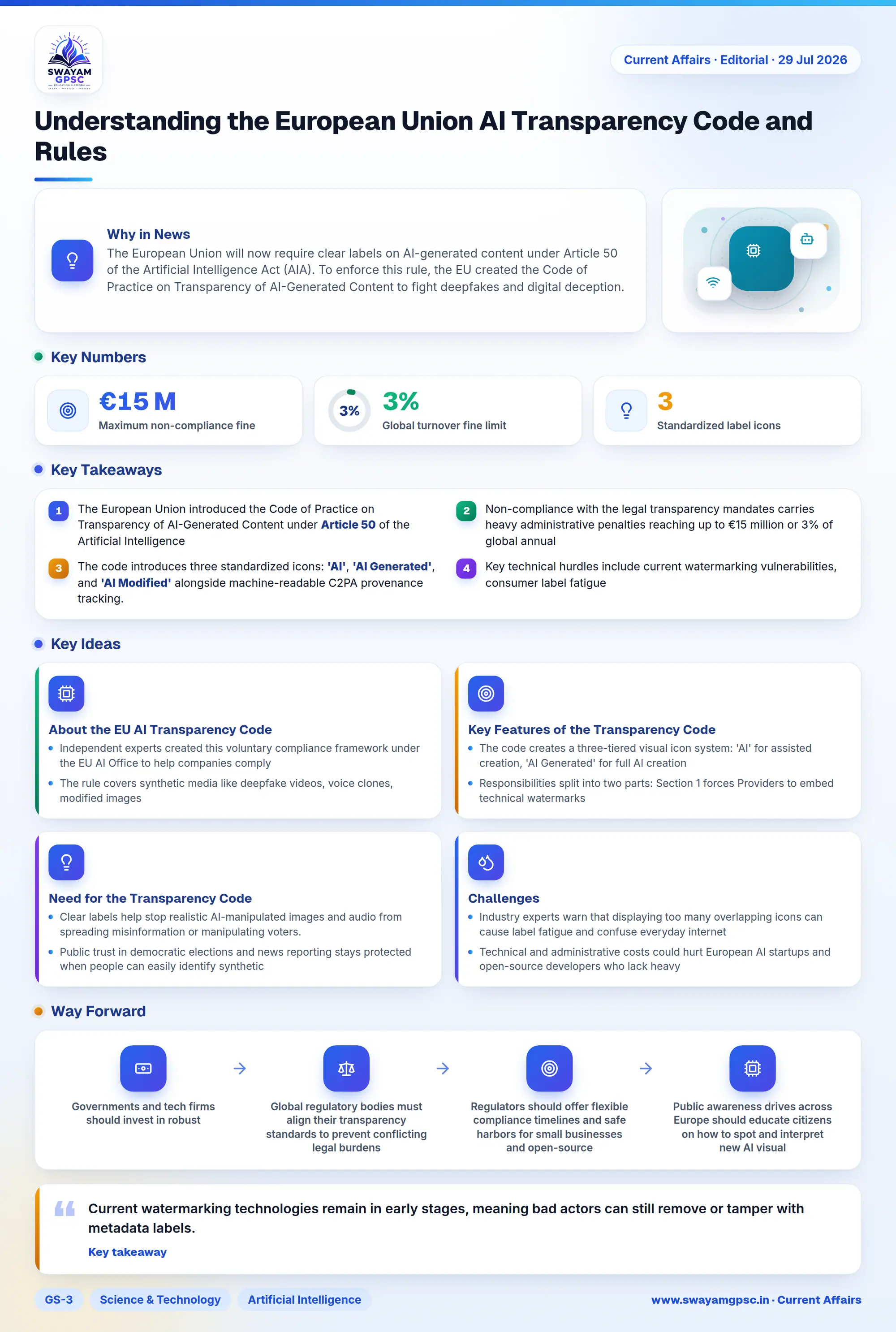
Understanding the European Union AI Transparency Code and Rules
#GS-3 #Science & Technology #Artificial Intelligence #ICT #Cyber Security #Current Events #International #EU AI Act #Deepfakes
Key takeaways
- The European Union introduced the Code of Practice on Transparency of AI-Generated Content under Article 50 of the Artificial Intelligence Act (AIA).
- Non-compliance with the legal transparency mandates carries heavy administrative penalties reaching up to €15 million or 3% of global annual turnover.
- The code introduces three standardized icons: 'AI', 'AI Generated', and 'AI Modified' alongside machine-readable C2PA provenance tracking.
- Key technical hurdles include current watermarking vulnerabilities, consumer label fatigue, and cross-border regulatory differences with frameworks like India's IT Rules.
Why in News
- The European Union will now require clear labels on AI-generated content under Article 50 of the Artificial Intelligence Act (AIA).
- To enforce this rule, the EU created the Code of Practice on Transparency of AI-Generated Content to fight deepfakes and digital deception.
About the EU AI Transparency Code
- Independent experts created this voluntary compliance framework under the EU AI Office to help companies comply with Article 50.
- The rule covers synthetic media like deepfake videos, voice clones, modified images, and unverified AI text through machine-readable marks and visual disclosures.
- Violating these underlying rules can trigger severe legal fines of up to €15 million or 3% of global annual turnover.
Key Features of the Transparency Code
- The code creates a three-tiered visual icon system: 'AI' for assisted creation, 'AI Generated' for full AI creation, and 'AI Modified' for altered media.
- Responsibilities split into two parts: Section 1 forces Providers to embed technical watermarks, while Section 2 mandates Deployers to show clear visible labels.
- Developers must track origin details using tamper-resistant metadata standards like C2PA Content Credentials across digital platforms.
- System developers must share public detection tools so platforms, fact-checkers, and users can verify synthetic content.
- The framework includes specific exemptions for law enforcement, satire, minor edits like color tuning, and human-edited text.
Need for the Transparency Code
- Clear labels help stop realistic AI-manipulated images and audio from spreading misinformation or manipulating voters.
- Public trust in democratic elections and news reporting stays protected when people can easily identify synthetic media sources.
- Visible rules shield citizens against financial scams and extortion that rely on cloned voices and fake identities.
- A unified framework across the European Single Market replaces fragmented voluntary rules with a single legal standard.
- Explicit guidelines protect vulnerable populations from targeted online harassment and non-consensual synthetic imagery.
Challenges
- Current watermarking technologies remain in early stages, meaning bad actors can still remove or tamper with metadata labels.
- Industry experts warn that displaying too many overlapping icons can cause label fatigue and confuse everyday internet users.
- Technical and administrative costs could hurt European AI startups and open-source developers who lack heavy resources.
- National regulatory agencies across EU member states have different readiness levels, which could lead to inconsistent legal enforcement.
- The code differs from foreign regulations like India's IT Rules, which hold social platforms accountable rather than AI system creators.
Way Forward
- Governments and tech firms should invest in robust, open-source C2PA metadata watermarks that survive file sharing across platforms.
- Global regulatory bodies must align their transparency standards to prevent conflicting legal burdens for international software developers.
- Regulators should offer flexible compliance timelines and safe harbors for small businesses and open-source models while tools improve.
- Public awareness drives across Europe should educate citizens on how to spot and interpret new AI visual icons.
- Dedicated Signatory Taskforces should continually update technical detection criteria as generative AI models advance.
Conclusion
- The EU AI Transparency Code establishes an important global benchmark for holding generative AI platforms accountable.
- Balancing technical watermarking upgrades with simple user labels will be crucial to protect trust without stifling tech innovation.