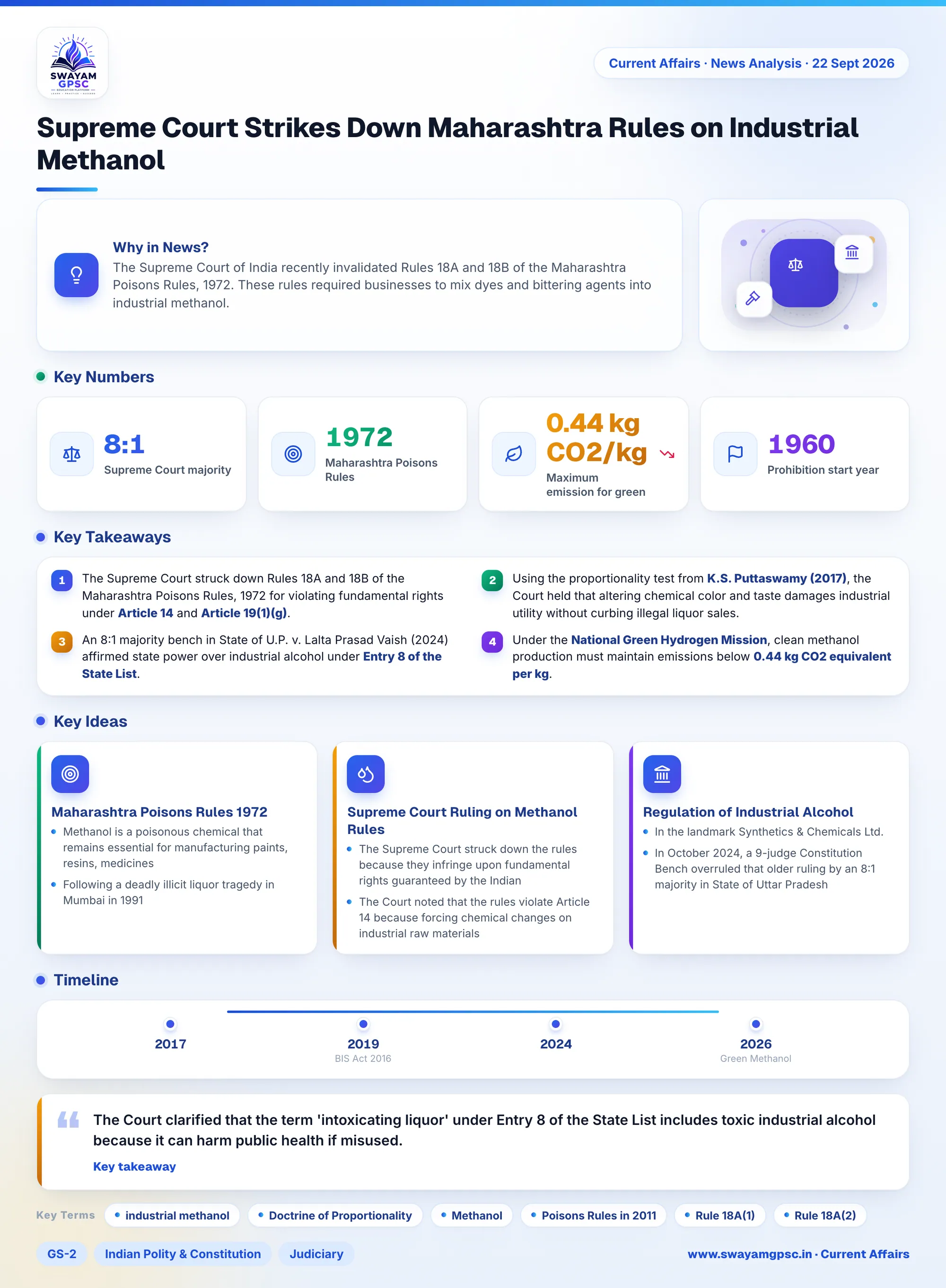
Supreme Court Strikes Down Maharashtra Rules on Industrial Methanol
#GS-2 #Indian Polity & Constitution #Judiciary #Federalism #Governance & Social Justice #Government Policies & Interventions #National
Key takeaways
- The Supreme Court struck down Rules 18A and 18B of the Maharashtra Poisons Rules, 1972 for violating fundamental rights under Article 14 and Article 19(1)(g).
- Using the proportionality test from *K.S. Puttaswamy (2017)*, the Court held that altering chemical color and taste damages industrial utility without curbing illegal liquor sales.
- An 8:1 majority bench in *State of U.P. v. Lalta Prasad Vaish (2024)* affirmed state power over industrial alcohol under Entry 8 of the State List.
- Under the National Green Hydrogen Mission, clean methanol production must maintain emissions below 0.44 kg CO2 equivalent per kg.
Why in News?
- The Supreme Court of India recently invalidated Rules 18A and 18B of the Maharashtra Poisons Rules, 1972.
- These rules required businesses to mix dyes and bittering agents into industrial methanol.
- The Court declared these restrictions unconstitutional because they fail the legal Doctrine of Proportionality.
Maharashtra Poisons Rules 1972
- Methanol is a poisonous chemical that remains essential for manufacturing paints, resins, medicines, and cleaning solvents.
- Following a deadly illicit liquor tragedy in Mumbai in 1991, Maharashtra updated its Poisons Rules in 2011 to add Rules 18A and 18B.
- Rule 18A(1) restricted methanol sales strictly to vendors holding a 'Form A' licence.
- Rule 18A(2) made it compulsory to mix methylene carmine and denatonium saccharide into industrial methanol to discourage illegal alcohol production.
- Rule 18B empowered government officials to seize any methanol stocks held without a valid Form A licence.
Supreme Court Ruling on Methanol Rules
- The Supreme Court struck down the rules because they infringe upon fundamental rights guaranteed by the Indian Constitution.
- The Court noted that the rules violate Article 14 because forcing chemical changes on industrial raw materials is unreasonable and arbitrary.
- The judgment stated that the restrictions violate Article 19(1)(g) by burdening legitimate businesses and ruining chemical purity for non-drug industries.
- Applying the proportionality test from *K.S. Puttaswamy v. Union of India (2017)*, the Court ruled that mandatory denaturing is neither suitable nor necessary.
- The judges observed that changing chemical taste or color fails to prevent liquor deaths caused by illegal theft, police corruption, and black marketing.
- The bench highlighted that total alcohol prohibition often pushes liquor sales underground.
- This underground trade creates five major problems: lost tax revenue, high enforcement spending, systemic corruption, illegal distillation, and growing drug abuse.
- The Court cited Gujarat as an example, where mass poisonous liquor incidents continue to occur despite official prohibition active since 1960.
Regulation of Industrial Alcohol in India
- In the landmark *Synthetics & Chemicals Ltd. (1990)* case, the Union government held exclusive control over industrial alcohol under Entry 52 of the Union List.
- In October 2024, a 9-judge Constitution Bench overruled that older ruling by an 8:1 majority in *State of Uttar Pradesh v. Lalta Prasad Vaish*.
- The Court clarified that the term 'intoxicating liquor' under Entry 8 of the State List includes toxic industrial alcohol because it can harm public health if misused.
- As a result, state governments now hold complete legislative power to regulate, supervise, and tax industrial alcohol.
- Because methanol is dangerous, authorities continue to monitor its commercial sale under the Poisons Act, 1919.
- This Central law gives state governments explicit power to write their own rules for licensing, stock checking, and transport of toxic substances.
- States use this framework to require transport permits under excise supervision and mandate strict record-keeping by industrial users.
- The Central Government sets technical quality standards to ensure safety across industrial chemical applications.
- Under the Methanol (Quality Control) Order, 2019, issued under the BIS Act 2016, all commercial methanol must carry the official BIS Standard Mark.
- Methanol products must meet the specific chemical requirements set in standard IS 517 : 1986.
- As India moves toward clean energy, official agencies increasingly view methanol as a promising clean fuel source.
- In February 2026, the Ministry of New and Renewable Energy issued formal rules defining Green Methanol under the National Green Hydrogen Mission.
- To qualify as green fuel, total non-biogenic emissions during production cannot exceed 0.44 kg CO2 equivalent per kg of methanol.
- This new standard aims to reduce pollution in shipping and heavy industry while turning India into a clean energy exporter.