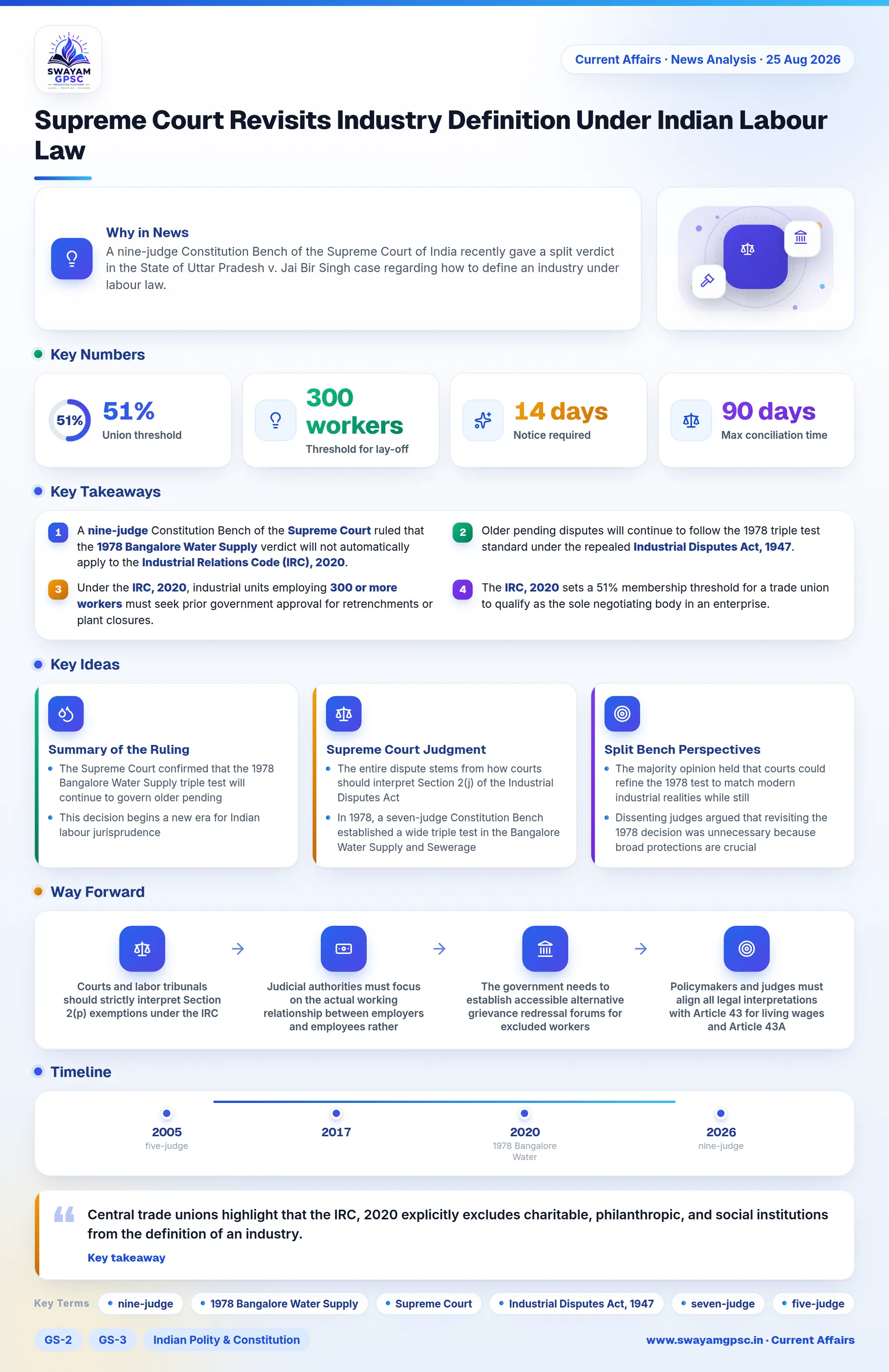
Supreme Court Revisits Industry Definition Under Indian Labour Law
#GS-2 #GS-3 #Indian Polity & Constitution #Judiciary #Governance & Social Justice #Economy #Employment #Industrial Policy #Labour Law Reforms
Key takeaways
- A nine-judge Constitution Bench of the Supreme Court ruled that the 1978 Bangalore Water Supply verdict will not automatically apply to the Industrial Relations Code (IRC), 2020.
- Older pending disputes will continue to follow the 1978 triple test standard under the repealed Industrial Disputes Act, 1947.
- Under the IRC, 2020, industrial units employing 300 or more workers must seek prior government approval for retrenchments or plant closures.
- The IRC, 2020 sets a 51% membership threshold for a trade union to qualify as the sole negotiating body in an enterprise.
- Judicial interpretations must align with constitutional mandates under Article 43 for living wages and Article 43A for worker participation in management.
Why in News
- A nine-judge Constitution Bench of the Supreme Court of India recently gave a split verdict in the State of Uttar Pradesh v. Jai Bir Singh case regarding how to define an industry under labour law.
- The apex court decided that the broad, worker-friendly definition of an industry set by the landmark 1978 Bangalore Water Supply judgment will not automatically apply to the newly enacted Industrial Relations Code (IRC), 2020.
- This ruling provides a fresh legal starting point for interpreting future workplace disputes, though central trade unions fear it could weaken essential worker protections.
Summary of the Ruling
- The Supreme Court confirmed that the 1978 Bangalore Water Supply triple test will continue to govern older pending disputes under the Industrial Disputes Act, 1947, but not new cases under the IRC, 2020.
- This decision begins a new era for Indian labour jurisprudence, sparking debate over balancing economic growth with social protection and worker rights.
Supreme Court Judgment on the Definition of Industry
- The entire dispute stems from how courts should interpret Section 2(j) of the Industrial Disputes Act, 1947 regarding what constitutes an industry.
- In 1978, a seven-judge Constitution Bench established a wide triple test in the Bangalore Water Supply and Sewerage Board vs A. Rajappa case.
- Subsequent judicial rulings created confusion regarding whether government welfare activities, public hospitals, and educational institutions count as industries.
- Because of this legal uncertainty, a five-judge Bench in State of U.P. v. Jai Bir Singh (2005) referred the matter to a larger bench, leading to a nine-judge Bench setup in 2017.
- The original 1978 ruling intentionally adopted a broad approach to maximize legal protections for workers under the Industrial Disputes Act, 1947.
- That 1978 ruling created the famous triple test, requiring systematic activity, employer-employee cooperation, and the delivery of goods or services to satisfy human wants.
- The 1978 test deliberately ignored profit motives, extending labour rights to workers in municipal bodies, non-profit hospitals, and charitable organizations.
- Under the 1978 standard, only core sovereign functions of the state like defence, law enforcement, and courts were excluded from being classified as an industry.
- In the recent 2026 ruling, the nine-judge Bench held that courts must analyze the definition of an industry under the IRC, 2020 independently.
- The court majority stated that the IRC, 2020 offers a clean slate, so judges do not need to follow the broad 1978 precedent automatically.
- Therefore, the 1978 verdict will no longer serve as the primary legal anchor for deciding what counts as an industry under future IRC, 2020 disputes.
- However, the court clarified that all ongoing legal proceedings filed under the repealed Industrial Disputes Act, 1947 will still follow the 1978 Bangalore Water Supply framework.
Split Bench Perspectives
- The majority opinion held that courts could refine the 1978 test to match modern industrial realities while still applying it to older pending disputes.
- Dissenting judges argued that revisiting the 1978 decision was unnecessary because broad protections are crucial during an era of growing privatization and global trade.
- Separate judicial opinions noted that while courts must interpret the IRC, 2020 independently, the lack of a profit goal should not automatically exclude an entity from being an industry.
Key Provisions of Industrial Relations Code (IRC), 2020
- The Industrial Relations Code, 2020 consolidates three major laws, including the Industrial Disputes Act, 1947, Trade Unions Act, 1926, and Industrial Employment (Standing Orders) Act, 1946, to simplify compliance and boost business growth.
- The code expands the definition of a worker to cover sales promotion employees, working journalists, and specific supervisory staff.
- It defines an industry as any systematic activity involving employer-worker cooperation, regardless of capital investment or profit motive.
- The code grants statutory recognition to trade unions, requiring a 51% membership threshold for a union to act as the sole negotiating union.
- It offers fixed-term contract workers the same statutory benefits and gratuity as permanent staff after completing 1 year of continuous service.
- Workers must now provide a 14 days advance notice before going on strike, while strikes remain prohibited during active conciliation proceedings.
- Establishments with 300 or more workers must obtain prior government approval before carrying out lay-offs, retrenchments, or factory closures.
- If conciliation efforts fail after 90 days, workers can take their dispute directly to an Industrial Tribunal for faster resolution.
Concerns Raised by Trade Unions
- Central trade unions highlight that the IRC, 2020 explicitly excludes charitable, philanthropic, and social institutions from the definition of an industry.
- Unions fear that disconnecting the new code from the 1978 precedent will strip millions of non-profit workers of minimum wage guarantees and collective bargaining rights.
- This ruling increases worker concerns over the nationwide rollout of the 4 Labour Codes, which unions feel compromise job security and welfare protections.
- Trade unions warn that employers in a contract-heavy economy might misuse labels like charity or public project to evade labor regulations.
- Unions argue that the judgment shows a pro-corporate tilt by focusing on an enterprise's organizational structure rather than the actual work performed.
- Narrowing the legal definition leaves employees in welfare organizations vulnerable to arbitrary terminations without access to trade union support.
Way Forward
- Courts and labor tribunals should strictly interpret Section 2(p) exemptions under the IRC, 2020 so that state-run commercial activities do not claim total immunity.
- Judicial authorities must focus on the actual working relationship between employers and employees rather than evaluating an enterprise based only on its tax status.
- The government needs to establish accessible alternative grievance redressal forums for excluded workers to protect them from exploitation.
- Policymakers and judges must align all legal interpretations with Article 43 for living wages and Article 43A for worker participation in industrial management.
Conclusion
- The latest ruling by the Supreme Court marks a major shift in national labour jurisprudence by untethering the IRC, 2020 from historical precedents.
- India must balance business flexibility and economic growth with constitutional principles of social justice and worker protection under the Directive Principles of State Policy.