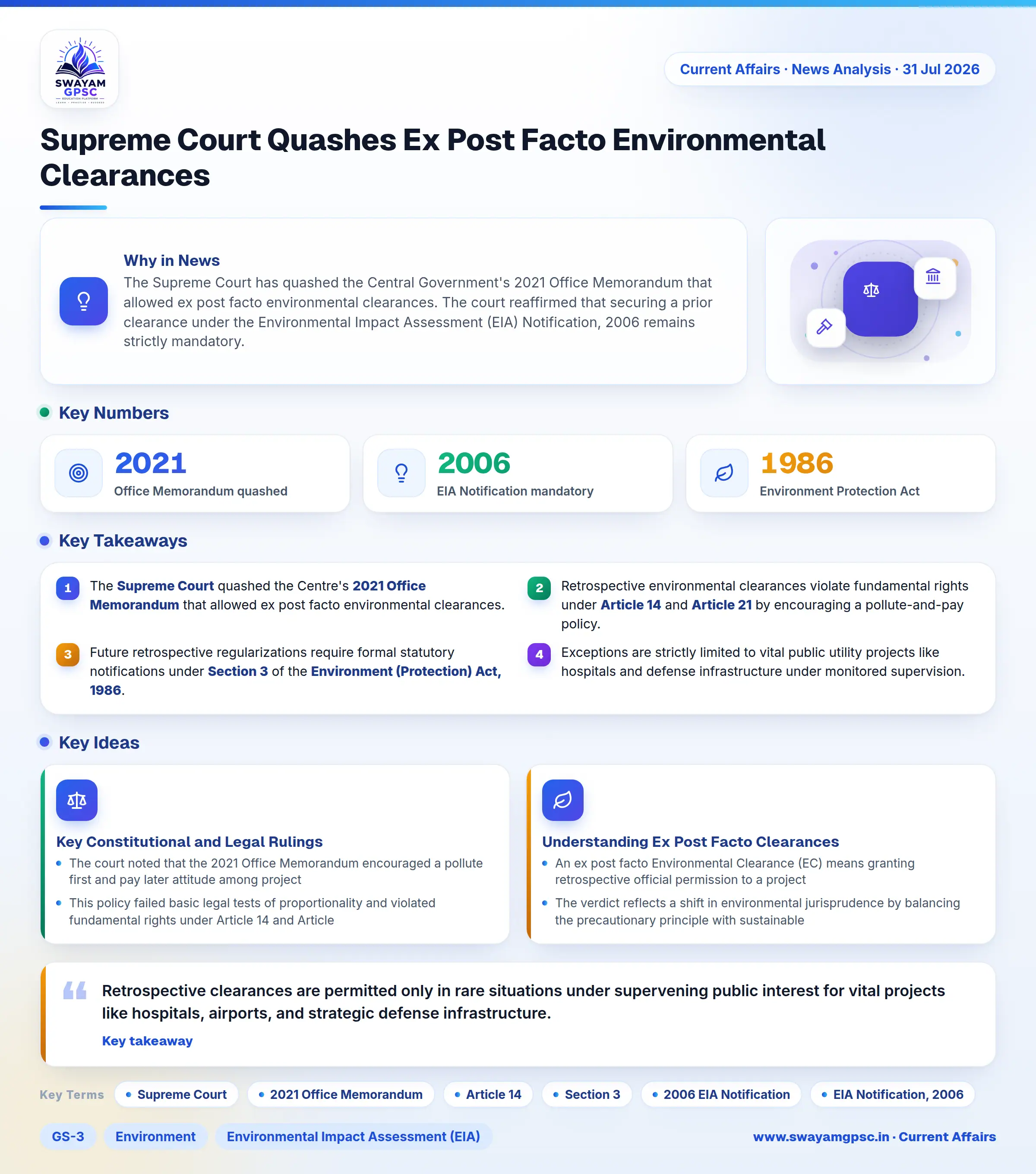
Supreme Court Quashes Ex Post Facto Environmental Clearances
#GS-3 #Environment #Environmental Impact Assessment (EIA) #Conservation #GS-2 #Judiciary #Supreme Court #Constitution
Key takeaways
- The Supreme Court quashed the Centre's 2021 Office Memorandum that allowed ex post facto environmental clearances.
- Retrospective environmental clearances violate fundamental rights under Article 14 and Article 21 by encouraging a pollute-and-pay policy.
- Future retrospective regularizations require formal statutory notifications under Section 3 of the Environment (Protection) Act, 1986.
- Exceptions are strictly limited to vital public utility projects like hospitals and defense infrastructure under monitored supervision.
- The EIA Notification, 2006 strictly mandates securing environmental clearances before starting project construction.
Why in News
- The Supreme Court has quashed the Central Government's 2021 Office Memorandum that allowed ex post facto environmental clearances.
- The court reaffirmed that securing a prior clearance under the Environmental Impact Assessment (EIA) Notification, 2006 remains strictly mandatory.
- The court clarified that retrospective environmental regularization cannot happen through administrative orders because such orders create a permanent parallel amnesty system.
- Any retrospective approval must strictly come through a formal statutory notification issued under the Environment (Protection) Act, 1986.
Key Constitutional and Legal Rulings
- The court noted that the 2021 Office Memorandum encouraged a pollute first and pay later attitude among project developers.
- This policy failed basic legal tests of proportionality and violated fundamental rights under Article 14 and Article 21 of the Constitution.
- Clearances already granted under earlier notifications remain valid unless individuals challenge them separately in court.
- Future amnesties require valid statutory rules framed under Section 3 of the Environment (Protection) Act, 1986.
- Retrospective clearances are permitted only in rare situations under supervening public interest for vital projects like hospitals, airports, and strategic defense infrastructure.
Understanding Ex Post Facto Clearances and Jurisprudence
- An ex post facto Environmental Clearance (EC) means granting retrospective official permission to a project that started construction without prior approval.
- The verdict reflects a shift in environmental jurisprudence by balancing the precautionary principle with sustainable development principles.
- The court recognized that demolishing huge public assets creates massive economic waste and ecological debris.
- The 2006 EIA Notification mandates evaluating ecological impacts, collecting public objections, and fixing safeguards before starting any construction work.