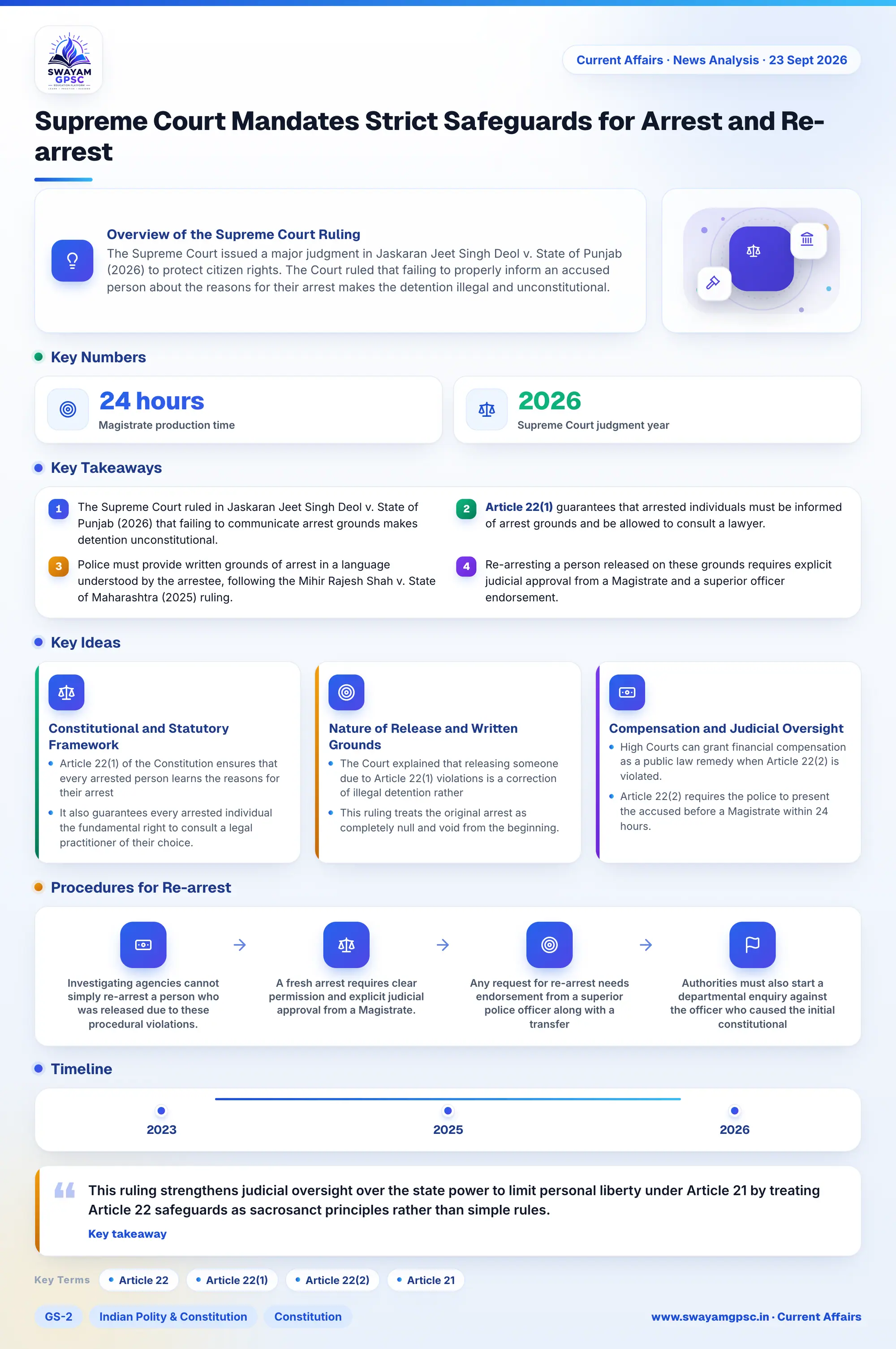
Supreme Court Mandates Strict Safeguards for Arrest and Re-arrest
#GS-2 #Indian Polity & Constitution #Constitution #Judiciary #Fundamental Rights #Judgements & Cases #Quick Facts For Prelims #Rapid Fire CA
Key takeaways
- The Supreme Court ruled in Jaskaran Jeet Singh Deol v. State of Punjab (2026) that failing to communicate arrest grounds makes detention unconstitutional.
- Article 22(1) guarantees that arrested individuals must be informed of arrest grounds and be allowed to consult a lawyer.
- Police must provide written grounds of arrest in a language understood by the arrestee, following the Mihir Rajesh Shah v. State of Maharashtra (2025) ruling.
- Re-arresting a person released on these grounds requires explicit judicial approval from a Magistrate and a superior officer endorsement.
- High Courts can award compensation for violating Article 22(2), which mandates producing the accused before a Magistrate within 24 hours.
Overview of the Supreme Court Ruling
- The Supreme Court issued a major judgment in Jaskaran Jeet Singh Deol v. State of Punjab (2026) to protect citizen rights.
- The Court ruled that failing to properly inform an accused person about the reasons for their arrest makes the detention illegal and unconstitutional.
- This decision reinforces the vital protections provided under Article 22 of the Constitution.
Constitutional and Statutory Framework
- Article 22(1) of the Constitution ensures that every arrested person learns the reasons for their arrest without delay.
- It also guarantees every arrested individual the fundamental right to consult a legal practitioner of their choice.
- Under the Bharatiya Nagarik Suraksha Sanhita (BNSS), 2023, police officers must share the full details of the offense with the accused.
Nature of Release and Written Grounds
- The Court explained that releasing someone due to Article 22(1) violations is a correction of illegal detention rather than granting bail.
- This ruling treats the original arrest as completely null and void from the beginning.
- Building on the Pankaj Bansal v. Union of India (2023) case, the Mihir Rajesh Shah v. State of Maharashtra (2025) ruling requires written grounds of arrest across all laws.
- Police must provide these written reasons in a language that the arrested person can easily understand.
Procedures for Re-arrest and Accountability
- Investigating agencies cannot simply re-arrest a person who was released due to these procedural violations.
- A fresh arrest requires clear permission and explicit judicial approval from a Magistrate.
- Any request for re-arrest needs endorsement from a superior police officer along with a transfer of the investigation to a different officer.
- Authorities must also start a departmental enquiry against the officer who caused the initial constitutional breach.
Compensation and Judicial Oversight
- High Courts can grant financial compensation as a public law remedy when Article 22(2) is violated.
- Article 22(2) requires the police to present the accused before a Magistrate within 24 hours.
- Victims retain the freedom to pursue private civil remedies for the violation of their rights in addition to public law compensation.
- This ruling strengthens judicial oversight over the state power to limit personal liberty under Article 21 by treating Article 22 safeguards as sacrosanct principles rather than simple rules.