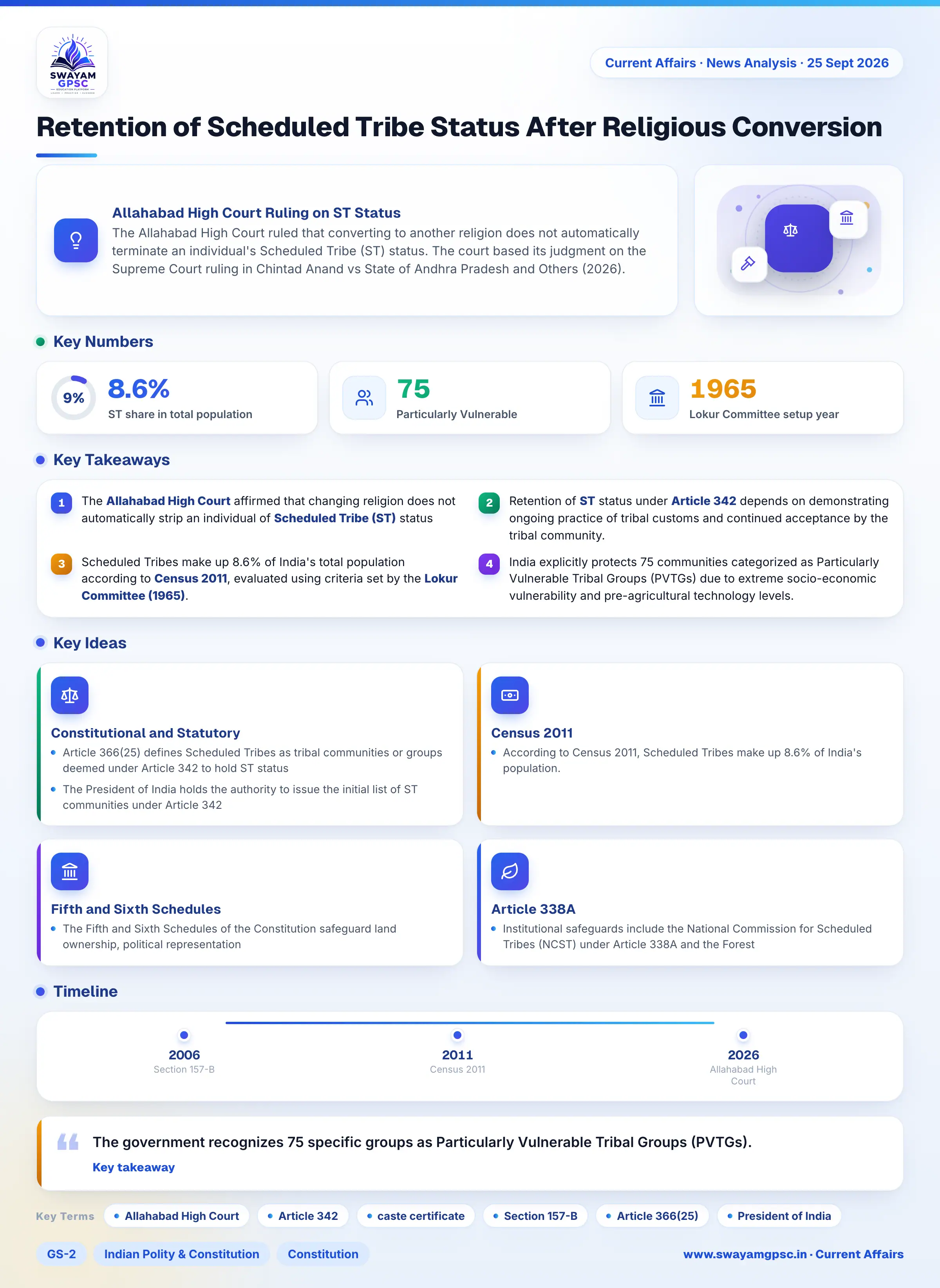
Retention of Scheduled Tribe Status After Religious Conversion
#GS-2 #Indian Polity & Constitution #Constitution #GS-1 #Indian Society #Vulnerable Sections #Current Events #National #Scheduled Tribes #Judiciary
Key takeaways
- The Allahabad High Court affirmed that changing religion does not automatically strip an individual of Scheduled Tribe (ST) status, relying on the Supreme Court ruling in *Chintad Anand vs State of Andhra Pradesh (2026)*.
- Retention of ST status under Article 342 depends on demonstrating ongoing practice of tribal customs and continued acceptance by the tribal community.
- Scheduled Tribes make up 8.6% of India's total population according to Census 2011, evaluated using criteria set by the Lokur Committee (1965).
- India explicitly protects 75 communities categorized as Particularly Vulnerable Tribal Groups (PVTGs) due to extreme socio-economic vulnerability and pre-agricultural technology levels.
Allahabad High Court Ruling on ST Status
- The Allahabad High Court ruled that converting to another religion does not automatically terminate an individual's Scheduled Tribe (ST) status. The court based its judgment on the Supreme Court ruling in *Chintad Anand vs State of Andhra Pradesh and Others (2026)*. This standard differs from Scheduled Caste (SC) rules under the Constitution (Scheduled Castes) Order, 1950, which limits SC status strictly to Hinduism, Sikhism, and Buddhism.
- To claim constitutional rights under Article 342, a converted person must prove that they have not broken away from their ethnic roots. They must show clear evidence of ongoing participation in tribal customs, traditions, and rituals, as well as continued acceptance by their community.
- A caste certificate provided by an executive official such as a Tehsildar does not serve as permanent legal proof. Courts can reject a certificate if evidence shows that the person completely integrated into a non-tribal society over many years.
- The court highlighted state laws that ban selling tribal land under Section 157-B of the UP Zamindari Abolition and Land Reforms (UPZA&LR) Act, 1950 and Section 99 of the UP Revenue Code, 2006. These legal rules prevent non-tribal persons from acquiring agricultural land owned by ST members.
Constitutional and Statutory Provisions for Scheduled Tribes
- Article 366(25) defines Scheduled Tribes as tribal communities or groups deemed under Article 342 to hold ST status for constitutional protection.
- The President of India holds the authority to issue the initial list of ST communities under Article 342, while only Parliament has the legal power to modify this official list.
- According to Census 2011, Scheduled Tribes make up 8.6% of India's population. Government bodies identify these groups using criteria defined by the Lokur Committee (1965), including primitive traits, distinct culture, geographical isolation, and socio-economic backwardness.
- The Fifth and Sixth Schedules of the Constitution safeguard land ownership, political representation, and traditional governance rights for tribal populations.
- Institutional safeguards include the National Commission for Scheduled Tribes (NCST) under Article 338A and the Forest Rights Act (FRA), 2006, which protects historical land rights and biodiversity conservation.
- The government recognizes 75 specific groups as Particularly Vulnerable Tribal Groups (PVTGs). These communities use pre-agricultural technology, experience geographic isolation, and face extreme economic vulnerability requiring targeted state support.