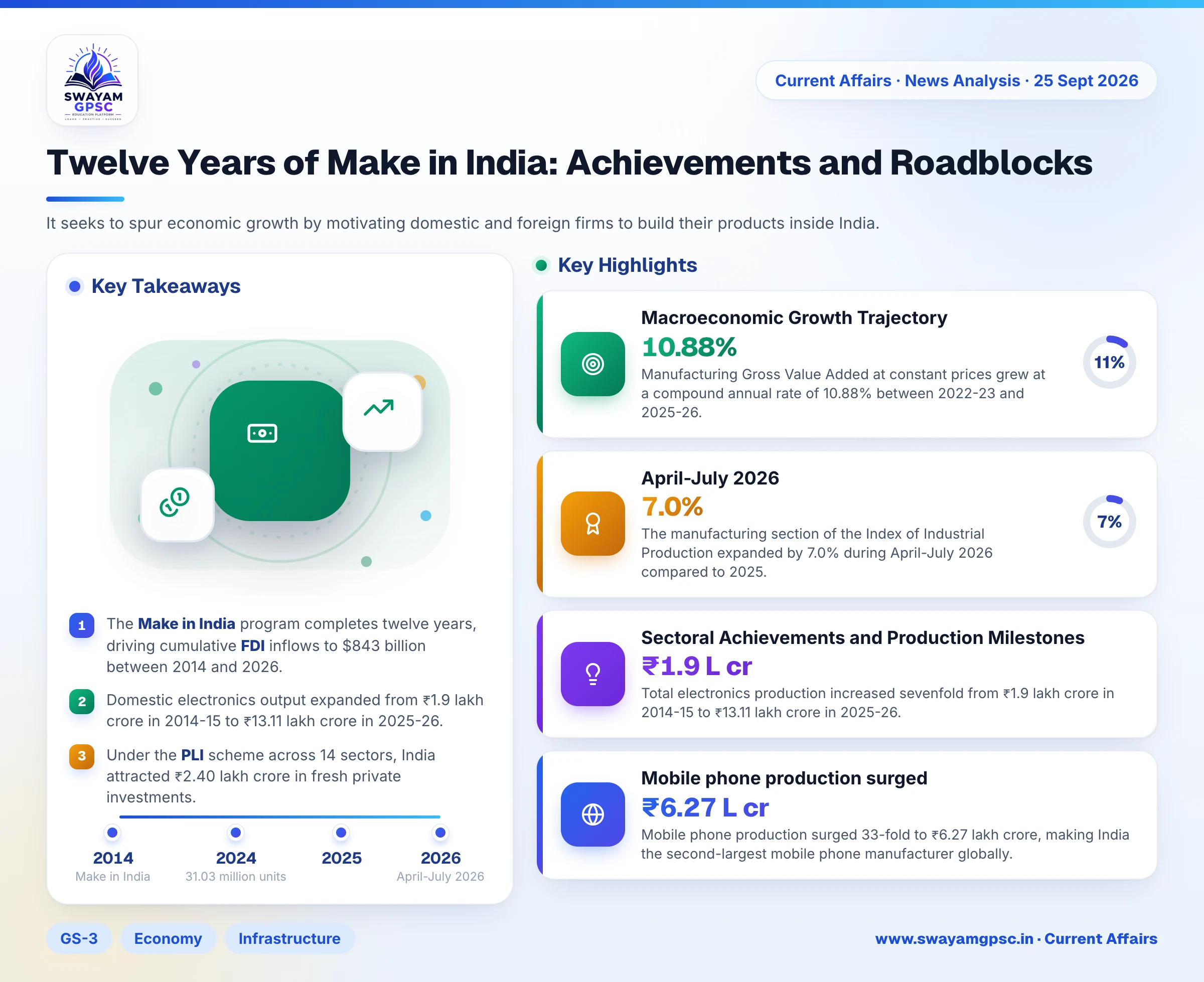
Twelve Years of Make in India: Achievements and Roadblocks
#GS-3 #Economy #Infrastructure #Manufacturing #Make in India #Industrial Growth #PLI Scheme
Key takeaways
- The Make in India program completes twelve years, driving cumulative FDI inflows to $843 billion between 2014 and 2026.
- Domestic electronics output expanded from ₹1.9 lakh crore in 2014-15 to ₹13.11 lakh crore in 2025-26.
- Under the PLI scheme across 14 sectors, India attracted ₹2.40 lakh crore in fresh private investments.
- Indian manufacturing faces a downstream assembly trap that remains reliant on imported components like microchips and printed circuit boards.
Why in News
- The Indian government marked the twelfth anniversary of the Make in India initiative launched on September 25, 2014.
- The initiative transformed from an investment promotion campaign into a deep industrial manufacturing model across 27 sectors.
Overview and Mandate of Make in India
- The Make in India campaign aims to convert the country into a global manufacturing, design, and innovation center.
- It seeks to spur economic growth by motivating domestic and foreign firms to build their products inside India.
- The program operates under the philosophy of Minimum Government, Maximum Governance.
- Under Make in India 2.0, the government expanded the focus to 27 sectors including 15 manufacturing and 12 service sectors.
Macroeconomic Growth Trajectory
- Manufacturing Gross Value Added at constant prices grew at a compound annual rate of 10.88% between 2022-23 and 2025-26.
- The manufacturing section of the Index of Industrial Production expanded by 7.0% during April-July 2026 compared to 2025.
Sectoral Achievements and Production Milestones
- Total electronics production increased sevenfold from ₹1.9 lakh crore in 2014-15 to ₹13.11 lakh crore in 2025-26.
- Mobile phone production surged 33-fold to ₹6.27 lakh crore, making India the second-largest mobile phone manufacturer globally.
- Vehicle output reached 31.03 million units in 2024-25, marking a 33% expansion over 2014-15.
- Between 2020-21 and 2024-25, passenger and commercial vehicle output grew by 65%, three-wheelers by 71%, and two-wheelers by 30%.
- The pharmaceutical sector maintained 3rd place globally by volume and 11th by value, with annual turnover reaching ₹4,71,898 crore in 2024-25.
- Domestic medical device production grew by 48.2% to reach ₹41,500 crore in 2024-25.
- Crude steel production doubled from 81.7 million tonnes in 2014-15 to 170.0 million tonnes in 2025-26.
- Indian Railways produced 54,809 coaches between 2014 and 2024, while producing 1,674 locomotives and 6,677 modern LHB coaches in 2025-26.
- Domestic defense production value grew by 283% from ₹46,429 crore in 2014-15 to ₹1.78 lakh crore in FY 2025-26.
Upstream Capabilities in Strategic Technologies
- Indian pharmaceutical firms manufactured Trastuzumab Emtansine, which is the world's first biosimilar antibody drug for breast cancer.
- Researchers commercialized Docaravimab-Miromavimab, the first anti-rabies monoclonal antibody combination in the world.
- Scientists introduced Miqnaf for bacterial pneumonia alongside Desidustat to treat anemia in chronic kidney conditions.
- A pilot plant began operations in March 2026 at ARCI Hyderabad to produce sintered Nd-Fe-B rare earth magnets for electric vehicles.
- ISRO and SCL developed space-grade microprocessors named VIKRAM3201 and KALPANA3201.
- Solar module manufacturing capacity expanded from 2.3 GW in 2014 to 192 GW by June 2026, while cell capacity reached 30 GW.
- Heavy engineering and capital goods production doubled to ₹5,69,900 crore in 2024-25.
- Machine tool production grew by 132.2% and earthmoving machinery output expanded by 160.3%.
Institutional Reforms and Key Enablers
- The government allowed 100% FDI through the automatic route in most sectors, attracting $843 billion in cumulative FDI between 2014 and 2026.
- The National Single Window System (NSWS) integrated 327 Central and 3,452 State approvals to streamline industrial clearances.
- Under PM GatiShakti, the Network Planning Group evaluated 396 infrastructure projects worth ₹18.66 lakh crore.
- The India Industrial Land Bank (IILB) mapped 4,220 industrial parks across 6.98 lakh hectares of land.
- The PLI scheme across 14 sectors attracted ₹2.40 lakh crore in investment and created over 14 lakh direct jobs by June 2026.
- The Startup India program recognized over 2.54 lakh startups by September 2026.
Major Policy Schemes for Industrial Deepening
- The government approved Semicon 2.0 in July 2026 with an outlay of ₹1,27,500 crore to build semiconductor fabrication units.
- The Mobile Phone Manufacturing Scheme (MPMS) received ₹62,500 crore to move manufacturing from assembly to core component production.
- The BHAVYA scheme allocated ₹33,660 crore to set up 100 plug and play industrial parks over 6 years.
- BHAVYA-Rasayan provided ₹3,030 crore to build three specialized chemical parks with central waste management facilities.
- The Rare Earth Magnets Scheme allocated ₹7,280 crore to establish 6,000 MTPA permanent magnet production capacity.
- The PLI for Specialty Steel scheme expanded to cover superalloys, cold-rolled steel, and titanium alloys.
Challenges
- Domestic assembly lines still rely heavily on imported sub-assemblies, precision parts, and raw components.
- Expanding final product assembly has increased imports of capital equipment and circuit boards from countries like China.
- High industrial power tariffs and complex land regulations at the state level increase production costs relative to global rivals.
- Translating research innovations into private commercial production lines faces a shortage of venture capital funds.
Way Forward
- Future PLI disbursements should reward local value addition instead of simple final assembly turnover.
- Expanding multi-modal transport under PM GatiShakti can reduce logistics costs below 9% of GDP.
- Funding from the Anusandhan National Research Foundation (ANRF) should foster research partnerships with deep-tech startups.
- Integrating small and medium enterprises into global defense and electronics supply chains will strengthen local production.
Conclusion
- Sustaining industrial growth requires moving beyond basic assembly toward mastering precision engineering and component manufacturing.
- Combining infrastructure growth under PM GatiShakti with tech schemes like Semicon 2.0 will build resilient supply chains.