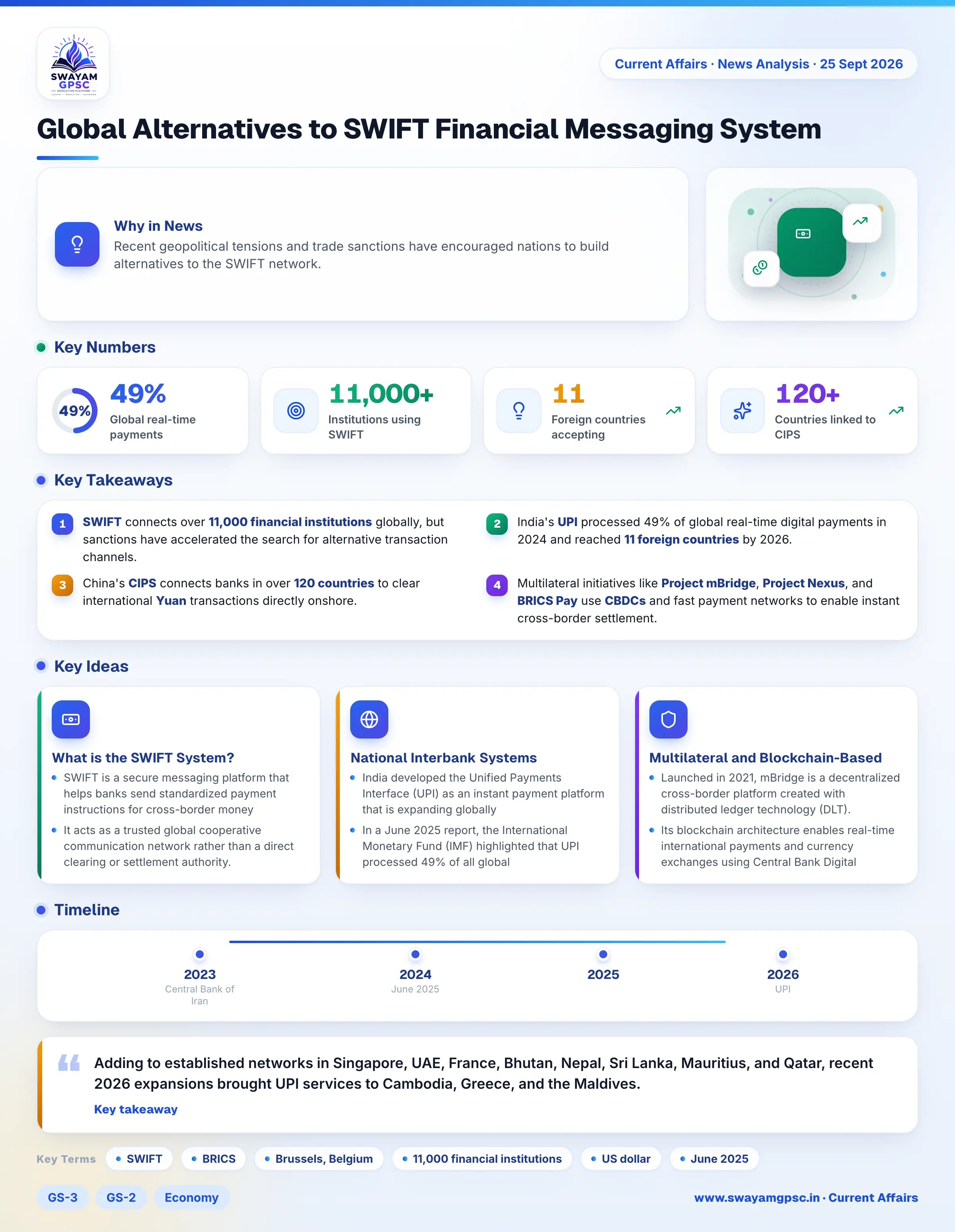
Global Alternatives to SWIFT Financial Messaging System
#GS-3 #GS-2 #Economy #Banking #Infrastructure #Current Events #International #National #Banking Sector & NBFCs #Capital Market #SWIFT #Cross-Border Payments #Central Bank Digital Currency (CBDC)
Key takeaways
- SWIFT connects over 11,000 financial institutions globally, but sanctions have accelerated the search for alternative transaction channels.
- India's UPI processed 49% of global real-time digital payments in 2024 and reached 11 foreign countries by 2026.
- China's CIPS connects banks in over 120 countries to clear international Yuan transactions directly onshore.
- Multilateral initiatives like Project mBridge, Project Nexus, and BRICS Pay use CBDCs and fast payment networks to enable instant cross-border settlement.
Why in News
- Recent geopolitical tensions and trade sanctions have encouraged nations to build alternatives to the SWIFT network.
- Global groupings such as BRICS are developing cross-border settlement channels using local currencies, Central Bank Digital Currencies (CBDCs), and innovative systems like mBridge and Project Nexus.
What is the SWIFT System?
- SWIFT is a secure messaging platform that helps banks send standardized payment instructions for cross-border money transfers without settling funds directly.
- It acts as a trusted global cooperative communication network rather than a direct clearing or settlement authority.
- The system standardizes financial messages to help banks process international payments rapidly and safely.
- Founded in 1973 in Brussels, Belgium, SWIFT is supervised by central banks from G10 countries, the European Central Bank, and the National Bank of Belgium.
- More than 11,000 financial institutions worldwide use SWIFT, making it the primary system for global interbank communication.
- While the US dollar dominates most transactions, the network also handles payments in euros, Japanese yen, British pounds, and Indian rupees.
- Banks rely on unique 8-character or 11-character alphanumeric codes called SWIFT or BIC codes to confirm institution identity, country, city, and branch.
- Removing a country's banks from SWIFT blocks their ability to send transfers, process export revenues, or secure foreign credit.
- Disrupting access to this network can affect credit card processing and trigger global market problems, including higher energy and commodity prices.
National Interbank Systems
- India developed the Unified Payments Interface (UPI) as an instant payment platform that is expanding globally through linkages with foreign payment networks.
- In a June 2025 report, the International Monetary Fund (IMF) highlighted that UPI processed 49% of all global real-time payment volume in 2024.
- By 2026, UPI operates in 11 foreign countries for merchant acceptance and international money transfers.
- Adding to established networks in Singapore, UAE, France, Bhutan, Nepal, Sri Lanka, Mauritius, and Qatar, recent 2026 expansions brought UPI services to Cambodia, Greece, and the Maldives.
- Ongoing efforts aim to serve Non-Resident Indians (NRIs) and connect with nations like Japan to create instant payment links.
- Launched in 2015 by the People's Bank of China, the Cross-Border Interbank Payment System (CIPS) clears cross-border Yuan transactions directly within China.
- CIPS allows foreign banks to skip offshore clearing houses and connects institutions across 120 countries, including all BRICS members except India.
- The Bank of Russia created the System for Transfer of Financial Messages (SPFS) in 2014 to bypass Western economic sanctions.
- SPFS became vital for Russian banks after major domestic institutions were cut off from SWIFT in 2022.
- SEPAMA operates as Iran's domestic interbank messaging network.
- In 2023, the Central Bank of Iran linked SEPAMA with Russia's SPFS to enable direct banking messages between both countries.
Multilateral and Blockchain-Based Platforms
- Launched in 2021, mBridge is a decentralized cross-border platform created with distributed ledger technology (DLT).
- Its blockchain architecture enables real-time international payments and currency exchanges using Central Bank Digital Currencies (CBDCs).
- The project started under the BIS Innovation Hub alongside central banks from China, Thailand, UAE, and Hong Kong, with the Saudi Central Bank joining in 2024.
- More than 31 observing members participate in mBridge, including the Reserve Bank of India (RBI).
- The system achieved basic operational capability in 2024, enabling multi-currency wholesale trade settlements.
- The Bank for International Settlements (BIS) withdrew from mBridge in 2024 due to concerns that nations might use it to bypass sanctions.
- By late 2025, the platform functioned mainly as a Yuan-based trade network for energy products between China and Gulf nations.
- Designed by the BIS Innovation Hub, Project Nexus aims to connect national Fast Payment Systems (FPS) for instant cross-border retail payments.
- India and four ASEAN countries, including Malaysia, Philippines, Singapore, and Thailand, serve as founding partners.
- Project Nexus builds on UPI and existing payment channels to create a single cross-border retail network.
- Proposed by the BRICS Business Council in 2018, BRICS Pay is a decentralized digital platform designed to streamline payments among member nations.
- Intended for BRICS members and friendly states, BRICS Pay works alongside traditional financial networks like SWIFT, Visa, and Mastercard.
- The BRICS grouping plans to link national infrastructure, local currencies, and CBDCs by connecting networks like UPI in India and Pix in Brazil.
- Digital tokens backed by fiat currencies, such as USDC or USDT, settle international payments in seconds using public blockchain networks.
- Because stablecoins operate continuously with low fees, companies increasingly use them for foreign business payments and payroll.