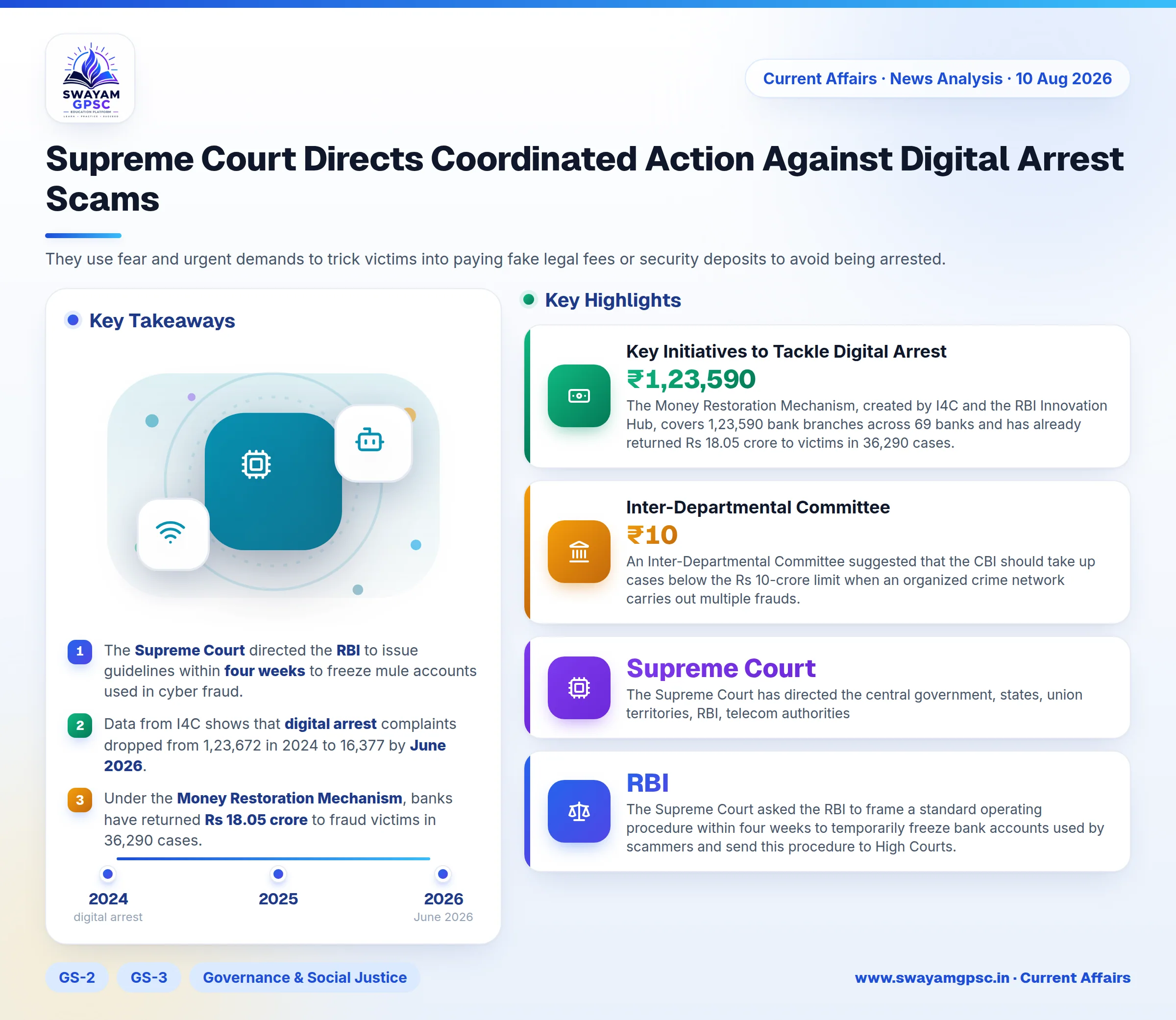
Supreme Court Directs Coordinated Action Against Digital Arrest Scams
#GS-2 #GS-3 #Governance & Social Justice #Cyber Security #Regulatory Bodies #National Events #Digital Arrest
Key takeaways
- The Supreme Court directed the RBI to issue guidelines within four weeks to freeze mule accounts used in cyber fraud.
- Data from I4C shows that digital arrest complaints dropped from 1,23,672 in 2024 to 16,377 by June 2026.
- Under the Money Restoration Mechanism, banks have returned Rs 18.05 crore to fraud victims in 36,290 cases.
- The Supreme Court gave all states four weeks to implement the e-Zero FIR mechanism and establish Cyber Crime Coordination Centres.
Why in News
- The Supreme Court has directed the central government, states, union territories, RBI, telecom authorities, and police agencies to take joint action against digital arrest scams and return money to victims quickly.
- The Supreme Court asked the RBI to frame a standard operating procedure within four weeks to temporarily freeze bank accounts used by scammers and send this procedure to High Courts.
- The court also ordered all states and union territories to set up victim grievance systems and money recovery mechanisms following the guidelines of the Ministry of Home Affairs.
Understanding Digital Arrest Scams
- A digital arrest is an online fraud where criminals pretend to be police or legal officials to scare people and steal their money.
- Scammers contact people using fake phone numbers and forged documents, falsely claiming that the person is involved in a serious crime.
- They use fear and urgent demands to trick victims into paying fake legal fees or security deposits to avoid being arrested.
Decline in Digital Arrest Complaints
- Data from the Indian Cyber Crime Coordination Centre (I4C) shows that complaints about digital arrest dropped from 1,23,672 in 2024 to 58,249 in 2025.
- This positive trend continued into 2026, with only 16,377 complaints reported by June 2026.
Key Initiatives to Tackle Digital Arrest
- The Money Restoration Mechanism, created by I4C and the RBI Innovation Hub, covers 1,23,590 bank branches across 69 banks and has already returned Rs 18.05 crore to victims in 36,290 cases.
- The e-Zero FIR mechanism is currently working in 19 states, while 14 states have set up special Cyber Crime Coordination Centres.
- The Supreme Court has mandated that all remaining states and union territories start using both the e-Zero FIR mechanism and Cyber Crime Coordination Centres within four weeks.
- The government notified the Telecommunications (Radio Equipment Possession Authorisation) Rules, 2025 and is finalizing the Telecommunications (User Identification) Rules, 2025 to stop telecom misuse.
- An Inter-Departmental Committee suggested that the CBI should take up cases below the Rs 10-crore limit when an organized crime network carries out multiple frauds.