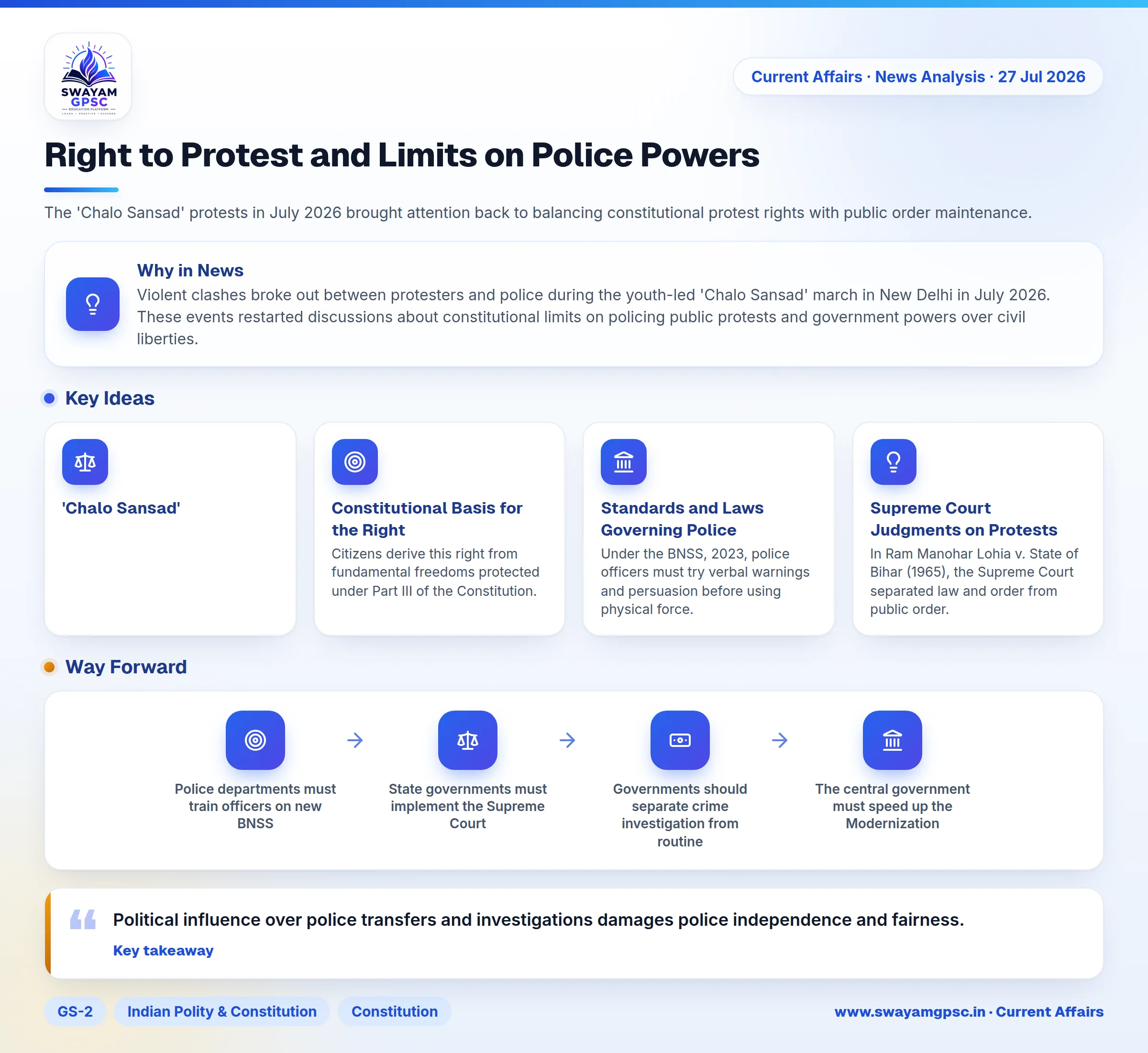
Right to Protest and Limits on Police Powers
#GS-2 #Indian Polity & Constitution #Constitution #Executive #Judiciary #Governance & Social Justice #Regulatory Bodies #GS-3 #Current Events #National #Fundamental Rights #Police Reforms #Public Order
Why in News
- Violent clashes broke out between protesters and police during the youth-led **'Chalo Sansad'** march in New Delhi in **July 2026**.
- These events restarted discussions about constitutional limits on policing public protests and government powers over civil liberties.
- Security forces closed Metro stations and enforced internet restrictions during the demonstrations.
- Protesters alleged that police used tear gas, pellet guns, shock batons, and lathi charges against them.
- These allegations led to legal challenges and scrutiny before the **Delhi High Court**.
Summary
- The **'Chalo Sansad'** protests in **July 2026** brought attention back to balancing constitutional protest rights with public order maintenance.
- The incident highlighted major concerns regarding police excess, digital shutdowns, and personal freedoms.
- This analysis examines constitutional protections, statutory provisions, and court rulings that govern public demonstrations in India.
- It also stresses the urgent need for accountable and rights-focused policing through systemic reforms.
Constitutional Basis for the Right to Protest
- The Indian Constitution protects the right to protest, even though the word protest does not appear directly in the text.
- Citizens derive this right from fundamental freedoms protected under **Part III** of the Constitution.
- **Article 19(1)(a)** guarantees freedom of speech and expression to all citizens.
- **Article 19(1)(b)** gives citizens the right to assemble peacefully without weapons.
- **Article 19(1)(c)** protects the right to form associations or trade unions.
- **Article 21** safeguards life and personal liberty, which includes expressing grievances against government decisions.
- These constitutional guarantees help citizens hold government officers accountable and encourage public debate.
- The right to protest is not absolute because the State can place reasonable restrictions on these rights.
- Under **Article 19(2)**, authorities can restrict free speech to protect national sovereignty, State security, foreign relations, and public order.
- Under **Article 19(3)**, authorities can restrict peaceful assembly to preserve public order and national integrity.
- Statutory powers for regulating public gatherings come from laws like **Section 163** of the **Bharatiya Nagarik Suraksha Sanhita (BNSS), 2023**.
- Local laws like the **Delhi Police Act, 1978** allow police officers to decide protest routes, timings, and conditions.
- Under the **Bharatiya Nyaya Sanhita (BNS), 2023**, a group of five or more people forms an unlawful assembly only if they intend to use criminal force or break laws.
- A lawful public gathering can turn into an unlawful assembly if participants change their behavior during the event.
Standards and Laws Governing Police Action
- The **National Human Rights Commission (NHRC)** manual instructs police officers to protect public rights and uphold the rule of law.
- International standards like the **UN Basic Principles on the Use of Force and Firearms (1990)** require police force to be lawful, necessary, and proportionate.
- Under the **BNSS, 2023**, police officers must try verbal warnings and persuasion before using physical force.
- If force becomes unavoidable, officers must use only the minimum force needed to control the crowd.
- The **BNSS, 2023** and the **Supreme Court** ruling in ***D.K. Basu v. State of West Bengal (1997)*** require police officers making arrests to wear clear name tags.
- Current laws do not clearly require name tags for officers handling crowd control, which creates accountability problems when officers hide their identity.
Supreme Court Judgments on Protests and Police Excess
- In ***Ram Manohar Lohia v. State of Bihar (1965)***, the **Supreme Court** separated law and order from public order.
- The court ruled that law and order covers local issues, while public order covers disruptions affecting society at large.
- The court held that authorities can restrict protests only during genuine threats to public order.
- In ***Himat Lal K. Shah v. Commissioner of Police (1973)***, the court decided that authorities cannot create arbitrary rules that destroy protest rights.
- In ***In Re: Ramlila Maidan Incident (2012)***, the court affirmed that peaceful protest is a constitutional right and force must be the last option.
- In ***Anita Thakur v. State of Jammu & Kashmir (2016)***, the court ruled that excessive police force violates fundamental rights and awarded compensation to victims.
- In ***Mazdoor Kisan Shakti Sangathan v. Union of India (2018)***, the court ruled that regulation must not eliminate the right to assemble entirely.
- In ***Amit Sahni v. Commissioner of Police (2020)***, the court decided that demonstrators cannot block public roads or occupy public spaces indefinitely.
Challenges and Concerns Regarding Excessive Policing
- Political influence over police transfers and investigations damages police independence and fairness.
- Outdated training programs ignore de-escalation skills, human rights concepts, and modern forensic methods.
- India signed the **UN Convention Against Torture (UNCAT)** in **1997** but has not ratified it or passed a domestic anti-torture law.
- In **January 2024**, India had **155 police personnel per lakh population**, which is far below the **UN-recommended norm of 222**.
- Police departments suffer from a **21% vacancy rate** across the country.
- Long working hours cause **83.8% of personnel reporting high stress (SPIR 2025)**, leading to severe burnout and force misuse.
- Excessive lathi charges and mass arrests violate the **Doctrine of Proportionality**.
- Masked personnel and missing name badges during crowd control violate principles from ***D.K. Basu v. State of West Bengal (1997)***.
- Rough treatment of female demonstrators violates constitutional dignity guarantees under **Article 21**.
- Blanket internet shutdowns during protests violate speech rights under **Article 19(1)(a)** and business rights under **Article 19(1)(g)**.
- In ***Anuradha Bhasin v. Union of India (2020)***, the court stated that internet bans must meet strict legal and necessity checks.
- State governments have not properly set up **Police Complaints Authorities (PCAs)** recommended in **Prakash Singh (2006)**.
- Most states still rely on the outdated colonial **Police Act, 1861** instead of adopting the **Model Police Act, 2006**.
Way Forward
- Police departments must train officers on new **BNSS, 2023** and **BNS, 2023** provisions with focus on non-lethal crowd control.
- State governments must implement the **Supreme Court** directives from ***Prakash Singh v. Union of India (2006)*** to create independent **Police Complaints Authorities (PCAs)**.
- Governments should separate crime investigation from routine law and order duties, as advised by the **Second Administrative Reforms Commission (2nd ARC)** and the **Malimath Committee**.
- The central government must speed up the **Modernization of Police Forces (MPF)** scheme to fill vacancies and equip officers with body cameras.
- Police leadership must shift toward **SMART** policing to build a sensitive, modern, mobile, and accountable police force.
Conclusion
- The right to protest remains a foundational part of Indian democracy, while maintaining public order is a essential state responsibility.
- Any restriction on public protests must respect the **Rule of Law**, **Constitutional Morality**, and the **Doctrine of Proportionality**.
- The **'Chalo Sansad'** incident shows why India must balance civil dissent with public safety through strict adherence to constitutional values.