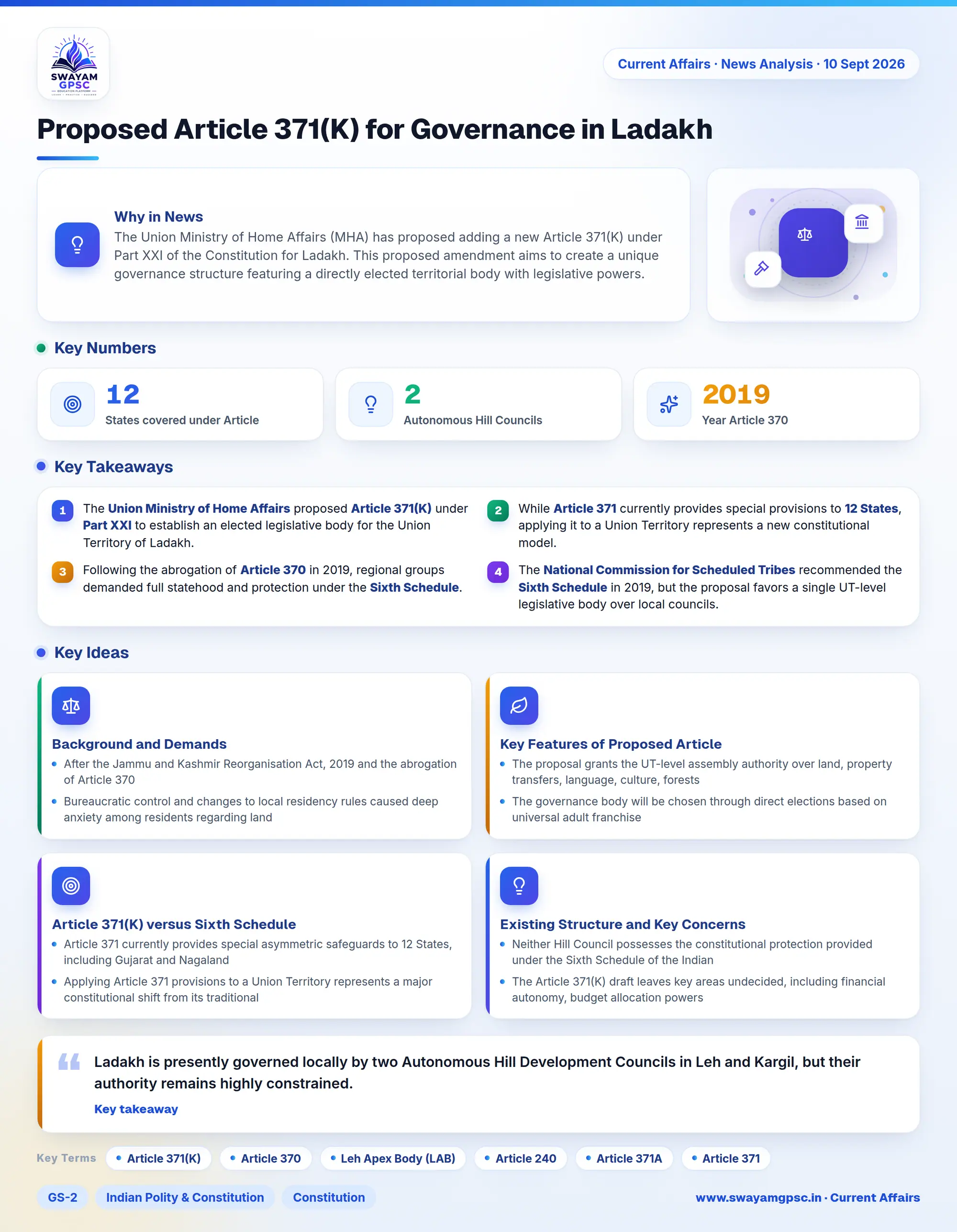
Proposed Article 371(K) for Governance in Ladakh
#GS-2 #Indian Polity & Constitution #Constitution #Federalism #Current Events #National
Key takeaways
- The Union Ministry of Home Affairs proposed Article 371(K) under Part XXI to establish an elected legislative body for the Union Territory of Ladakh.
- While Article 371 currently provides special provisions to 12 States, applying it to a Union Territory represents a new constitutional model.
- Following the abrogation of Article 370 in 2019, regional groups demanded full statehood and protection under the Sixth Schedule.
- The National Commission for Scheduled Tribes recommended the Sixth Schedule in 2019, but the proposal favors a single UT-level legislative body over local councils.
Why in News
- The Union Ministry of Home Affairs (MHA) has proposed adding a new Article 371(K) under Part XXI of the Constitution for Ladakh.
- This proposed amendment aims to create a unique governance structure featuring a directly elected territorial body with legislative powers.
Background and Demands
- After the Jammu and Kashmir Reorganisation Act, 2019 and the abrogation of Article 370, Ladakh became a Union Territory without a legislative assembly.
- Bureaucratic control and changes to local residency rules caused deep anxiety among residents regarding land, employment, and cultural preservation.
- These concerns prompted the Leh Apex Body (LAB) and Kargil Democratic Alliance (KDA) to unite and demand full statehood along with Sixth Schedule protections.
- The regional groups also demanded dedicated public service commissions for local employment and expanded parliamentary representation for the region.
Key Features of Proposed Article 371(K)
- The proposal grants the UT-level assembly authority over land, property transfers, language, culture, forests, environment, and natural resources.
- The governance body will be chosen through direct elections based on universal adult franchise, ending purely bureaucratic administration.
- The legislative powers would align with subjects reserved for presidential regulations in Union Territories under Article 240.
- This framework mirrors provisions in Article 371A for Nagaland and Article 371G for Mizoram, preventing central laws on local traditions and land from applying without local consent.
- The primary goal is to restore elected democratic governance while safeguarding regional ecology and tribal culture without granting full statehood.
Article 371(K) versus Sixth Schedule
- Article 371 currently provides special asymmetric safeguards to 12 States, including Gujarat and Nagaland, to protect local rights and land.
- Applying Article 371 provisions to a Union Territory represents a major constitutional shift from its traditional application to full states.
- The Sixth Schedule under Article 244 creates Autonomous District Councils (ADCs) with wide administrative, judicial, and legislative autonomy in four northeastern states.
- Although the National Commission for Scheduled Tribes (NCST) advocated the Sixth Schedule for Ladakh in 2019, the Centre preferred a single UT-level mechanism under Article 371(K).
Existing Structure and Key Concerns
- Ladakh is presently governed locally by two Autonomous Hill Development Councils in Leh and Kargil, but their authority remains highly constrained.
- Neither Hill Council possesses the constitutional protection provided under the Sixth Schedule of the Indian Constitution.
- The Article 371(K) draft leaves key areas undecided, including financial autonomy, budget allocation powers, and executive control.
- Crucial matters like police administration and public order maintenance also remain unresolved under the proposed Union Territory structure.