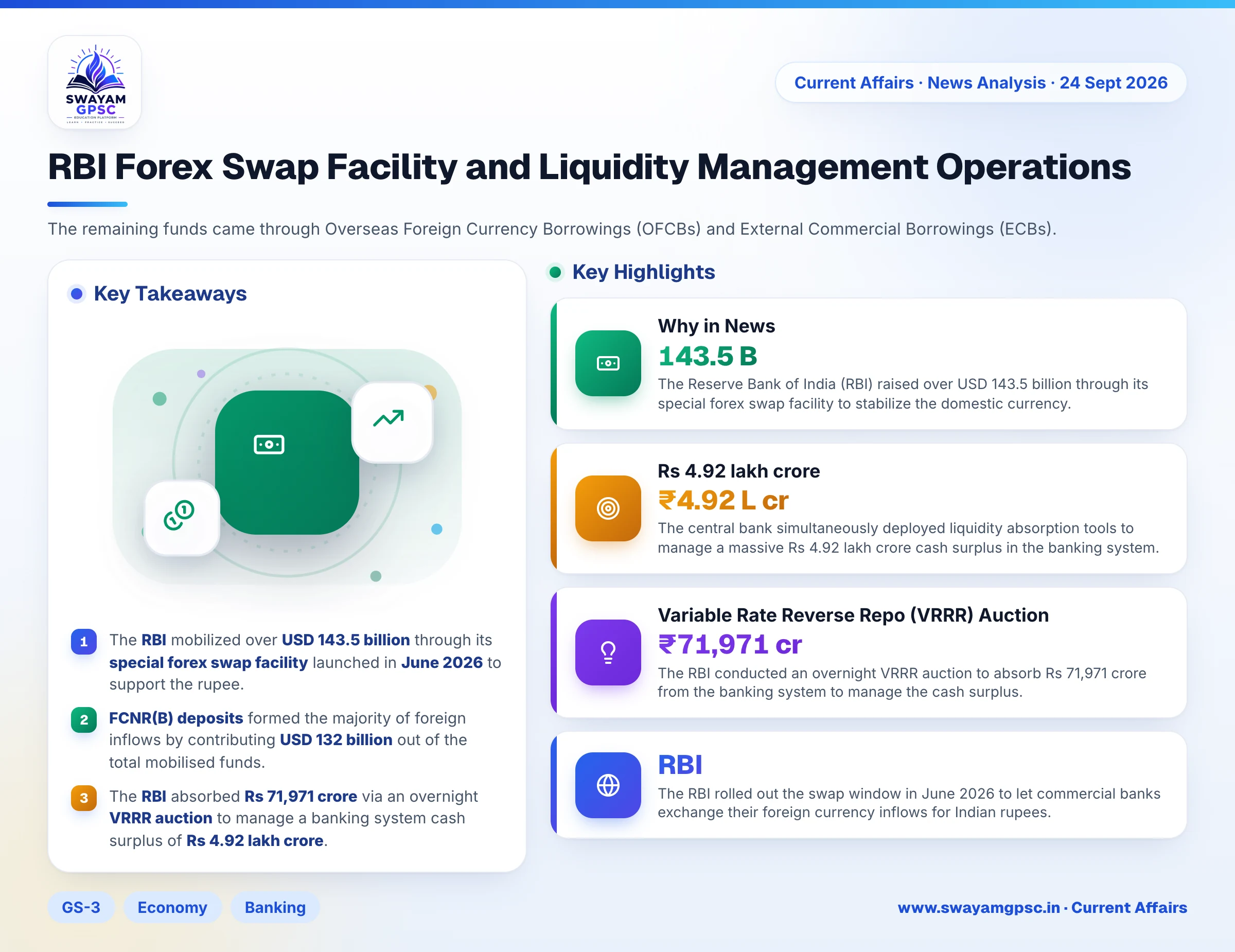
RBI Forex Swap Facility and Liquidity Management Operations
#GS-3 #Economy #Banking #Monetary Policy #Foreign Exchange #Reserve Bank of India
Key takeaways
- The RBI mobilized over USD 143.5 billion through its special forex swap facility launched in June 2026 to support the rupee.
- FCNR(B) deposits formed the majority of foreign inflows by contributing USD 132 billion out of the total mobilised funds.
- The RBI absorbed Rs 71,971 crore via an overnight VRRR auction to manage a banking system cash surplus of Rs 4.92 lakh crore.
- The central bank uses Open Market Operations (OMO) sales of Government securities to permanently withdraw excess rupee liquidity.
Why in News
- The Reserve Bank of India (RBI) raised over USD 143.5 billion through its special forex swap facility to stabilize the domestic currency.
- The central bank simultaneously deployed liquidity absorption tools to manage a massive Rs 4.92 lakh crore cash surplus in the banking system.
Special Forex Swap Facility
- The RBI rolled out the swap window in June 2026 to let commercial banks exchange their foreign currency inflows for Indian rupees.
- This facility protects commercial banks from exchange rate risks on Foreign Currency Non-Resident (Bank) (FCNR(B)) deposits and External Commercial Borrowings (ECBs).
- The primary goal of this tool is to boost US dollar inflows, improve forex market liquidity, and stop the rupee from weakening.
Composition of Forex Inflows
- Out of the USD 143.5 billion collected by September 2026, FCNR(B) deposits accounted for the vast majority at USD 132 billion.
- The remaining funds came through Overseas Foreign Currency Borrowings (OFCBs) and External Commercial Borrowings (ECBs).
Variable Rate Reverse Repo (VRRR) Auction
- The RBI conducted an overnight VRRR auction to absorb Rs 71,971 crore from the banking system to manage the cash surplus.
- The VRRR is an active monetary policy tool under the Liquidity Adjustment Facility (LAF) that absorbs excess bank funds for a fixed time.
- This operation helps keep short-term overnight money market rates aligned with the benchmark repo rate.
- Commercial banks set the interest rate during a VRRR auction through competitive bidding, unlike fixed-rate reverse repos.
Open Market Operations (OMO)
- Alongside VRRR, the RBI conducts Open Market Operations (OMO) to permanently pull out excess rupee liquidity.
- The central bank achieves this permanent liquidity drain by selling Government securities directly in the open market.