RBI Draft Guidelines on Data Governance Framework for Banks
#GS-2 #GS-3 #Governance & Social Justice #E-Governance #Science & Technology #ICT #Cyber Security #Economy #Banking #Current Events #National
Why in News
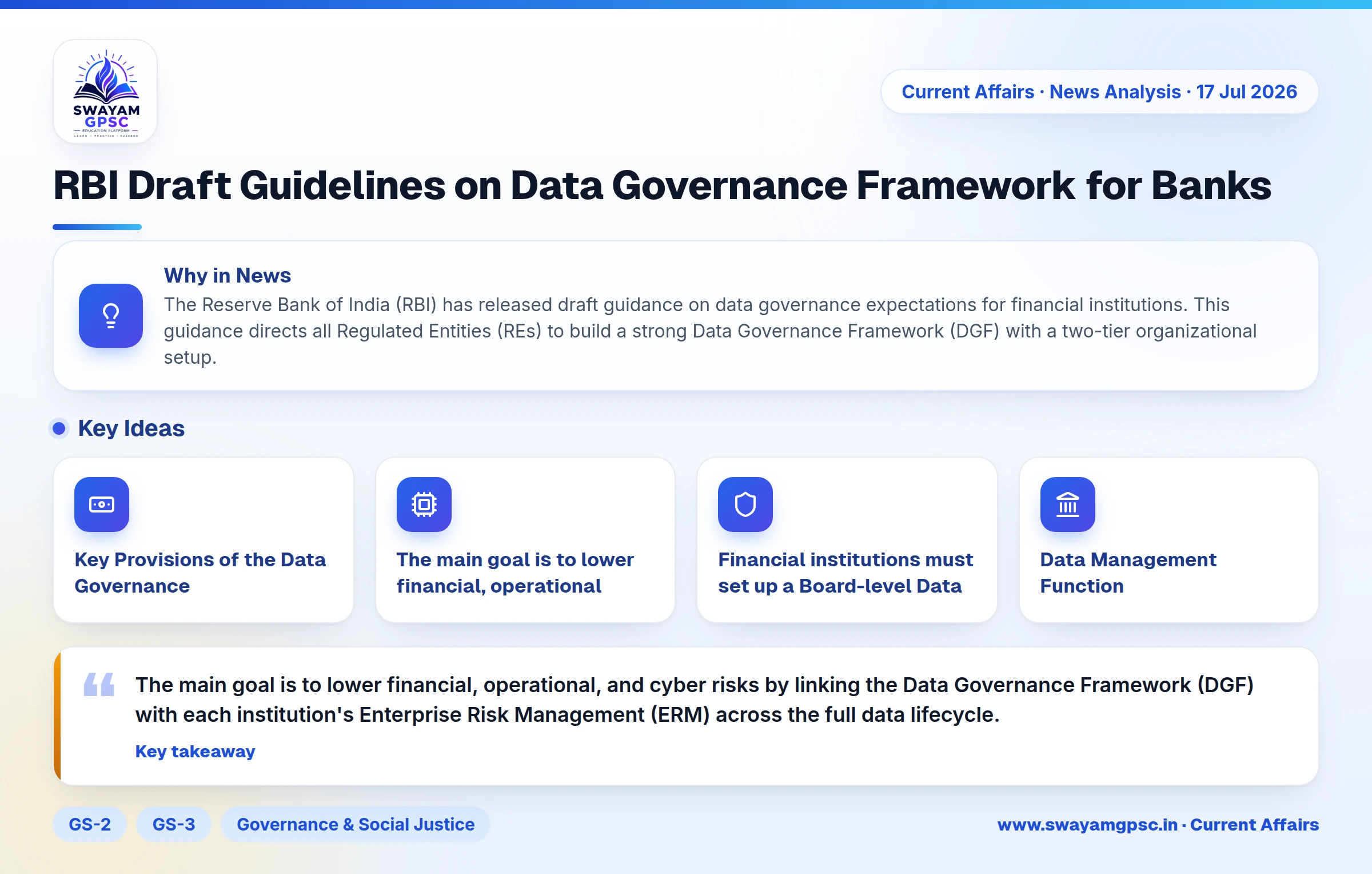
- The Reserve Bank of India (RBI) has released draft guidance on data governance expectations for financial institutions.
- This guidance directs all Regulated Entities (REs) to build a strong Data Governance Framework (DGF) with a two-tier organizational setup.
- The new framework aims to boost data security, enforce accountability, and ensure compliance with the Digital Personal Data Protection (DPDP) Act, 2023.
Key Provisions of the Data Governance Framework
- The main goal is to lower financial, operational, and cyber risks by linking the Data Governance Framework (DGF) with each institution's Enterprise Risk Management (ERM) across the full data lifecycle.
- Financial institutions must set up a Board-level Data Governance Committee to supervise policy execution, review security breaches, and check framework performance.
- Institutions must also form an Executive Data Governance Committee and a dedicated Data Management Function led by an officer ranked Chief General Manager (CGM) or higher.
- The framework assigns explicit duties to Data Owners for quality and governance, Data Stewards for daily execution, and Data Custodians for technical storage, backups, and safe data disposal.
- Institutions must handle data responsibly through purpose-based collection, consent checks, encryption, tokenisation, anonymisation, and secure archiving.
- Banks must establish a Single Source of Truth (SSOT) for key data while keeping metadata and data lineage logs to maintain accuracy and enable audits.
- The framework combines data quality, privacy, ownership, cross-border data transfer, and vendor risks into the main Enterprise Risk Management (ERM) system.
- Banks stay fully responsible for data shared with third-party vendors and group companies, requiring strict access controls, encryption, contracts, and regular audits.
- This step will strengthen operational resilience, enhance data-based decisions, safeguard customer information, and build a safer digital banking system in India.