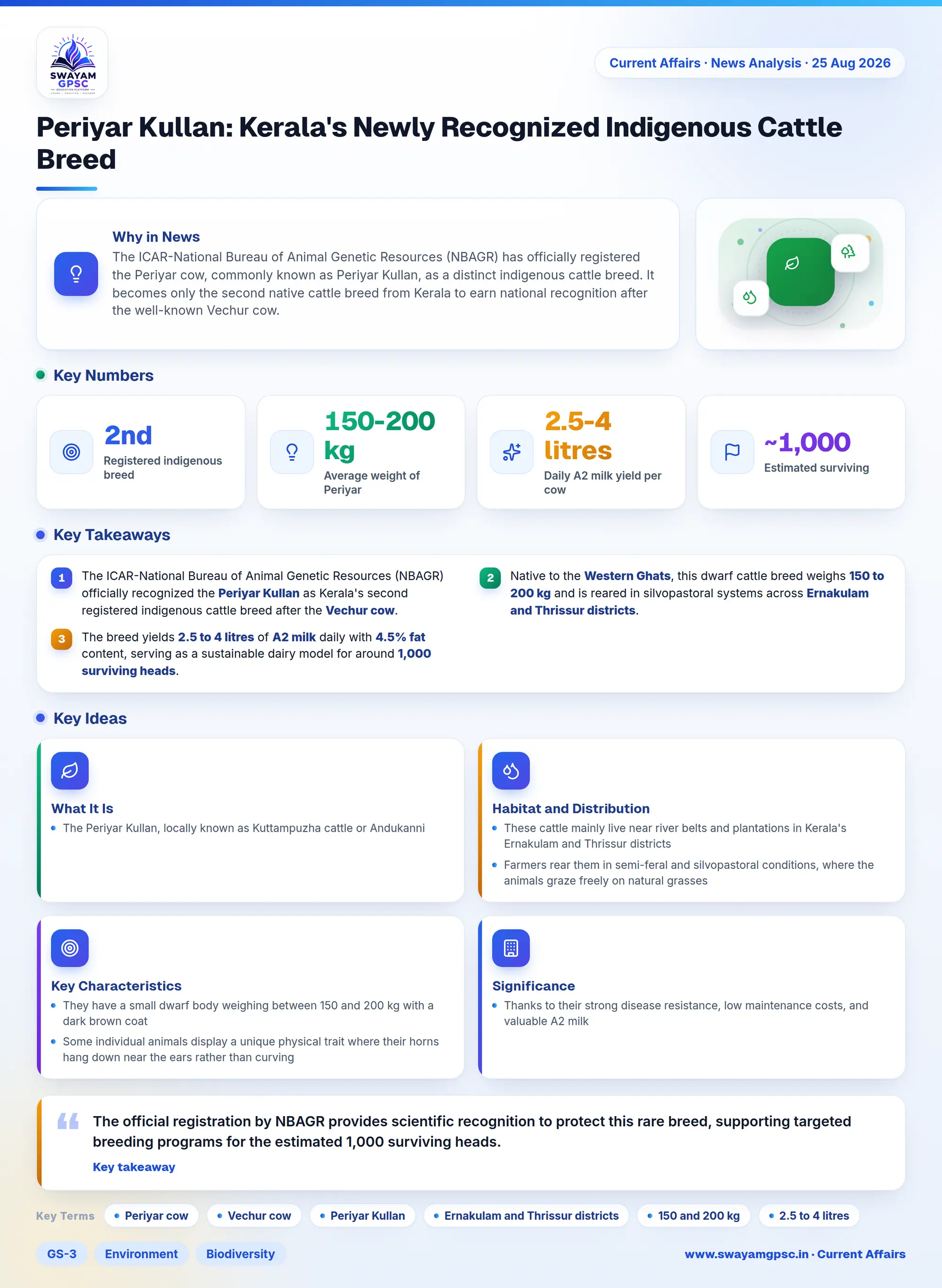
Periyar Kullan: Kerala's Newly Recognized Indigenous Cattle Breed
#GS-3 #Environment #Biodiversity #Agriculture #Current Events #National #Periyar Kullan
Key takeaways
- The ICAR-National Bureau of Animal Genetic Resources (NBAGR) officially recognized the Periyar Kullan as Kerala's second registered indigenous cattle breed after the Vechur cow.
- Native to the Western Ghats, this dwarf cattle breed weighs 150 to 200 kg and is reared in silvopastoral systems across Ernakulam and Thrissur districts.
- The breed yields 2.5 to 4 litres of A2 milk daily with 4.5% fat content, serving as a sustainable dairy model for around 1,000 surviving heads.
Why in News
- The ICAR-National Bureau of Animal Genetic Resources (NBAGR) has officially registered the Periyar cow, commonly known as Periyar Kullan, as a distinct indigenous cattle breed.
- It becomes only the second native cattle breed from Kerala to earn national recognition after the well-known Vechur cow.
What It Is
- The Periyar Kullan, locally known as Kuttampuzha cattle or Andukanni, is a dwarf cattle breed found along the forest borders and plantation tracts of the Western Ghats in central Kerala.
Habitat and Distribution
- These cattle mainly live near river belts and plantations in Kerala's Ernakulam and Thrissur districts, especially in Koovappady, Angamaly, Kothamangalam, and Chalakudy.
- Farmers rear them in semi-feral and silvopastoral conditions, where the animals graze freely on natural grasses, shrubs, and trees in rubber and spice plantations with minimal human intervention.
Key Characteristics
- They have a small dwarf body weighing between 150 and 200 kg with a dark brown coat, making them slightly heavier than the ultra-dwarf Vechur cow which weighs around 130 kg.
- Some individual animals display a unique physical trait where their horns hang down near the ears rather than curving upward.
- These cattle are self-reliant and range freely during the day in plantation areas, returning on their own to specific shelters by evening.
- Each cow produces 2.5 to 4 litres of milk daily that is rich in A2 beta-casein, containing about 4.5% fat and 9.1% Solids-Not-Fat (SNF).
- Female cattle reach breeding maturity at about 26 months, give birth to their first calf at 35 months, and have an average pregnancy period of 279 days.
Significance
- The official registration by NBAGR provides scientific recognition to protect this rare breed, supporting targeted breeding programs for the estimated 1,000 surviving heads.
- Thanks to their strong disease resistance, low maintenance costs, and valuable A2 milk, these cows offer a practical and profitable dairy model for small farmers.