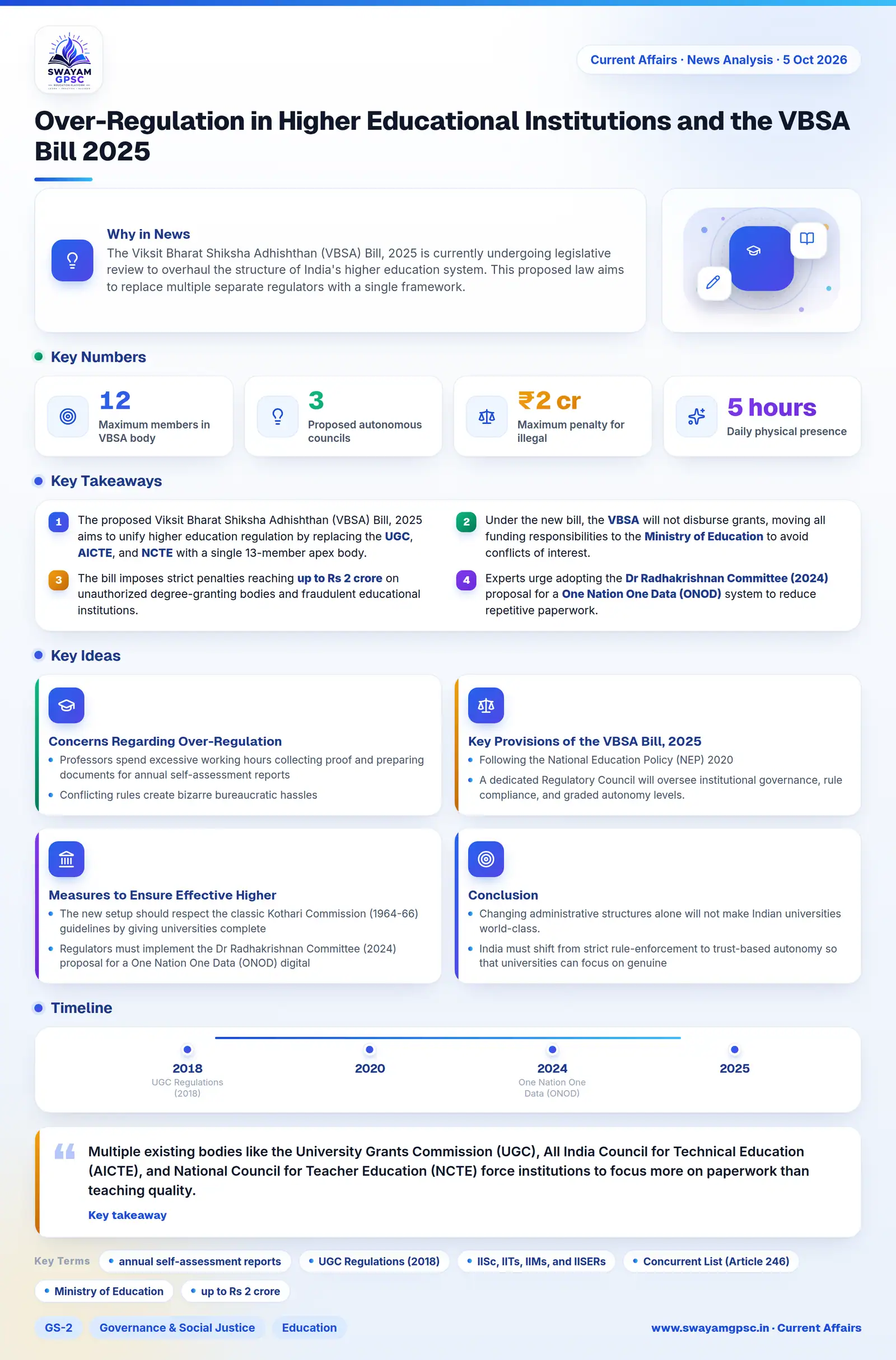
Over-Regulation in Higher Educational Institutions and the VBSA Bill 2025
#GS-2 #Governance & Social Justice #Education #GS-3 #Economy #Infrastructure #Quick Facts For Prelims #Government Policies & Interventions
Key takeaways
- The proposed Viksit Bharat Shiksha Adhishthan (VBSA) Bill, 2025 aims to unify higher education regulation by replacing the UGC, AICTE, and NCTE with a single 13-member apex body.
- Under the new bill, the VBSA will not disburse grants, moving all funding responsibilities to the Ministry of Education to avoid conflicts of interest.
- The bill imposes strict penalties reaching up to Rs 2 crore on unauthorized degree-granting bodies and fraudulent educational institutions.
- Experts urge adopting the Dr Radhakrishnan Committee (2024) proposal for a One Nation One Data (ONOD) system to reduce repetitive paperwork.
- Maintaining institutional autonomy remains vital, as top premier bodies like IITs and IIMs achieved global status primarily by operating outside rigid regulatory oversight.
Why in News
- The Viksit Bharat Shiksha Adhishthan (VBSA) Bill, 2025 is currently undergoing legislative review to overhaul the structure of India's higher education system.
- This proposed law aims to replace multiple separate regulators with a single framework.
- However, the bill has renewed intense debate around the persistent problem of over-regulation in Higher Educational Institutions (HEIs).
Concerns Regarding Over-Regulation in HEIs
- Multiple existing bodies like the University Grants Commission (UGC), All India Council for Technical Education (AICTE), and National Council for Teacher Education (NCTE) force institutions to focus more on paperwork than teaching quality.
- Professors spend excessive working hours collecting proof and preparing documents for annual self-assessment reports instead of focusing on research.
- Conflicting rules create bizarre bureaucratic hassles, such as the UGC Regulations (2018) which require a 40-hour work week but specify only five hours of daily physical presence.
- Heavy state surveillance creates fear, driving universities to avoid innovative changes and adopt safe mediocrity to protect themselves from penalties.
- Top institutions like IISc, IITs, IIMs, and IISERs achieved international success specifically because they operated outside standard regulatory controls.
- Academics fear that placing Institutes of National Importance (INIs) under the new VBSA structure might destroy the functional freedom that made them successful.
- Because education falls under the Concurrent List (Article 246), state governments argue that a centralized regulator harms state authority and limits state university autonomy.
- The reliance on digital submission systems puts poorly funded rural state universities at a major disadvantage compared to well-equipped private colleges.
Key Provisions of the VBSA Bill, 2025
- Following the National Education Policy (NEP) 2020, the bill creates a single apex commission called the Viksit Bharat Shiksha Adhishthan (VBSA) consisting of a Chairperson and maximum 12 members.
- A dedicated Regulatory Council will oversee institutional governance, rule compliance, and graded autonomy levels.
- An independent Accreditation Council will handle digital performance assessments and learning outcome evaluations.
- A specialized Standards Council will set national rules for learning goals, curriculum guidelines, and student credit transfers.
- Unlike the current UGC setup, the VBSA will have no grant-disbursal powers, leaving financial grants entirely with the Ministry of Education to prevent conflicts of interest.
- Medical and legal studies are explicitly excluded from this bill and will remain under their own existing statutory councils.
- The legislation sets severe financial fines reaching up to Rs 2 crore for fake colleges and unapproved degree providers.
Measures to Ensure Effective Higher Education Regulation
- The new setup should respect the classic Kothari Commission (1964-66) guidelines by giving universities complete academic freedom and protecting top institutes like IITs.
- Regulators must implement the Dr Radhakrishnan Committee (2024) proposal for a One Nation One Data (ONOD) digital portal to eliminate repeating inspections.
- The Accreditation Council needs to stop checking simple physical building metrics and start judging real student outcomes like critical thinking, job placement, and research quality.
- The government must follow the NEP 2020 formula of light-touch supervision, stopping financial fraud while staying away from daily teaching and hiring decisions.
- Establishing an independent appeals court and giving states fair representation in VBSA management will protect cooperative federalism and prevent central dominance.
Conclusion
- Changing administrative structures alone will not make Indian universities world-class.
- India must shift from strict rule-enforcement to trust-based autonomy so that universities can focus on genuine research and creative learning.