Financial Stability in an Age of Global Flux
#GS-3 #Economy #Banking #Reserve Bank of India (RBI) #Financial Stability #Current Events #National #Monetary Policy #Fiscal Policy
Key takeaways
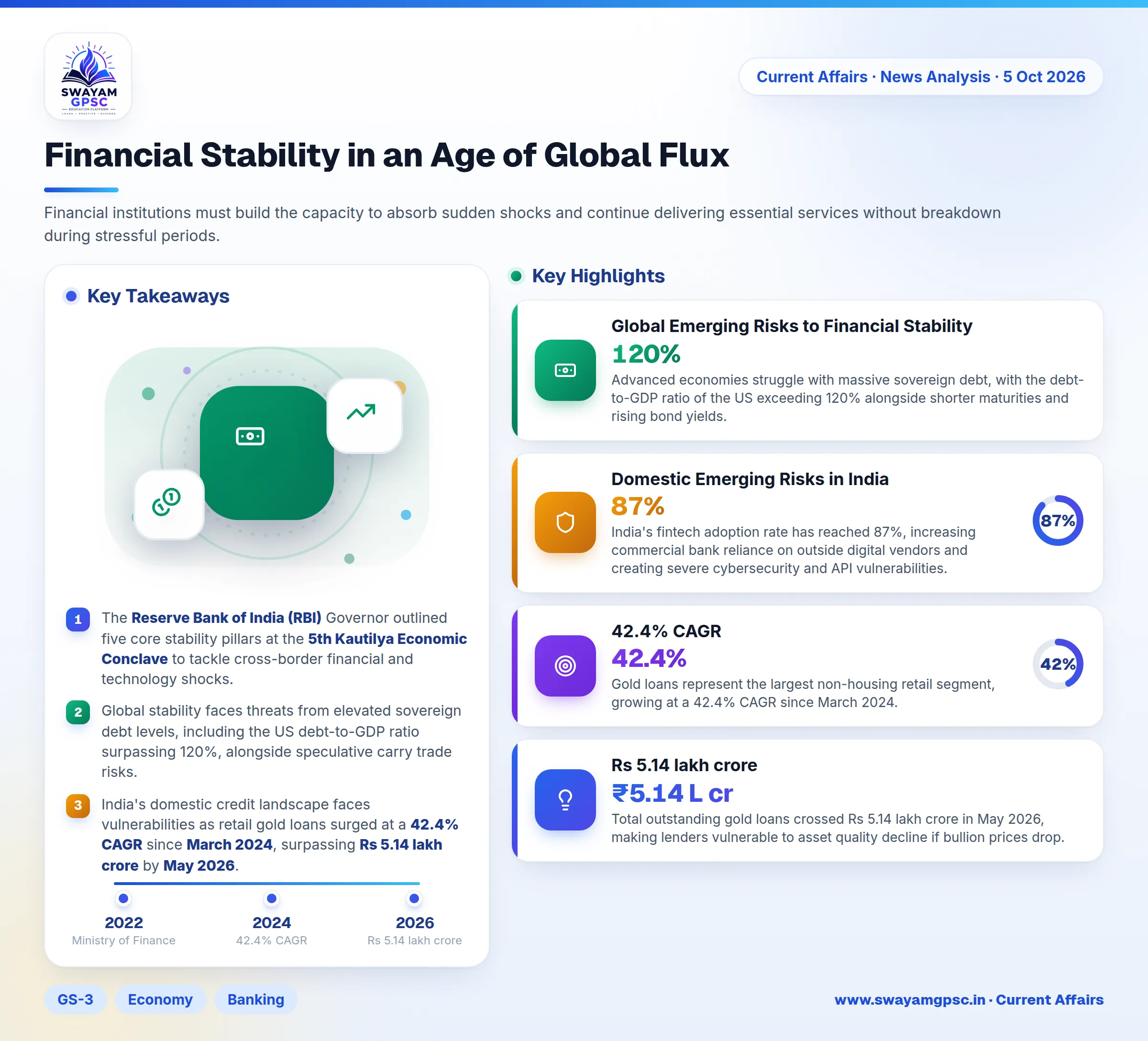
- The Reserve Bank of India (RBI) Governor outlined five core stability pillars at the 5th Kautilya Economic Conclave to tackle cross-border financial and technology shocks.
- Global stability faces threats from elevated sovereign debt levels, including the US debt-to-GDP ratio surpassing 120%, alongside speculative carry trade risks.
- India's domestic credit landscape faces vulnerabilities as retail gold loans surged at a 42.4% CAGR since March 2024, surpassing Rs 5.14 lakh crore by May 2026.
- Fintech integration in India has hit 87%, requiring faster deployment of protective tools like the Reserve Bank Innovation Hub (RBIH) platform MuleHunter.ai to counter cyber fraud.
Why in News
- The Governor of the Reserve Bank of India (RBI) outlined five major priorities to protect financial stability during global uncertainties.
- He shared these views at the 5th Kautilya Economic Conclave organized in New Delhi under the theme Resilience in an Age of Flux.
Summary of the Speech
- The Reserve Bank of India (RBI) outlined five core priorities that focus on systemic resilience, new risks, granular data, broad resilience, and preserving institutional trust.
- India faces rising domestic risks from unsecured retail loans, speculative derivatives trading, fintech vulnerabilities, higher bank funding costs, gold loans, and global spillover effects.
Five Priorities Outlined by the RBI
- Financial institutions must build the capacity to absorb sudden shocks and continue delivering essential services without breakdown during stressful periods.
- Regulators must understand modern systemic risks that originate across borders and spread through deeply linked global channels.
- Future financial crises are far more likely to emerge from geopolitical tensions, cyber warfare, or technology disruptions than from standard bank lending.
- Better risk evaluation demands non-fragmented and granular data covering non-bank financial intermediaries, digital linkages, and common technological dependencies.
- Systemic resilience must expand beyond traditional commercial lenders to include shadow banks, digital payment networks, tech systems, and external technology vendors.
- The Governor warned that financial instability in any corner of the globe quickly turns into a serious threat for everyone.
- Financial innovations like Artificial Intelligence (AI) and asset tokenization can improve business speed, but they must never compromise foundational institutional trust, settlement certainty, or market integrity.
Background of the Kautilya Economic Conclave
- The Institute of Economic Growth (IEG) first launched the Kautilya Economic Conclave (KEC) in 2022 in close partnership with the Ministry of Finance.
- The event brings together domestic and global experts to examine pressing questions around economic expansion, financial stability, technology integration, and global investment flows.
Global Emerging Risks to Financial Stability
- Advanced economies struggle with massive sovereign debt, with the debt-to-GDP ratio of the US exceeding 120% alongside shorter maturities and rising bond yields.
- This trend creates dangerous capital flight risks for developing economies like India, Brazil, and Indonesia whenever global investors quickly dismantle speculative carry trades.
- Global stock markets rely heavily on elevated tech valuations linked to the rapid expansion of the artificial intelligence sector.
- A sudden drop in tech capital spending or earnings could trigger rapid market sell-offs, harming chip-dependent economies like Taiwan and South Korea.
- Non-bank financial intermediaries like hedge funds and private equity firms hold substantial hidden leverage across bond and equity markets.
- Stress in the shadow banking sector can spill into regular banking, echoing the UK's liability-driven investment pension crisis in 2022.
- The fast-growing private credit market shows clear signs of deterioration, evidenced by rising defaults and expanded use of risky payment-in-kind structures.
- Rising geopolitical tensions in West Asia and trade route disruptions across the Red Sea and Suez Canal, combined with sophisticated cyberattacks, threaten cross-border financial systems.
Domestic Emerging Risks in India
- Unsecured personal credit is expanding rapidly through digital apps and buy-now-pay-later facilities, even while corporate balance sheets look relatively healthy.
- Fresh default rates are climbing notably among retail borrowers younger than 25 years old, posing severe credit risks if the economy slows.
- Excessive retail speculation in Futures & Options (F&O) and elevated valuations of mid-cap and small-cap stocks threaten household savings during sudden market corrections.
- India's fintech adoption rate has reached 87%, increasing commercial bank reliance on outside digital vendors and creating severe cybersecurity and API vulnerabilities.
- Commercial banks face shrinking low-cost CASA deposits and higher funding costs as customers move funds into term deposits.
- To protect net interest margins, banks are taking higher balance-sheet risks by lending to riskier, high-yield credit segments.
- Gold loans represent the largest non-housing retail segment, growing at a 42.4% CAGR since March 2024.
- Total outstanding gold loans crossed Rs 5.14 lakh crore in May 2026, making lenders vulnerable to asset quality decline if bullion prices drop.
Way Forward
- The central bank must implement countercyclical macroprudential tools, such as higher risk weights on unsecured retail loans and shadow banking exposures, to curb reckless credit growth.
- Regulators like SEBI should place strict PAN-level limits on retail derivatives and restrict dangerous zero-day options to protect retail savings from steep losses.
- Banks must actively grow their low-cost CASA deposit base, reduce dependence on volatile short-term wholesale funds, and maintain strict compliance with the Liquidity Coverage Ratio (LCR).
- Financial institutions should deploy AI-driven fraud-fighting systems, such as MuleHunter.ai built by the Reserve Bank Innovation Hub (RBIH), to combat digital scams.
- Emerging nations should adopt the World Bank Three-Pillar Approach by improving domestic resource mobilization, expanding risk-sharing mechanisms, and utilizing the G20 Common Framework for orderly debt workouts.
- India must maintain strong foreign exchange reserves to protect the rupee against sudden global capital outflows while encouraging local currency settlements in cross-border trade.
Conclusion
- India's regulatory framework must move beyond simple crisis prevention toward developing robust shock-absorbing strength across all market institutions.
- By enforcing disciplined macroprudential rules and upgrading cyber defenses, India can turn financial stability into a solid foundation for sustainable growth.