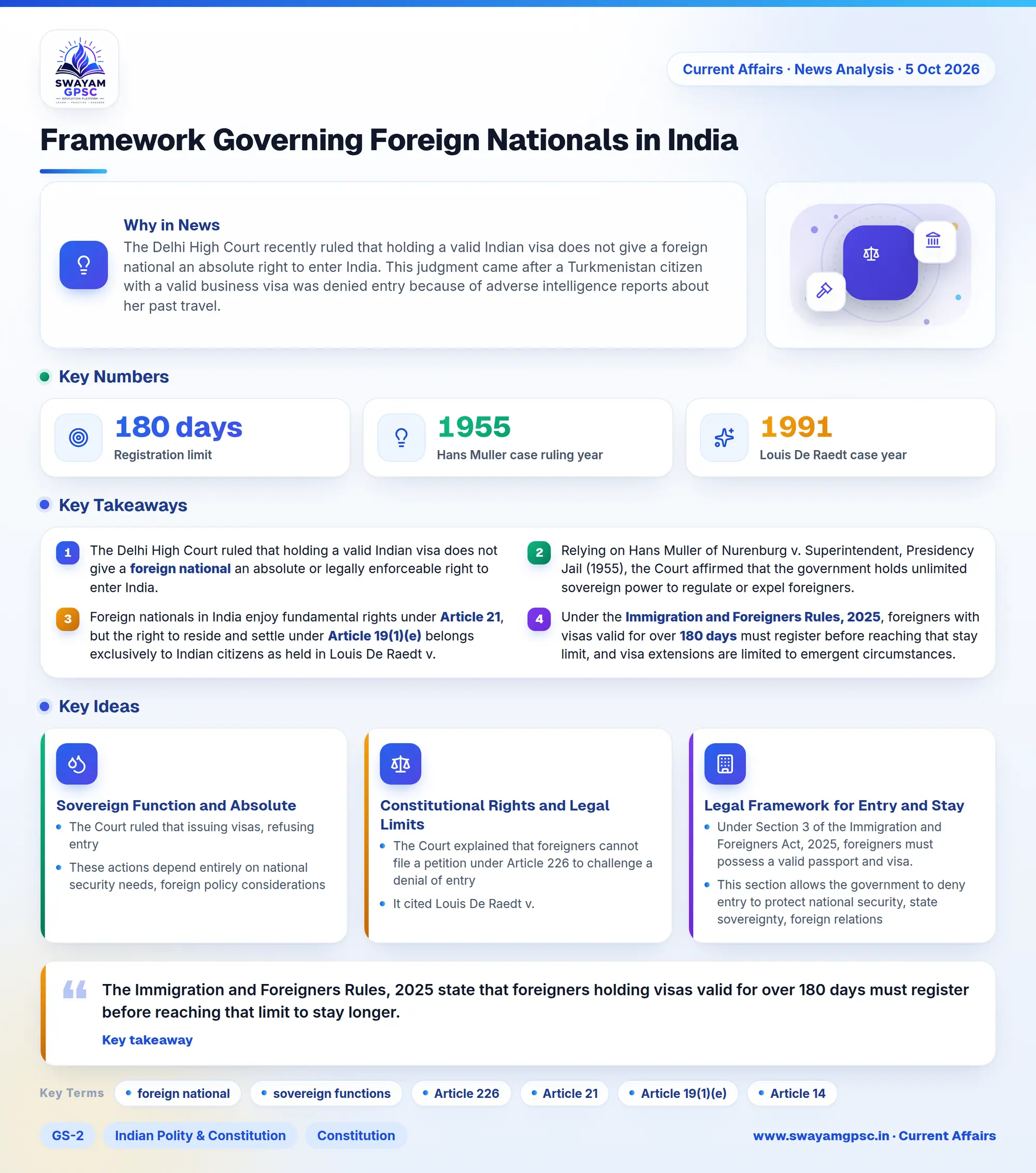
Framework Governing Foreign Nationals in India
#GS-2 #Indian Polity & Constitution #Constitution #Judiciary #Governance & Social Justice #Regulatory Bodies #Current Events #National #Rapid Fire CA #Quick Facts For Prelims #Government Policies & Interventions
Key takeaways
- The Delhi High Court ruled that holding a valid Indian visa does not give a foreign national an absolute or legally enforceable right to enter India.
- Relying on Hans Muller of Nurenburg v. Superintendent, Presidency Jail (1955), the Court affirmed that the government holds unlimited sovereign power to regulate or expel foreigners.
- Foreign nationals in India enjoy fundamental rights under Article 21, but the right to reside and settle under Article 19(1)(e) belongs exclusively to Indian citizens as held in Louis De Raedt v. Union of India (1991).
- Under the Immigration and Foreigners Rules, 2025, foreigners with visas valid for over 180 days must register before reaching that stay limit, and visa extensions are limited to emergent circumstances.
Why in News
- The Delhi High Court recently ruled that holding a valid Indian visa does not give a foreign national an absolute right to enter India.
- This judgment came after a Turkmenistan citizen with a valid business visa was denied entry because of adverse intelligence reports about her past travel.
Sovereign Function and Absolute Discretion
- The Court ruled that issuing visas, refusing entry, and granting immigration clearances are fundamental sovereign functions.
- These actions depend entirely on national security needs, foreign policy considerations, and administrative discretion.
- The Court pointed to the landmark Supreme Court ruling in Hans Muller of Nurenburg v. Superintendent, Presidency Jail (1955).
- This ruling confirmed that the Central Government holds unlimited power to control the entry or expulsion of foreigners.
- A visa is only a conditional permission, which means getting one from an embassy does not guarantee entry into the country.
- The final authority to grant or deny admission rests completely with immigration officers working at the port of entry.
Constitutional Rights and Legal Limits for Foreigners
- The Court explained that foreigners cannot file a petition under Article 226 to challenge a denial of entry because they lack an enforceable right to enter India.
- It cited Louis De Raedt v. Union of India (1991) to show that a foreigner's fundamental rights are restricted to Article 21.
- The fundamental right to reside and settle in India under Article 19(1)(e) belongs solely to Indian citizens.
- The Court rejected the petitioner's claim that denying her entry while letting her husband enter violated Article 14.
- Officials proved that both individuals were not in identical situations because adverse intelligence inputs applied only to the petitioner.
Legal Framework for Entry and Stay
- Under Section 3 of the Immigration and Foreigners Act, 2025, foreigners must possess a valid passport and visa.
- This section allows the government to deny entry to protect national security, state sovereignty, foreign relations, or public health.
- Section 7 of the same law gives the Central Government broad power to prohibit, regulate, or restrict foreign visitors.
- The Immigration and Foreigners Rules, 2025 state that foreigners holding visas valid for over 180 days must register before reaching that limit to stay longer.
- The government will grant visa extensions only under emergency circumstances.
- Border immigration officers have full authority to inspect documents, request extra details, and decide whether a person may enter the country.