India's Journey Towards Universal Literacy
#GS-2 #Governance & Social Justice #Education #Government Policies & Interventions
Key takeaways
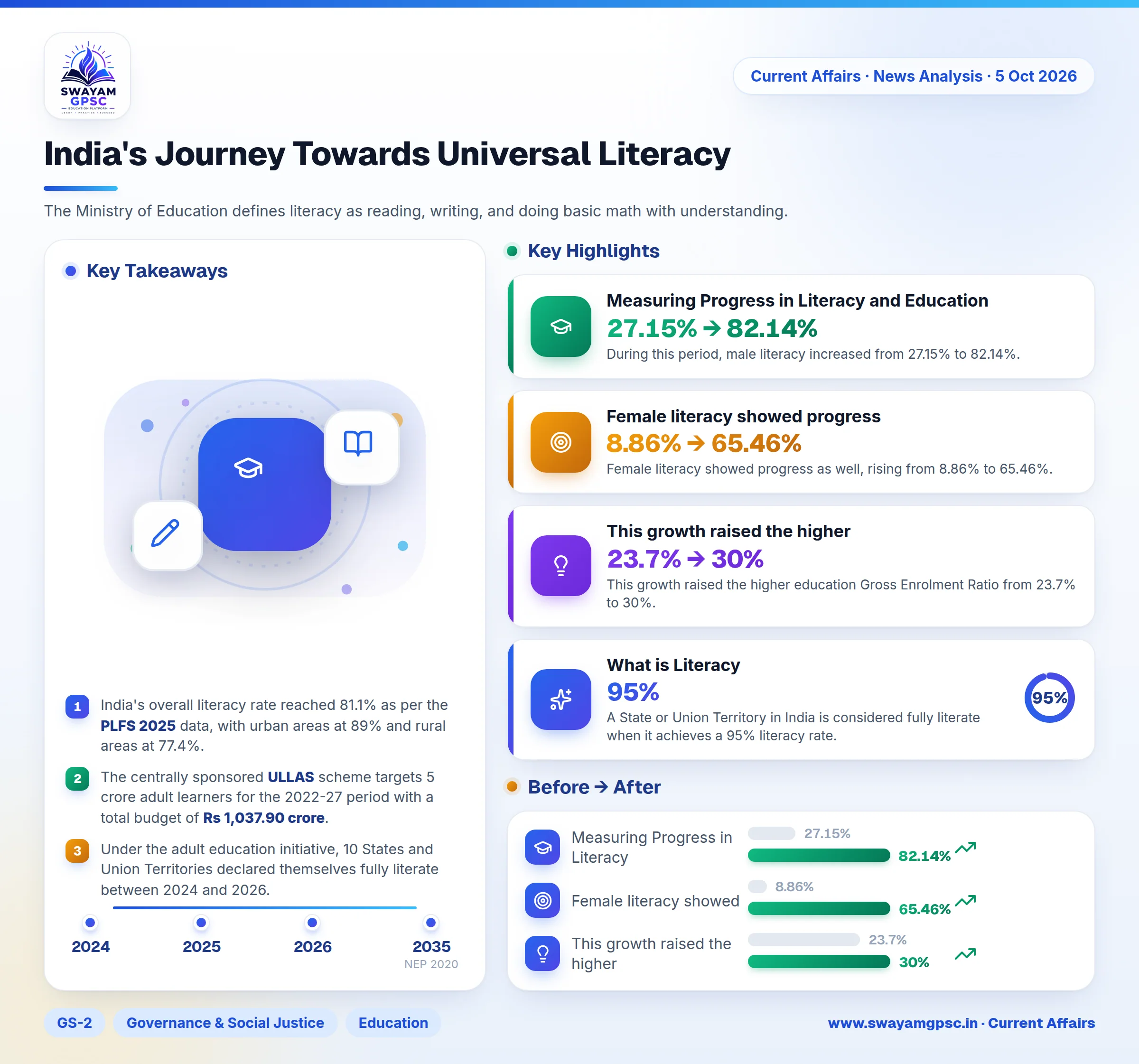
- India's overall literacy rate reached 81.1% as per the PLFS 2025 data, with urban areas at 89% and rural areas at 77.4%.
- The centrally sponsored ULLAS scheme targets 5 crore adult learners for the 2022-27 period with a total budget of Rs 1,037.90 crore.
- Under the adult education initiative, 10 States and Union Territories declared themselves fully literate between 2024 and 2026.
- The NIPUN Bharat mission aims to achieve universal foundational literacy and numeracy for children aged 3-8 years by 2026-27.
- The NEP 2020 has set a target to increase the Gross Enrolment Ratio in higher education to 50% by the year 2035.
Why in News
- India is focusing heavily on raising its literacy rate to achieve universal literacy and strengthen foundational education.
- The National Education Policy (NEP) 2020 builds on this progress to address remaining gaps in the education system.
- This policy focuses on foundational literacy, numeracy, fair access to education, and building a skilled workforce.
What is Literacy
- The Ministry of Education defines literacy as reading, writing, and doing basic math with understanding.
- This modern definition also includes important life skills like digital literacy and financial literacy.
- A State or Union Territory in India is considered fully literate when it achieves a 95% literacy rate.
- The global body UNESCO defines literacy as using numbers, reading, writing, and digital tools to solve everyday problems.
- Literacy is a basic human right that helps people get jobs, enjoy equal treatment, and access other rights.
- India's overall literacy rate has grown significantly from just 14% in 1947, showing major progress in school access.
- During this same period, the female literacy rate grew from a very low 8%.
- The National Education Policy (NEP) 2020 aims to transform education to make citizens skilled and ready for the future.
Measuring Progress in Literacy and Education
- India's overall literacy rate rose from 18.32% in 1951 to 74.04% in 2011.
- During this period, male literacy increased from 27.15% to 82.14%.
- Female literacy showed progress as well, rising from 8.86% to 65.46%.
- The country still faces a gap between areas, with urban literacy at 84.1% and rural literacy at 67.8% in 2011.
- Between 2001 and 2011, rural female literacy grew by 26%, which was much faster than the 10% growth for rural males.
- The Periodic Labour Force Survey (PLFS) 2025 shows that India's overall literacy rate reached 81.1%.
- For people aged 7 years and older, urban literacy reached 89% while rural literacy stood at 77.4%.
- The gender gap remains visible, as urban male literacy reached 93.1% compared to 84.8% for rural males.
- Urban female literacy stood at 84.8%, while rural female literacy was lower at 70.3%.
- School enrolment has expanded greatly, crossing 24.72 crore students according to the UDISE+ 2025-26 report.
- The Gross Enrolment Ratio (GER) is 42.8% at the Foundational stage and 91.7% at the Preparatory stage.
- The GER stands at 89.6% at the Middle stage and drops to 71.7% at the Secondary stage.
- Student dropout rates are 1.8% at the Preparatory stage, 3.6% at the Middle stage, and 7.0% at the Secondary stage.
- The student retention rate drops from 98.5% at the Foundational stage to 51.9% at the Secondary stage.
- The transition rate is 99.2% from Foundational to Preparatory and 93.8% from Preparatory to Middle stage.
- The transition rate from Middle to Secondary school stands at 88.3%.
- Higher education enrolment grew from 3.42 crore in 2014-15 to 4.50 crore in 2023-24.
- This growth raised the higher education Gross Enrolment Ratio from 23.7% to 30%.
- The number of students graduating from higher education rose from 88.28 lakh in 2014-15 to over 1.09 crore in 2023-24.
- More women, Scheduled Castes, Scheduled Tribes, and backward groups are entering higher education now.
- This progress supports the target of the NEP 2020 to achieve a 50% higher education GER by the year 2035.
ULLAS Initiative
- The government started ULLAS, also known as the New India Literacy Programme (NILP), as a centrally sponsored scheme.
- This scheme targets adults aged 15 years and above who could not attend formal school.
- It focuses on basic reading, writing, math, life skills, and keeping up learning throughout life.
- The programme uses the slogan Jan Jan Saakshar to encourage local citizens to volunteer and join the effort.
- It uses a mix of online and offline learning through the ULLAS App, which offers study materials in 27 languages.
- Local teachers, social workers, ASHA workers, and Anganwadi workers help find learners and volunteers through local surveys.
- Learners take the Foundational Literacy and Numeracy Assessment Test (FLNAT) to get their official literacy certificate.
- For the years 2022-27, the scheme has a budget of Rs 1,037.90 crore and aims to help 5 crore learners.
- Currently, 4.03 crore learners and 52.20 lakh volunteers have registered, and over 3.3 crore learners took the FLNAT exam.
- Between 2024 and 2026, 10 States and Union Territories declared themselves fully literate under this initiative.
- These areas include Ladakh, Mizoram, Goa, Tripura, Himachal Pradesh, Chandigarh, Andaman & Nicobar Islands, Sikkim, Uttarakhand, and Jammu & Kashmir.
NIPUN Bharat and Other Initiatives
- The government launched NIPUN Bharat in July 2021 under the Samagra Shiksha program.
- This initiative aims to help children aged 3-8 years learn basic reading, writing, and math by Grade 3 by the year 2026-27.
- The Samagra Shiksha scheme supports high-quality, inclusive school education and trains teachers to meet global goals.
- It combines three older programs: Sarva Shiksha Abhiyan (SSA), Rashtriya Madhyamik Shiksha Abhiyan (RMSA), and Teacher Education.
- The PM SHRI scheme upgrads over 14,500 schools to make learning creative, modern, and helpful for all kids.
- The PM e-VIDYA initiative brings together digital, TV, and radio lessons to help 25 crore school children study easily.
- The PM POSHAN scheme serves hot meals to 11.20 crore students across 10.36 lakh government and aided schools.
- This food program improves daily school attendance, keeps children in school, and fights hunger.
Conclusion
- India's literacy plans have grown from basic reading and writing to digital skills and lifelong learning.
- Key schemes work together to make education high-quality, fair, and easy to access.
- These programs help build a skilled and strong population to support the national goal of Viksit Bharat.