Nevada's Hawk Fire: Disaster Response and Wildfire Impact
#GS-3 #Disaster Management #Disaster Preparedness #Disaster Response #Geography #Disaster Geography #Current Events #International #Wildfires #Hawk Fire
Key takeaways
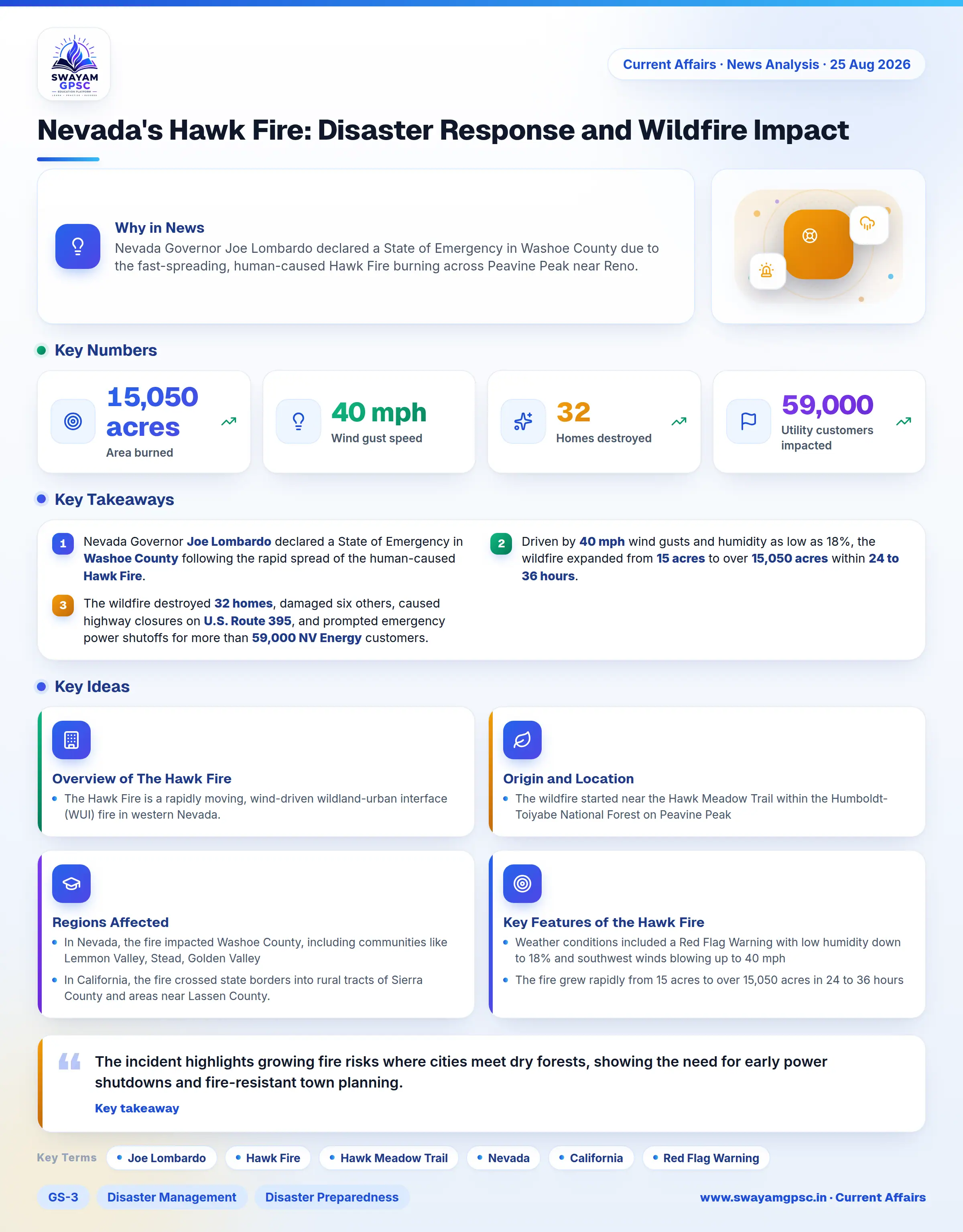
- Nevada Governor Joe Lombardo declared a State of Emergency in Washoe County following the rapid spread of the human-caused Hawk Fire.
- Driven by 40 mph wind gusts and humidity as low as 18%, the wildfire expanded from 15 acres to over 15,050 acres within 24 to 36 hours.
- The wildfire destroyed 32 homes, damaged six others, caused highway closures on U.S. Route 395, and prompted emergency power shutoffs for more than 59,000 NV Energy customers.
Why in News
- Nevada Governor Joe Lombardo declared a State of Emergency in Washoe County due to the fast-spreading, human-caused Hawk Fire burning across Peavine Peak near Reno.
Overview of The Hawk Fire
- The Hawk Fire is a rapidly moving, wind-driven wildland-urban interface (WUI) fire in western Nevada. It spreads quickly across dry brush and grasses, jumping major transit corridors and threatening suburban neighborhoods and infrastructure.
Origin and Location
- The wildfire started near the Hawk Meadow Trail within the Humboldt-Toiyabe National Forest on Peavine Peak, located just northwest of Reno in Washoe County, Nevada.
Regions Affected
- In Nevada, the fire impacted Washoe County, including communities like Lemmon Valley, Stead, Golden Valley, Raleigh Heights, and areas around the University of Nevada, Reno.
- In California, the fire crossed state borders into rural tracts of Sierra County and areas near Lassen County.
Key Features of the Hawk Fire
- Weather conditions included a Red Flag Warning with low humidity down to 18% and southwest winds blowing up to 40 mph, which carried burning embers across dry plants.
- The fire grew rapidly from 15 acres to over 15,050 acres in 24 to 36 hours, jumping across U.S. Route 395 near Peppermint Drive and forcing road closures between Parr Boulevard and Red Rock Road.
- The disaster destroyed 32 residential homes, damaged six others, closed the Reno-Stead Airport to general flights, and caused power cuts for over 59,000 NV Energy customers.
Significance
- The incident highlights growing fire risks where cities meet dry forests, showing the need for early power shutdowns and fire-resistant town planning.
- It emphasizes the importance of smooth coordination between federal, state, and local emergency teams to fight widespread wildfires quickly.