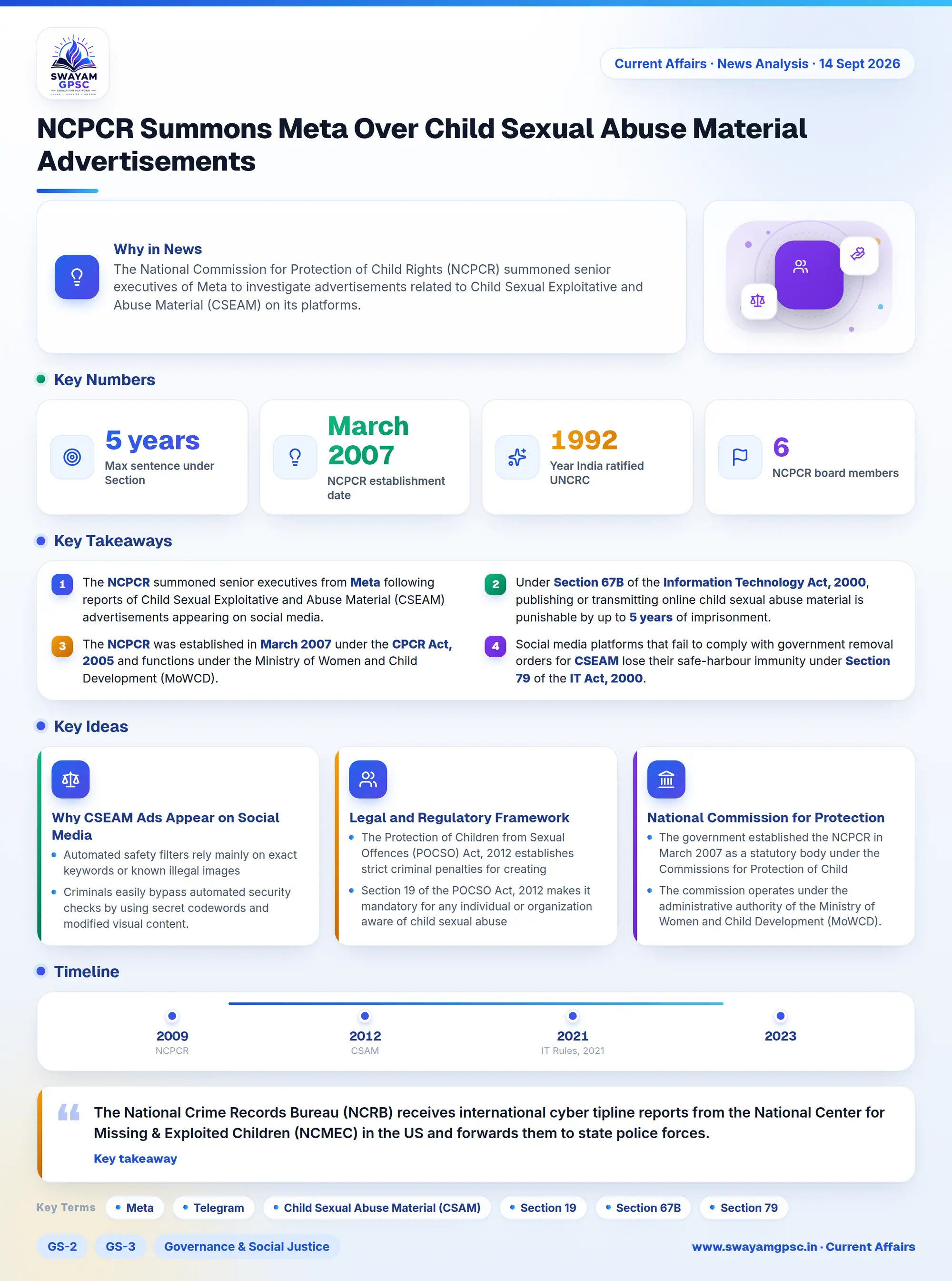
NCPCR Summons Meta Over Child Sexual Abuse Material Advertisements
#GS-2 #GS-3 #Governance & Social Justice #Cyber Security #Vulnerable Sections #Current Events #National
Key takeaways
- The NCPCR summoned senior executives from Meta following reports of Child Sexual Exploitative and Abuse Material (CSEAM) advertisements appearing on social media.
- Under Section 67B of the Information Technology Act, 2000, publishing or transmitting online child sexual abuse material is punishable by up to 5 years of imprisonment.
- The NCPCR was established in March 2007 under the CPCR Act, 2005 and functions under the Ministry of Women and Child Development (MoWCD).
- Social media platforms that fail to comply with government removal orders for CSEAM lose their safe-harbour immunity under Section 79 of the IT Act, 2000.
- India ratified the UN Convention on the Rights of the Child (UNCRC) in 1992, legally committing the nation to safeguard children from sexual exploitation.
Why in News
- The National Commission for Protection of Child Rights (NCPCR) summoned senior executives of Meta to investigate advertisements related to Child Sexual Exploitative and Abuse Material (CSEAM) on its platforms.
- The Ministry of Electronics and Information Technology (MeitY) also issued a strict notice ordering Meta to remove this illegal content and explain its technical safety failures.
Why CSEAM Ads Appear on Social Media Platforms
- Automated safety filters rely mainly on exact keywords or known illegal images, so they fail to detect altered text and disguised images.
- Criminals easily bypass automated security checks by using secret codewords and modified visual content.
- Automated content moderation tools often miscategorize child abuse content as standard adult content, which hides the real severity of the issue.
- Social media platforms partner with global third-party ad networks that follow relaxed screening standards to maximize advertising revenues.
- Advertisements act as digital bait by containing QR codes or web links that direct users to external encrypted platforms like Telegram.
- Human content moderators face heavy workloads and inadequate training, leading them to dismiss valid user complaints and leave harmful ads active.
Legal and Regulatory Framework Against CSEAM in India
- The Protection of Children from Sexual Offences (POCSO) Act, 2012 establishes strict criminal penalties for creating, storing, or sharing Child Sexual Abuse Material (CSAM).
- Section 19 of the POCSO Act, 2012 makes it mandatory for any individual or organization aware of child sexual abuse to notify the police immediately.
- Section 67B of the Information Technology Act, 2000 prescribes up to 5 years of imprisonment for sharing child sexual abuse material online.
- Section 79 of the Information Technology Act, 2000 offers legal immunity to digital platforms only if they maintain strict regulatory due diligence.
- The IT Rules, 2021 mandate that social media companies must deploy proactive automated tools to identify and remove child exploitation content.
- Social media platforms operating in India must appoint a resident Chief Compliance Officer, Nodal Contact Person, and Grievance Officer.
- Platforms that fail to remove CSEAM after receiving government orders lose their safe harbor legal protection under Section 79.
- Citizens can report online child exploitation on the National Cyber Crime Reporting Portal, while the Indian Cyber Crime Coordination Centre (I4C) coordinates law enforcement actions.
- The National Crime Records Bureau (NCRB) receives international cyber tipline reports from the National Center for Missing & Exploited Children (NCMEC) in the US and forwards them to state police forces.
- India ratified the UN Convention on the Rights of the Child (UNCRC), 1989 in 1992, committing to protect children from all forms of abuse.
National Commission for Protection of Child Rights (NCPCR)
- The government established the NCPCR in March 2007 as a statutory body under the Commissions for Protection of Child Rights (CPCR) Act, 2005.
- The commission operates under the administrative authority of the Ministry of Women and Child Development (MoWCD).
- The Central Government appoints the NCPCR team, which includes a Chairperson and 6 members, with a mandatory requirement of at least 2 women members.
- The commission ensures that national laws and policies match the child rights principles guaranteed by the Constitution and the UNCRC.
- The NCPCR actively monitors how effectively authorities implement the POCSO Act, 2012 and the Right to Education (RTE) Act, 2009.
- While investigating complaints, the commission exercises powers of a civil court under the Bharatiya Nagarik Suraksha Sanhita, 2023 to summon witnesses under oath.
- The NCPCR has the legal power to demand digital evidence, official documents, and records during its proceedings.
- The commission can request public records and legal reports directly from any court or government office.
- The NCPCR functions as a recommendatory body that suggests legal prosecution or government action rather than handing down direct criminal penalties.