China's Open-Source AI Strategy and Implications for India
#GS-3 #Science & Technology #Artificial Intelligence #Current Events #International
Key takeaways
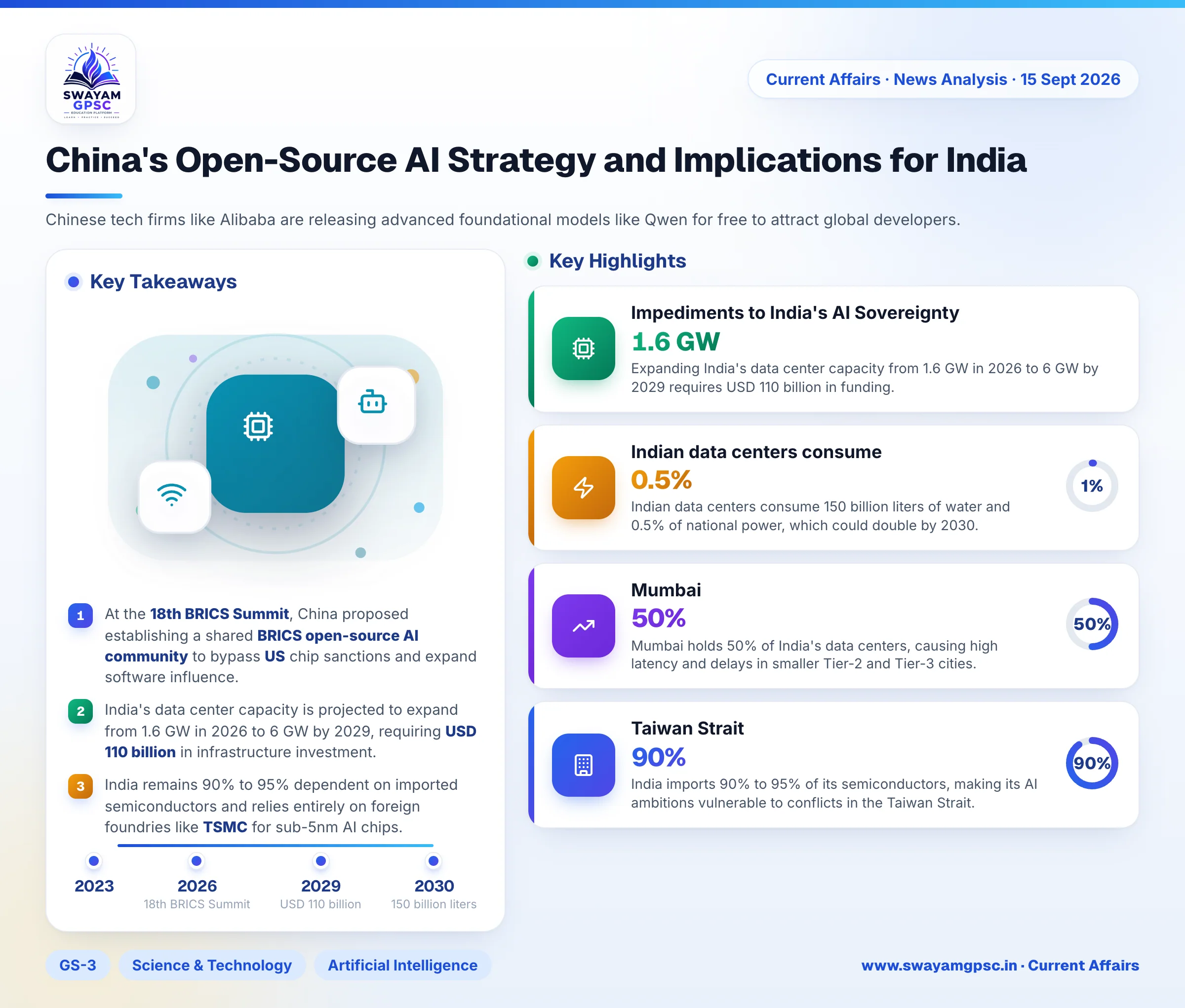
- At the 18th BRICS Summit, China proposed establishing a shared BRICS open-source AI community to bypass US chip sanctions and expand software influence.
- India's data center capacity is projected to expand from 1.6 GW in 2026 to 6 GW by 2029, requiring USD 110 billion in infrastructure investment.
- India remains 90% to 95% dependent on imported semiconductors and relies entirely on foreign foundries like TSMC for sub-5nm AI chips.
- To protect its digital autonomy, India is implementing the ₹10,300 crore IndiaAI Mission to build sovereign models and indigenous GPU computing power.
Why in News
- During the 18th BRICS Summit held in New Delhi in September 2026, China proposed creating a shared BRICS open-source AI community.
China's Open-Source AI Strategy
- China offered to lead the BRICS AI initiative by providing shared large language models (LLMs) and a dedicated cloud platform.
- Strict US semiconductor bans restrict China from dominating chip hardware, so Beijing focuses on dominating the software layer instead.
- Chinese tech firms like Alibaba are releasing advanced foundational models like Qwen for free to attract global developers.
- By sharing open-weight models like DeepSeek, China mimics the Android strategy to establish its software as default global infrastructure.
Implications for India
- Joining a China-led AI network risks shifting India's reliance from US proprietary models to Chinese systems with hidden data practices.
- India promotes democratic digital values, whereas China mandates that AI models align strictly with state objectives.
- Free foreign open-weight models could harm the commercial viability of Indian AI startups like Sarvam and BharatGen.
Impediments to India's AI Sovereignty
- Expanding India's data center capacity from 1.6 GW in 2026 to 6 GW by 2029 requires USD 110 billion in funding.
- Indian data centers consume 150 billion liters of water and 0.5% of national power, which could double by 2030.
- Mumbai holds 50% of India's data centers, causing high latency and delays in smaller Tier-2 and Tier-3 cities.
- India imports 90% to 95% of its semiconductors, making its AI ambitions vulnerable to conflicts in the Taiwan Strait.
- The India Semiconductor Mission (ISM) attracted USD 20 billion, but India still relies on TSMC for sub-5nm AI chips.
- The Digital Personal Data Protection (DPDP) Act, 2023 creates regulatory unpredictability for cross-border data flows and foreign cloud investments.
- The Copyright Act, 1957 lacks clear rules regarding fair use of copyrighted data for training generative AI models.
Way Forward
- India should fast-track the ₹10,300 crore IndiaAI Mission to build sovereign models on diverse datasets through initiatives like Bhashini.
- The government must expand public-private partnerships to build domestic GPU clusters and reduce reliance on foreign cloud servers.
- India should extend its Digital Public Infrastructure (DPI) model, similar to UPI, to offer democratic open-source AI tools globally.
- India can secure chip supply chains by strengthening partnerships like iCET with the US and the Quad semiconductor initiative.
- India should use global platforms like G20 and GPAI to set ethical governance rules for risks like agentic misalignment.
- Updating NEP 2020 and upgrading Atal Tinkering Labs (ATLs) will help build an AI-ready workforce.
Conclusion
- India must balance rapid AI adoption with technological self-reliance by building sovereign compute capacity and transparent digital infrastructure.