Minimum Support Price: Financial Challenges and Alternative Support Models
#GS-3 #GS-2 #Economy #Agriculture #Governance & Social Justice #Government Policies & Interventions #Food Security
Key takeaways
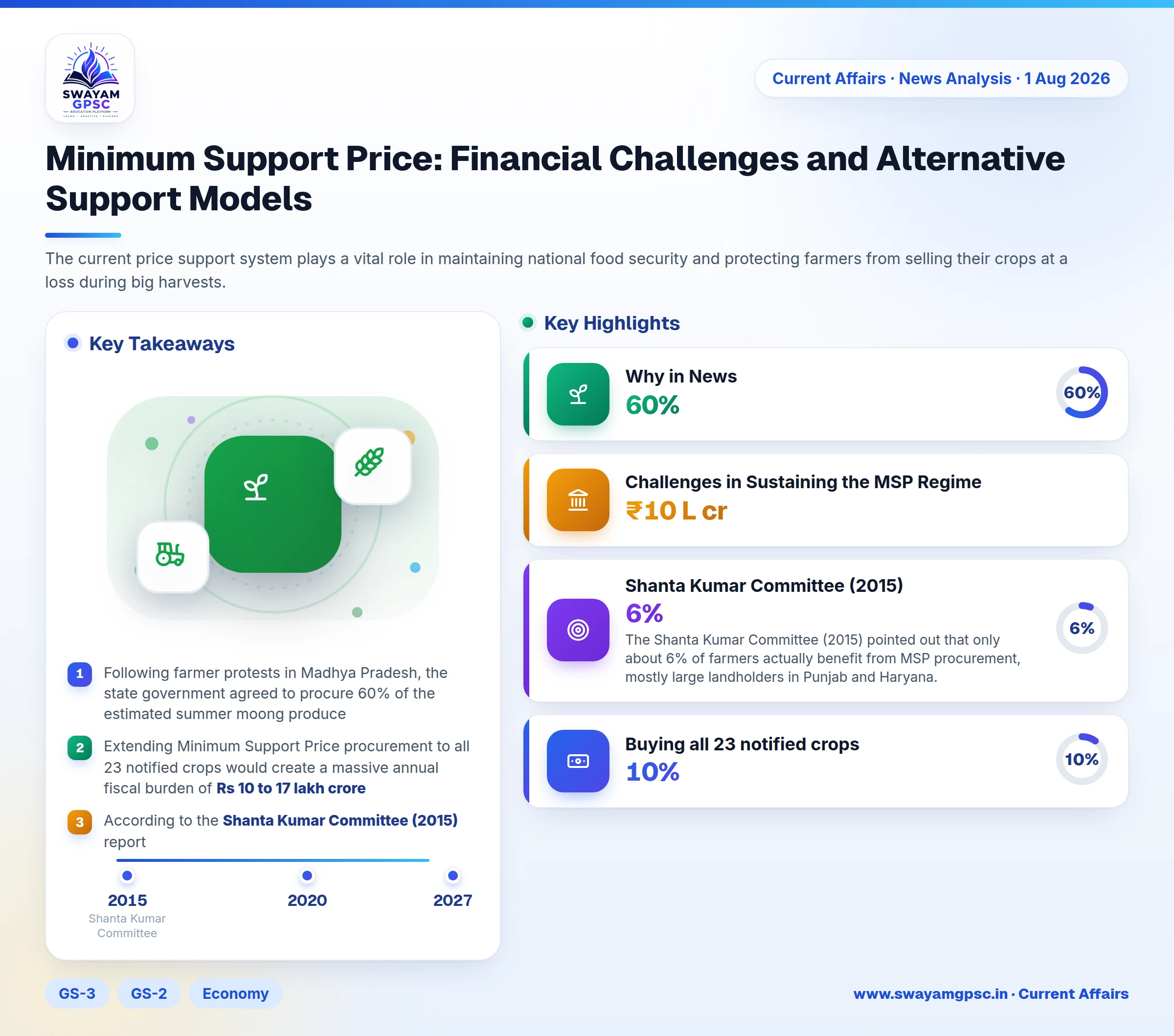
- Following farmer protests in Madhya Pradesh, the state government agreed to procure 60% of the estimated summer moong produce, up from the earlier 25% cap.
- Extending Minimum Support Price procurement to all 23 notified crops would create a massive annual fiscal burden of Rs 10 to 17 lakh crore for the government.
- According to the Shanta Kumar Committee (2015) report, only about 6% of Indian farmers currently receive benefits from official MSP procurement operations.
- India aims to end pulse imports by 2027 by guaranteeing 100% state procurement of key pulses through the 2028-29 season.
- During the 2024-25 marketing year, nationwide MSP foodgrain procurement expanded to reach over 1.84 crore farmers.
Why in News
- Farmer protests in Madhya Pradesh regarding the procurement of summer moong recently ended after the state government agreed to buy 60% of the produce, up from the previous 25% cap.
- This event has restarted the debate on the long-term financial viability of India's Minimum Support Price (MSP) framework and the urgent need for structural agricultural reforms.
Overview of the MSP Regime
- The current price support system plays a vital role in maintaining national food security and protecting farmers from selling their crops at a loss during big harvests.
- However, expanding government procurement faces serious challenges due to high financial costs, market distortions, environmental damage, storage problems, and international trade rules.
- A lasting solution requires moving away from pure price support toward direct financial support using measures like Minimum Income Support (MIP), market reforms, and climate-resilient farming.
Challenges in Sustaining the MSP Regime
- Buying all 23 notified crops at MSP would cost the government between Rs 10 lakh crore and Rs 17 lakh crore every year, leaving little money for irrigation, research, and storage infrastructure.
- Setting a legal price floor distorts open markets, discourages private traders from participating, and forces the government to become the main buyer.
- The repeal of the farm laws in 2020 reduced opportunities for direct private contracts, making farmers depend even more on government procurement.
- Assured buying for rice and wheat encourages single-crop farming, which prevents farmers from switching to pulses, oilseeds, and vegetables.
- Growing water-heavy paddy in dry regions like Punjab and Haryana causes heavy environmental harm by lowering groundwater levels, damaging soil quality, and causing stubble burning.
- The Shanta Kumar Committee (2015) pointed out that only about 6% of farmers actually benefit from MSP procurement, mostly large landholders in Punjab and Haryana.
- Massive buying creates excessive grain stocks, forcing agencies like the Food Corporation of India (FCI) to store grain far beyond buffer norms, leading to higher costs and waste.
- Official MSP calculations rely on old cost data, failing to reflect sudden increases in the prices of fertilizers, diesel, labor, and machinery.
- Aggressive price guarantees risk violating global trade rules under the WTO Agreement on Agriculture (AoA) by exceeding the allowed 10% limit for trade-distorting domestic support.
Understanding the MSP Framework and Mechanism
- The Minimum Support Price (MSP) is a guaranteed price floor announced by the central government before sowing season to protect farmers from sharp price crashes.
- The Commission for Agricultural Costs and Prices (CACP) recommends MSP rates after reviewing cultivation costs and market trends, while final approval comes from the Cabinet Committee on Economic Affairs (CCEA).
- To calculate production costs, the CACP includes both direct cash expenses and the estimated value of unpaid family labor.
- The central government currently sets official MSPs for 22 mandated crops along with a Fair and Remunerative Price (FRP) for sugarcane.
- State-backed agencies like FCI, NAFED, and the Cotton Corporation of India (CCI) handle the actual buying and storage of agricultural produce.
- The basic A2 cost covers direct paid-out expenses like seeds, fertilizers, fuel, and labor, while the A2+FL metric adds the calculated financial value of unpaid family labor.
- Since the 2018-19 season, the government sets the MSP at a minimum of 1.5 times the A2+FL cost, giving farmers an assured 50% return above expenses.
- The National Commission on Farmers, led by Dr. M.S. Swaminathan, suggested setting MSPs 50% above the comprehensive C2 cost, but the government rejected this due to heavy fiscal costs.
- Digital portals like e-Samriddhi and e-Samyukti allow pulse and oilseed growers to register using land records and receive direct bank payments.
- The CCI developed the Kapas Kisan App to help cotton farmers manage slot bookings, track quality reports, and view payment updates.
- To eliminate pulse imports by 2027, the government has committed to procuring 100% of state production for key pulses through 2028-29.
- Overall government procurement expanded during 2024-25, offering direct benefits to over 1.84 crore farmers across the country.
Way Forward: Alternative Support Systems for Farmers
- The government should establish Minimum Income Support (MIP) using direct per-acre cash transfers alongside higher financial payouts through PM-KISAN.
- Expanding the Price Deficiency Payment System under PM-AASHA can pay farmers the difference when market prices fall below MSP, avoiding physical grain buying and storage.
- Public spending must focus on building infrastructure through the Agriculture Infrastructure Fund (AIF), cold storage chains, and expanding the e-NAM trading platform.
- Promoting Farmer Producer Organisations (FPOs) can strengthen the bargaining power of small farmers, lower input costs, and help them get better prices.
- Agricultural planning should encourage farmers to grow pulses, oilseeds, and millets like Shree Anna to preserve natural resources and cut import bills.
- Encouraging contract farming with strong legal protection gives farmers price stability, reduces market risks, and brings private technology to farms.
- Research investments should focus on high-yield seeds, the Soil Health Card Scheme, and micro-irrigation under Per Drop More Crop.
- Government buying should target essential crops and needy areas, while allowing individual states to design local procurement rules.
- India should gradually replace price support subsidies with WTO-approved Green Box income support and infrastructure funding.
Conclusion
- A long-term solution for agriculture requires moving from price guarantees to direct income support through Minimum Income Support (MIP), backed by market reforms, crop insurance, and modern rural infrastructure.