International Criminal Court Faces Growing Pressure and Member Withdrawals
#GS-2 #Current Events #International #Governance & Social Justice #Bilateral Groupings & Agreements #Quick Facts For Prelims
Key takeaways
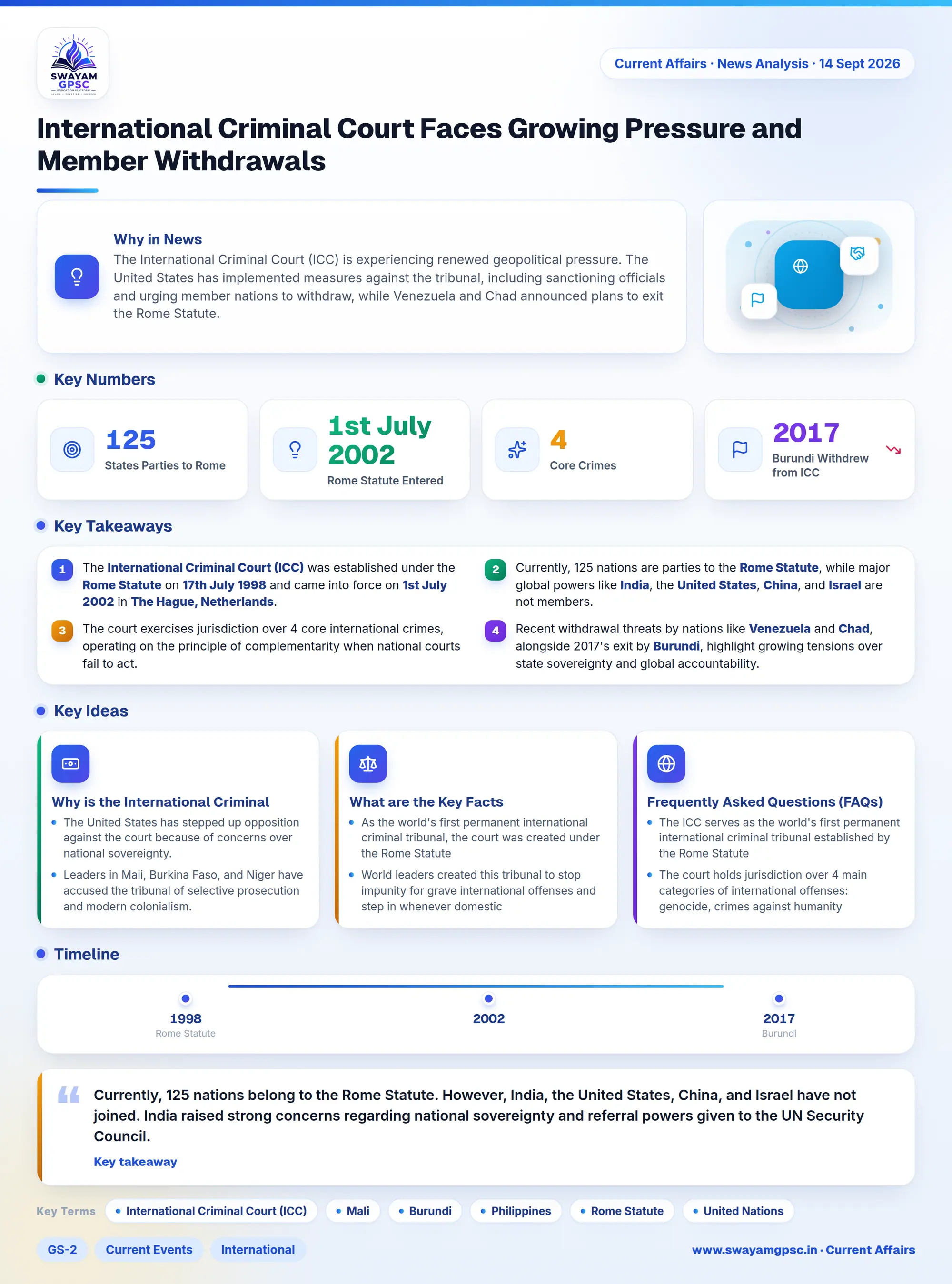
- The International Criminal Court (ICC) was established under the Rome Statute on 17th July 1998 and came into force on 1st July 2002 in The Hague, Netherlands.
- Currently, 125 nations are parties to the Rome Statute, while major global powers like India, the United States, China, and Israel are not members.
- The court exercises jurisdiction over 4 core international crimes, operating on the principle of complementarity when national courts fail to act.
- Recent withdrawal threats by nations like Venezuela and Chad, alongside 2017's exit by Burundi, highlight growing tensions over state sovereignty and global accountability.
Why in News
- The International Criminal Court (ICC) is experiencing renewed geopolitical pressure. The United States has implemented measures against the tribunal, including sanctioning officials and urging member nations to withdraw, while Venezuela and Chad announced plans to exit the Rome Statute.
- These ongoing actions have deepened global concerns regarding the legitimacy, universal acceptance, and practical success of the global criminal justice system.
Why is the International Criminal Court (ICC) Facing Growing Withdrawal Pressure?
- The United States has stepped up opposition against the court because of concerns over national sovereignty. This backlash follows tribunal investigations into U.S. military personnel in Afghanistan and Israeli leaders regarding the Gaza conflict.
- Leaders in Mali, Burkina Faso, and Niger have accused the tribunal of selective prosecution and modern colonialism. They claim the court targets African nations far more often than Western powers.
- In 2017, Burundi became the first nation to officially leave the court. Country leaders criticized what they saw as biased attention toward African regional conflicts.
- These state exits reflect a fundamental clash between global legal accountability and traditional principles of national sovereignty and non-interference.
- Withdrawing from the tribunal does not automatically cancel its legal authority over crimes committed during membership. For example, investigations continued in the Philippines even after the nation withdrew.
What are the Key Facts About the International Criminal Court (ICC)?
- As the world's first permanent international criminal tribunal, the court was created under the Rome Statute, adopted on 17th July 1998, and brought into force on 1st July 2002 in The Hague, Netherlands.
- World leaders created this tribunal to stop impunity for grave international offenses and step in whenever domestic legal institutions fail.
- The tribunal operates independently from the United Nations, although the UN Security Council retains authority to refer cases to it.
- The court holds legal authority over 4 core crimes: genocide, crimes against humanity, war crimes, and aggression.
- The court tries individual citizens rather than nation states for offenses committed after 1st July 2002. It works on complementarity, meaning it acts only when local authorities cannot or will not prosecute.
- The tribunal holds territorial authority over crimes committed in member states or by citizens of member states. It can also act in non-member states if the UN Security Council refers the situation.
- Currently, 125 nations belong to the Rome Statute. However, India, the United States, China, and Israel have not joined. India raised strong concerns regarding national sovereignty and referral powers given to the UN Security Council.
- The organization relies on 4 main branches: the Presidency, Judicial Divisions, Office of the Prosecutor, and Registry. The Assembly of States Parties oversees legislation and governance.
- Because the tribunal lacks its own police force, it relies entirely on member countries to arrest suspects, freeze financial assets, and enforce sentences.
- A major weakness of the court is its dependence on international cooperation. Enforcement becomes extremely difficult when sovereign states refuse to help or when powerful nations stay outside the treaty.
Frequently Asked Questions (FAQs)
- The ICC serves as the world's first permanent international criminal tribunal established by the Rome Statute to prosecute individuals who commit grave global crimes.
- The court holds jurisdiction over 4 main categories of international offenses: genocide, crimes against humanity, war crimes, and the crime of aggression.
- The court prosecutes specific individual persons rather than whole nation-states for core international crimes.
- Complementarity means the court acts as a final backup option, stepping in only when national court systems fail or refuse to investigate crimes properly.
- The court can investigate non-member nationals if the crime occurred inside a member state's territory, involved a member state citizen, or was referred by the UN Security Council.