India-UK Economic and Trade Agreement Comes into Force
#GS-2 #Indian Society #Effects of Globalization #GS-3 #Economy #Growth #Employment #Current Events #International #National #India-UK Relations #Free Trade Agreement #CETA
Why in News
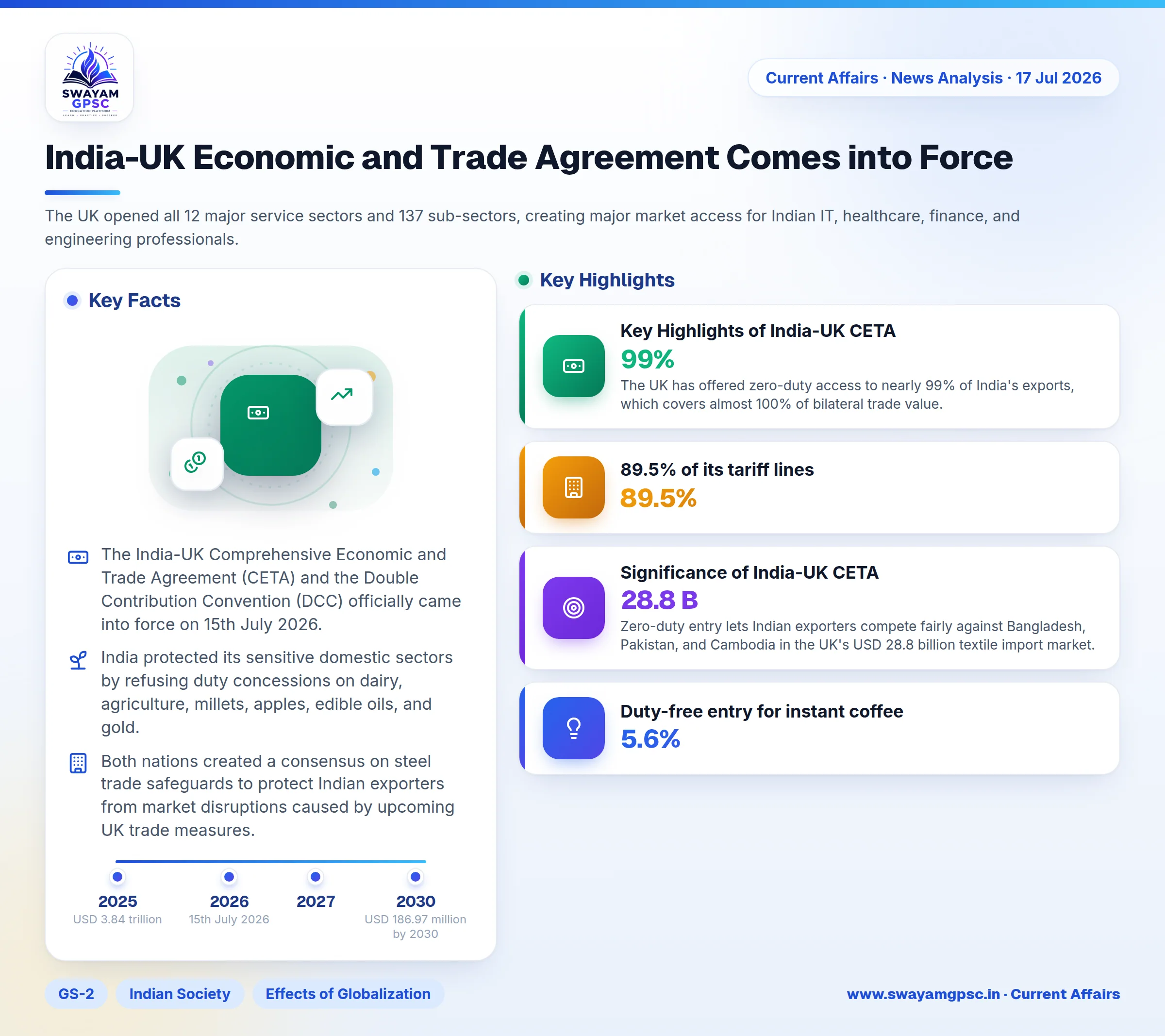
- The **India-UK Comprehensive Economic and Trade Agreement (CETA)** and the **Double Contribution Convention (DCC)** officially came into force on **15th July 2026**.
Summary
- The agreement significantly enhances bilateral trade by opening market access, strengthening services, encouraging investments, and helping professional mobility while protecting India's sensitive sectors.
- Its ultimate success relies on tackling non-tariff barriers, navigating carbon taxation, preparing **MSMEs**, and ensuring efficient implementation to boost India's place in global supply chains.
Key Highlights of India-UK CETA
- The UK has offered **zero-duty access to nearly 99% of India's exports**, which covers **almost 100% of bilateral trade value**.
- India gave tariff reductions on **89.5% of its tariff lines**, covering **91% of UK exports**, with **24.5% of UK exports receiving immediate duty-free access** while the rest phase in gradually.
- India protected its sensitive domestic sectors by refusing duty concessions on **dairy, agriculture, millets, apples, edible oils, and gold**.
- The UK opened all **12 major service sectors** and **137 sub-sectors**, creating major market access for Indian IT, healthcare, finance, and engineering professionals.
- Both nations created a consensus on steel trade safeguards to protect Indian exporters from market disruptions caused by upcoming UK trade measures.
- CETA establishes clear rules for professional mobility while barring hidden numerical limits and arbitrary tests that require proof of local worker unavailability.
- Tariff cuts for products covered under **Make in India** and the **PLI Scheme** are spread across **5, 7, and 10 years** to give domestic manufacturing room to expand.
- India allowed phased quota-based market access for vehicles, delaying duty cuts on affordable **EVs** until **Year 6** so Indian companies can build competitive capability.
Significance of India-UK CETA
- Zero-duty entry lets Indian exporters compete fairly against Bangladesh, Pakistan, and Cambodia in the UK's **USD 28.8 billion textile import market**.
- Duty-free entry for instant coffee supports Indian value-added products in a country that consumes **5.6% of India's tea exports, 2.9% of spice exports, and 1.7% of coffee exports**.
- Tariff removal opens the UK's **USD 4.9 billion marine products market** to Indian seafood exporters and supports coastal communities.
- Zero duties will boost engineering shipments toward **over USD 7.5 billion by 2029-30** while helping exports of smartphones, optical fiber cables, and IT services.
- Duty removal helps India sell more goods in the UK's **USD 30 billion pharmaceutical** and **USD 35.8 billion chemical** import markets.
- Free tariff entry lowers costs for Indian plastic products, strengthening India's position as the **13th largest supplier of plastics to the UK**.
- Tax elimination will raise sports goods and toy exports by **15%**, targeting **USD 186.97 million by 2030** to compete against China and Vietnam.
- Lower duties and streamlined processes improve the competitive position of Indian oilseed exporters in the British market.
- Duty-free clearance into the UK's **USD 8.9 billion leather market** strengthens India against competitors like Vietnam, Indonesia, and Bangladesh while generating factory employment.
- Tax removal on seafood enhances profit margins and expands processing activities in coastal states including **Andhra Pradesh, Kerala, Gujarat, Tamil Nadu, Odisha, and West Bengal**.
- The agreement promotes technology-neutral innovation across sectors and aids farming producers in **Andhra Pradesh, Tamil Nadu, Punjab, Maharashtra, Gujarat, Kerala, and the North Eastern States**.
- Lowered duties are expected to **double India's jewellery exports within 2 to 3 years**, boosting employment in manufacturing hubs like Surat, Jaipur, and Mumbai.
- Expanded tariff-free quotas protect Indian steel manufacturers from UK import limits while retaining market share.
What is the Double Contribution Convention (DCC)?
- The DCC is an agreement created to stop double social security payments for temporary workers traveling between India and the UK.
- The agreement extends the usual **12-month** National Insurance contribution exemption window for temporary foreign workers up to **60 months (5 years)**.
- The pact does not work retrospectively, so Indian workers present in the UK right before **15th July 2026** must continue paying UK social security taxes.
- Relieved employees must obtain a Certificate of Coverage from India's **Employees' Provident Fund Organisation (EPFO)** to confirm ongoing participation in India's social system.
- This convention will aid more than **75,000 Indian professionals and 900 companies**, saving over **USD 600 million annually** and driving the transformation of Indian units into **Global Capability Centres (GCCs)**.
Current Status of India-UK Bilateral Trade
- By 2025, **India's GDP reached USD 3.96 trillion** while the UK economy reached **USD 3.84 trillion**, demonstrating their immense economic roles.
- In fiscal year 2025-26, goods trade hit **USD 25.12 billion**, where India exported **USD 13.44 billion** and imported **USD 11.68 billion**, producing a **USD 1.76 billion trade surplus** for India.
- Services trade reached **USD 35.44 billion** in 2024, with Indian exports of **USD 21.66 billion** against imports of **USD 13.78 billion**, yielding a **USD 7.88 billion services surplus** for India.
- The **UK is India's 6th largest foreign investor with USD 35 billion in equity (up to Sept 2024)**, while Indian investment in the UK reached **USD 19 billion (up to March 2024)** across **over 971 companies** employing **over 1 lakh people**.
Challenges
- Strict **Sanitary and Phytosanitary (SPS)** rules, technical norms, and complex safety certifications may hinder market access for **MSMEs** alongside chemical, farm, and engineering sellers.
- Starting in **2027**, the UK's **Carbon Border Adjustment Mechanism (CBAM)** will impose taxes on carbon-dense goods like steel, aluminium, cement, and fertilizers, hurting India's export pricing.
- Lower import duties risk third-country items bypassing origination constraints to reach India through the UK, which could damage **Make in India** and the **PLI Scheme**.
- Rigid rules of origin require detailed paperwork and tracking, creating high compliance costs for small businesses wanting lower tariffs.
- Concessions on labor movement stay constrained, offering minimal visa relaxation despite the **Double Contribution Convention (DCC)** and keeping strict limits on service professionals.
- Exporters who lack knowledge about treaty rules and certification processes may fail to take full advantage of CETA provisions.
Way Forward
- India should upgrade testing labs, certification bodies, and product tracking to satisfy UK **SPS** criteria while resolving trade disputes through the **CETA Joint Committee**.
- Indian manufacturers must rapidly decarbonize production processes, as clean manufacturing offers the best defense against global climate-related trade levies.
- Setting up **MSME Trade Facilitation Centres** alongside paperless customs and **Authorised Economic Operator (AEO)** mechanisms will ease operational compliance for smaller units.
- Accelerating **Mutual Recognition Agreements (MRAs)** will expand services trade into high-tech domains like **AI**, cybersecurity, and data analytics.
- Authorities must enforce **Rules of Origin** rigorously to block third-party circumvention and apply **safeguard measures** whenever domestic industries face import distress.
Conclusion
- The **India-UK CETA** represents a decisive turn toward proactive, high-value trade integration with Western economies. Long-term gains will depend on domestic regulatory upgrades that overcome non-tariff hurdles and carbon import taxes.
Frequently Asked Questions (FAQs)
- What is the **India-UK CETA**? It is a comprehensive free trade deal boosting two-way commerce through tariff reductions, open services access, investment rules, and talent mobility while shielding vulnerable Indian sectors.
- What is the **Double Contribution Convention (DCC)**? It eliminates double social security payments for eligible professionals temporarily relocated to the UK for up to **5 years**, lowering costs for employers and increasing employee take-home pay.
- What are the main advantages of **CETA**? The agreement delivers zero-tariff access for most Indian exports, opens service industries, supports employment-intensive factories, attracts overseas capital, and integrates India into global manufacturing networks.
- What are the chief implementation obstacles for **CETA**? Key challenges involve **Non-Tariff Barriers (NTBs)**, the UK's **Carbon Border Adjustment Mechanism (CBAM)**, strict **Rules of Origin**, limited **MSME** adoption, and restricted visa allowances.
- How can India maximize benefits from **CETA**? India should modernize laboratory testing, educate **MSME** exporters, complete **Mutual Recognition Agreements (MRAs)**, uphold origination rules, decarbonize factories, and work closely through the **CETA Joint Committee**.