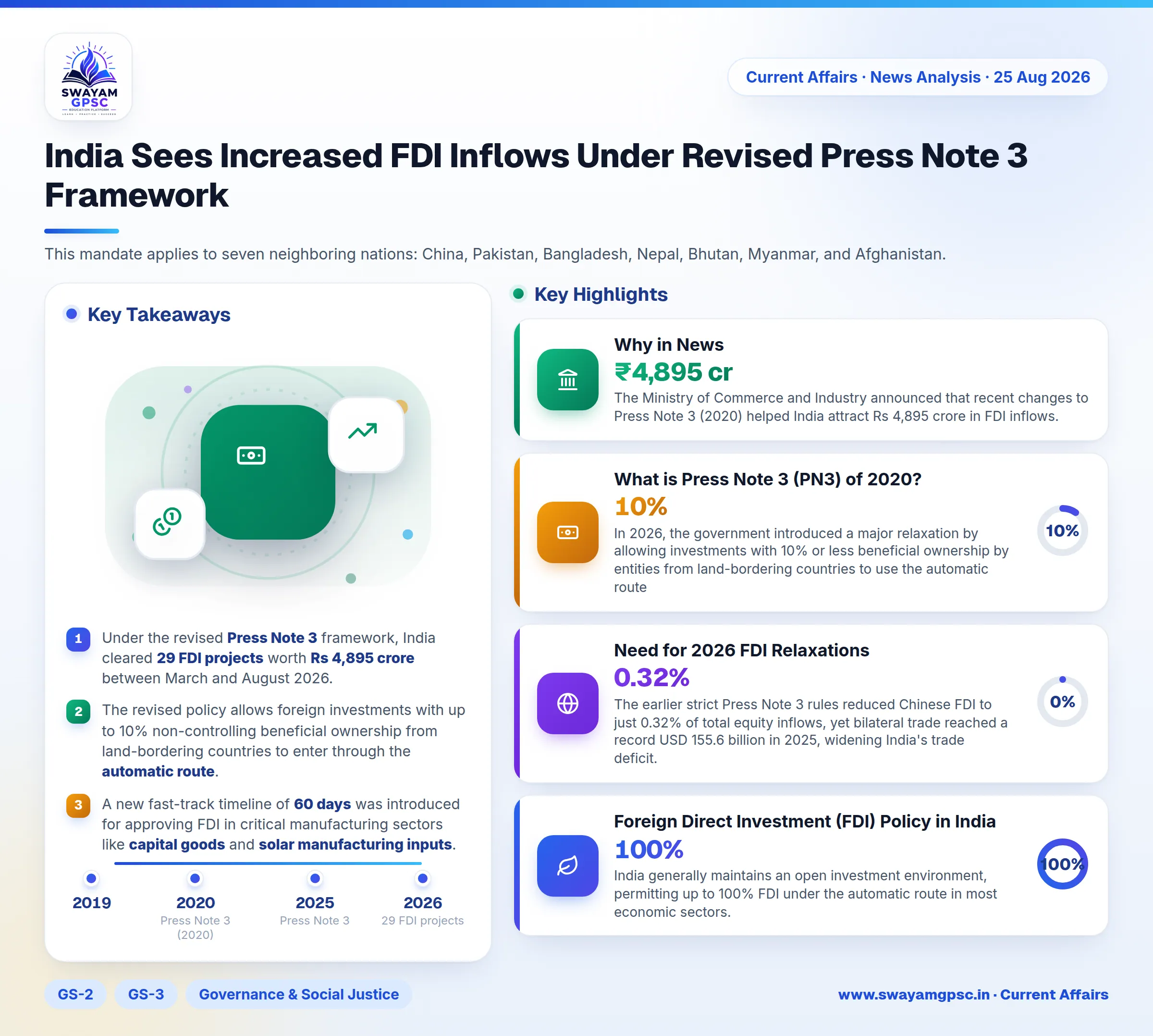
India Sees Increased FDI Inflows Under Revised Press Note 3 Framework
#GS-2 #GS-3 #Governance & Social Justice #Economy #Foreign Direct Investment #Government Policies & Interventions #National #Liberalization
Key takeaways
- Under the revised Press Note 3 framework, India cleared 29 FDI projects worth Rs 4,895 crore between March and August 2026.
- The revised policy allows foreign investments with up to 10% non-controlling beneficial ownership from land-bordering countries to enter through the automatic route.
- A new fast-track timeline of 60 days was introduced for approving FDI in critical manufacturing sectors like capital goods and solar manufacturing inputs.
- India relaxed these rules to help offset its trade deficit with China, which reached a record USD 155.6 billion in 2025.
Why in News
- The Ministry of Commerce and Industry announced that recent changes to Press Note 3 (2020) helped India attract Rs 4,895 crore in FDI inflows.
- Between March and August 2026, the government approved 29 FDI projects under these updated rules, showing that easing restrictions is helping the economy grow.
What is Press Note 3 (PN3) of 2020?
- The Department for Promotion of Industry and Internal Trade (DPIIT) issued Press Note 3 in 2020 to control foreign investments coming from countries that share a land border with India.
- Under this rule, any foreign company from a neighboring country, or any firm where the beneficial owner resides in such a country, must get prior government approval before investing.
- This mandate applies to seven neighboring nations: China, Pakistan, Bangladesh, Nepal, Bhutan, Myanmar, and Afghanistan.
- The main goal in 2020 was to stop foreign entities from taking over weak Indian companies during the Covid-19 pandemic, particularly targeting capital flows from China.
- In 2026, the government introduced a major relaxation by allowing investments with 10% or less beneficial ownership by entities from land-bordering countries to use the automatic route, provided they do not hold management control.
- This new ownership limit matches the standards defined under the Prevention of Money Laundering Act (PMLA).
- The government also created a fast-track approval process of 60 days for key sectors such as capital goods, electronic components, and solar manufacturing inputs like polysilicon and ingot-wafer, provided Indian residents hold majority ownership.
- To give these changes immediate legal strength, the Ministry of Finance issued the Foreign Exchange Management (Non-debt Instruments) Amendment Rules, 2026.
Need for 2026 FDI Relaxations
- The 2023-24 Economic Survey suggested that India can benefit from the China Plus One strategy by attracting controlled foreign direct investment instead of relying purely on imports.
- Allowing regulated FDI helps Indian manufacturing build local capacity, transfer technology, and create more value inside the country rather than just assembling imported parts.
- The earlier strict Press Note 3 rules reduced Chinese FDI to just 0.32% of total equity inflows, yet bilateral trade reached a record USD 155.6 billion in 2025, widening India's trade deficit.
- Relaxing investment rules encourages companies to produce goods locally in India rather than importing finished items from abroad.
- Key industries like electronics, semiconductors, solar modules, and battery components still rely heavily on components from neighboring markets, making foreign investment crucial for the Production Linked Incentive (PLI) scheme.
- The strict rules had created confusion for global PE/VC funds that contained small Chinese investors, but the new 10% threshold gives these investment funds clear guidelines.
- Following border disengagement agreements along the Line of Actual Control (LAC), diplomatic talks opened up space for a careful economic adjustment while protecting national security.
Foreign Direct Investment (FDI) Policy in India
- The DPIIT is the main authority that drafts India's FDI policy and tracks total capital flows using data provided by the RBI.
- India regulates all foreign direct investments under the Foreign Exchange Management Act (FEMA), 1999 along with the FEMA Non-Debt Instruments Rules, 2019.
- India generally maintains an open investment environment, permitting up to 100% FDI under the automatic route in most economic sectors.
- Foreign investors can buy shares or convertible debentures through the Automatic Route, where they simply notify the RBI after completing the transaction.
- Key sectors using the automatic route include agriculture, air transport services, auto components, automobiles, and greenfield biotechnology.
- Other sensitive sectors require prior approval under the Government Approval Route from the designated ministry before any money enters the country.
- Sectors requiring government approval include banking, public sector enterprises, broadcasting content, food products retail, and digital news streaming.
- The government regularly reviews its FDI framework to reduce bureaucratic delays and improve India's position on the Ease of Doing Business index.
- Strict screening mechanisms remain in place for sensitive sectors and investments originating from countries sharing a land border with India.
- The primary goals of India's FDI policy are to bring in capital, promote technological innovation, create jobs, expand domestic manufacturing, and link Indian firms to global supply chains.
Frequently Asked Questions
- Press Note 3 requires prior government clearance for any investment coming from countries sharing a land border with India or from companies owned by entities in those nations.
- The key reform in 2026 allows foreign investors from land-bordering countries to use the automatic route if their non-controlling beneficial ownership is 10% or less.
- The government established an expedited 60-day approval window for critical sectors like capital goods, electronic components, and solar manufacturing inputs.
- India relaxed these rules to boost domestic manufacturing, attract advanced technology, integrate with global value chains, and lower reliance on direct Chinese imports under the China Plus One strategy.
- Between March and August 2026, the new framework cleared 29 FDI projects worth Rs 4,895 crore, indicating smooth processing for legitimate foreign investments.