India's First Indigenous Non-GMO High-Expansion Popcorn Maize Seed Launched
#GS-3 #Economy #Agriculture #Food Security #Science & Technology #Biotechnology #Current Events #National #Cropping Patterns
Key takeaways
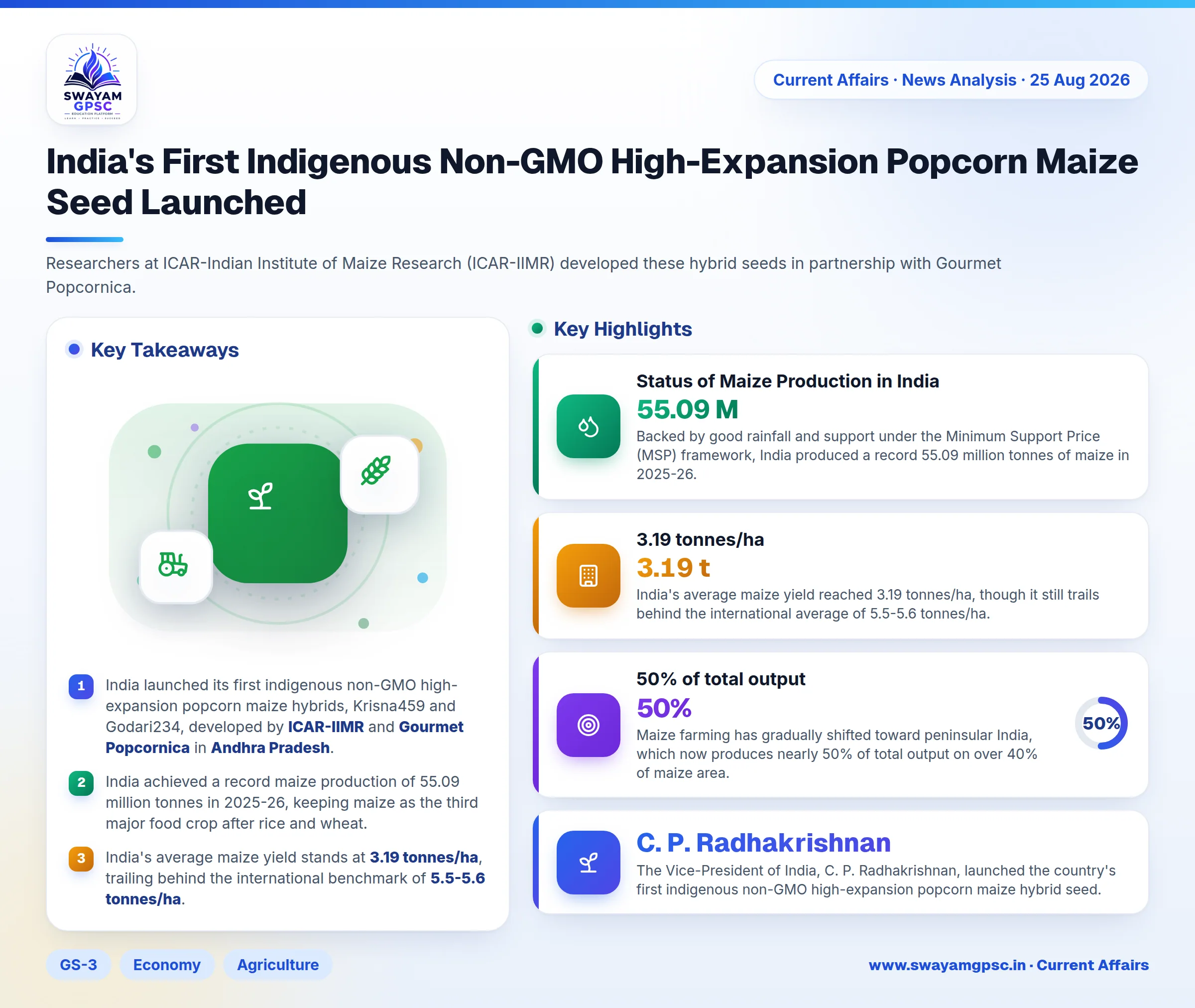
- India launched its first indigenous non-GMO high-expansion popcorn maize hybrids, Krisna459 and Godari234, developed by ICAR-IIMR and Gourmet Popcornica in Andhra Pradesh.
- India achieved a record maize production of 55.09 million tonnes in 2025-26, keeping maize as the third major food crop after rice and wheat.
- India's average maize yield stands at 3.19 tonnes/ha, trailing behind the international benchmark of 5.5-5.6 tonnes/ha.
- The private-public partnership connects over 17,500 farmers across 8 States covering nearly 40,000 acres of land into a farm-to-market value chain.
Why in News
- The Vice-President of India, C. P. Radhakrishnan, launched the country's first indigenous non-GMO high-expansion popcorn maize hybrid seed.
- The official launch took place at the Gourmet Popcornica processing facility located in Musunuru, Eluru district, Andhra Pradesh.
- This initiative strengthens the vision of Aatmanirbhar Bharat in agriculture by cutting reliance on imported popcorn hybrid technology.
- Developing seeds domestically conserves valuable foreign exchange and builds self-reliance in specialized food crops.
Key Features of the Hybrid Seed
- Researchers at ICAR-Indian Institute of Maize Research (ICAR-IIMR) developed these hybrid seeds in partnership with Gourmet Popcornica.
- The joint effort produced two commercial hybrid varieties named Krisna459 and Godari234.
- Scientists developed these seeds using conventional cross-breeding methods without artificial genetic modifications.
- Because they contain no foreign genetic material, these varieties satisfy strict international standards that demand non-GMO ingredients.
- The kernels expand significantly upon heating, giving them a high expansion ratio vital for commercial popcorn processing.
Significance and Value Chain Integration
- Gourmet Popcornica works directly with over 17,500 farmers across 8 States, covering nearly 40,000 acres of land.
- The model establishes a complete farm-to-market ecosystem equipped with processing, quality testing, cold storage, and packaging facilities.
- This direct integration opens up specialized premium markets for farmers and raises their earning potential.
- The project demonstrates how partnerships between public research bodies and private firms can create globally competitive agricultural value chains.
Popcorn Maize and Popping Mechanism
- Popcorn maize belongs to the scientific family Poaceae under the botanical name Zea mays and is a specialized flint corn variety.
- Each kernel features a tough outer shell that encloses starch and a tiny pocket of moisture.
- Heating the kernel converts its internal moisture into high-pressure steam inside the sealed hull.
- When the hull bursts from pressure, the kernel turns inside out into a soft white popped mass.
Status of Maize Production in India
- Maize ranks as the third most important food crop in India, right after rice and wheat.
- Indian farmers cultivate maize across varied climate zones for human food, animal feed, fodder, and industrial processing.
- Backed by good rainfall and support under the Minimum Support Price (MSP) framework, India produced a record 55.09 million tonnes of maize in 2025-26.
- India's average maize yield reached 3.19 tonnes/ha, though it still trails behind the international average of 5.5-5.6 tonnes/ha.
- Madhya Pradesh stands as the leading maize-producing state, followed by Karnataka, Maharashtra, Bihar, and Telangana.
- Maize farming has gradually shifted toward peninsular India, which now produces nearly 50% of total output on over 40% of maize area.
- Cultivation of Rabi maize is also expanding in states such as Andhra Pradesh, Bihar, Telangana, and West Bengal.