India-China Trade and Atmanirbhar Bharat
#GS-2 #GS-3 #Indian Polity & Constitution #International #Economy #Growth #Infrastructure #Agriculture #Employment #Science & Technology #ICT #Energy #Environment #Sustainable Development
Key takeaways
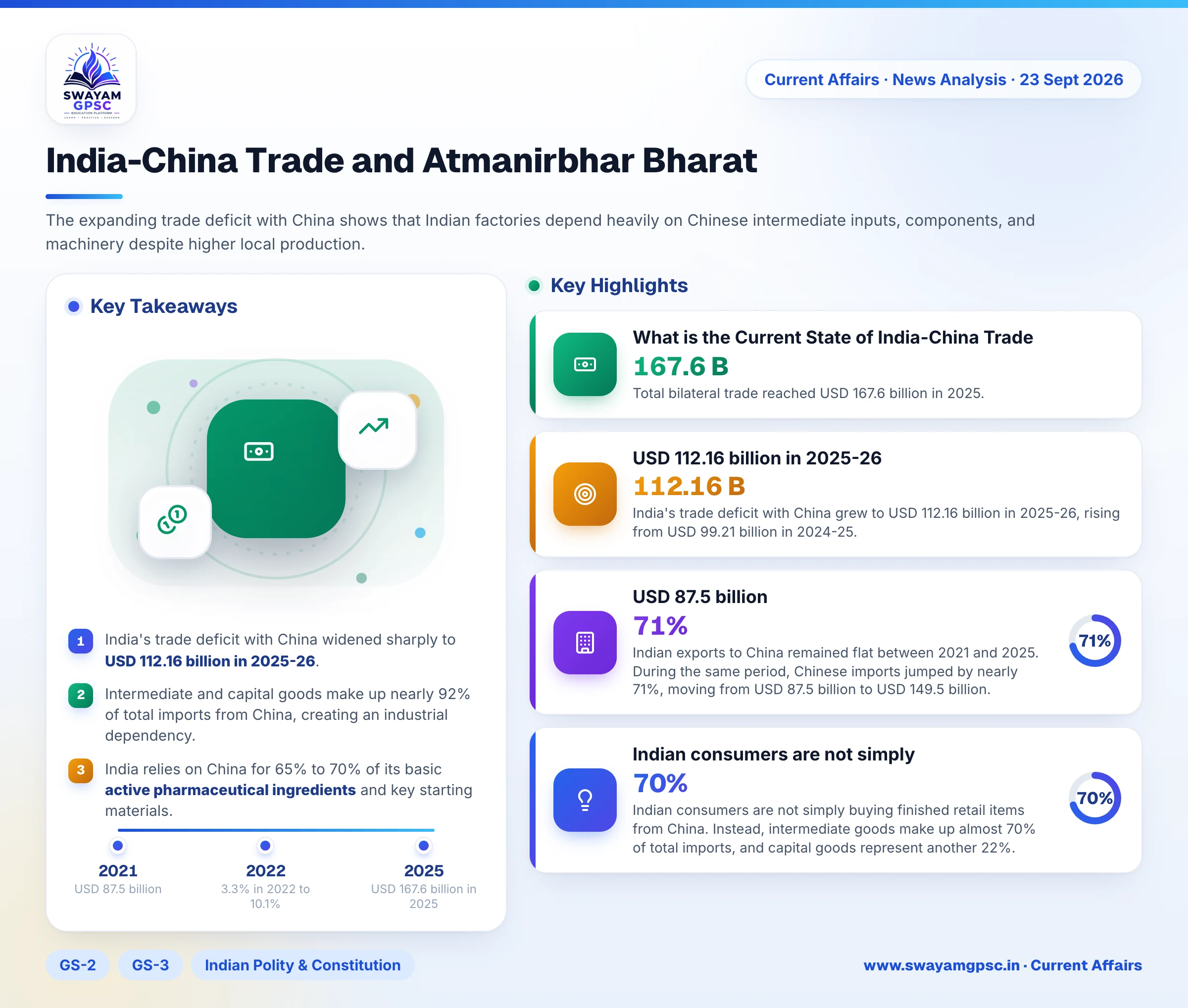
- India's trade deficit with China widened sharply to USD 112.16 billion in 2025-26.
- Intermediate and capital goods make up nearly 92% of total imports from China, creating an industrial dependency.
- India relies on China for 65% to 70% of its basic active pharmaceutical ingredients and key starting materials.
- China controls roughly 90% of global rare earth magnet manufacturing, creating strategic vulnerabilities for Indian industries.
Why in News
- India faces a growing trade deficit with China. This situation reveals a major flaw in the goal of the Atmanirbhar Bharat initiative.
- Domestic manufacturing output is growing rapidly. However, this growth relies heavily on Chinese intermediate goods, parts, and capital equipment.
- As a result, India has fallen into an assembly trap instead of achieving true industrial self-reliance.
Summary
- The expanding trade deficit with China shows that Indian factories depend heavily on Chinese intermediate inputs, components, and machinery despite higher local production.
- Achieving real self-reliance requires moving past mere assembly work through higher local value addition, domestic component production, research and development, MSME growth, and diverse supply chains.
What is the Current State of India-China Trade
- Total bilateral trade reached USD 167.6 billion in 2025.
- India's trade deficit with China grew to USD 112.16 billion in 2025-26, rising from USD 99.21 billion in 2024-25.
- Indian exports to China remained flat between 2021 and 2025. During the same period, Chinese imports jumped by nearly 71%, moving from USD 87.5 billion to USD 149.5 billion.
- Indian consumers are not simply buying finished retail items from China. Instead, intermediate goods make up almost 70% of total imports, and capital goods represent another 22%.
- China supplied 80% or more of India's imports across 636 tariff lines in FY26, compared to 461 tariff lines in FY19, showing deeper control over multiple industrial segments.
- Around 80% of total imports from China focus on just four major groups: electronics, machinery, organic chemicals, and plastics. Electronics alone accounts for roughly USD 38 billion.
Challenges
- Industrial policies like the Production Linked Incentive (PLI) scheme and the Phased Manufacturing Programme expanded downstream assembly operations. However, the lack of a strong local precision-component network keeps India dependent on Chinese supplies.
- In smartphone production, the share of imported parts and sub-assemblies inside the Chinese import basket grew from 3.3% in 2022 to 10.1% in 2025. This proves that domestic value addition remains limited despite higher export numbers.
- India joined the WTO Information Technology Agreement, which cut tariffs on several IT items. At the same time, the lack of strong domestic electronics companies made it hard to compete with Chinese firms.
- Unlike Western trade deficits driven by consumer spending, India's reliance on China is industrial. A sudden total trade cut would shut down Indian factory floors rather than just leave retail shelves empty.
- India sends low-value basic commodities like raw iron ore, cotton, and marine products to China. In return, India imports high-value tech capital goods, which creates an unequal trading relationship.
- India remains the pharmacy of the world. Yet, the country depends on China for 65% to 70% of its basic active pharmaceutical ingredients, intermediates, and key starting materials.
- Older public institutions like Hindustan Antibiotics Limited (1954) and Indian Drugs and Pharmaceuticals Limited (1961) tried to build local API capacity. Their decline later fueled heavy import dependence.
- More than 75% to 80% of solar cells and modules come from China, along with vital parts for electric vehicles (EVs) and lithium-ion battery cells, putting India's climate targets at risk.
- Integrated circuits, telecom hardware, and printed circuit board assemblies make up nearly a quarter of all Chinese imports, leaving the digital economy vulnerable.
- China controls nearly 90% of global rare earth magnet manufacturing, giving a geopolitical rival control over vital strategic chokepoints.
- When China placed export controls on rare earth magnets in April 2025, Indian car manufacturers suffered immediate factory slowdowns.
- Inverted tax structures make raw materials costlier than imported semi-knocked-down kits. This discourages local tier-2 and tier-3 component makers.
- India spends only 0.64% to 0.7% of GDP on research and development. Easy access to cheap Chinese parts discourages firms from investing in local innovation.
- Massive state subsidies, integrated factory clusters, and economies of scale make Chinese parts much cheaper than domestic alternatives.
- Placing high import duties or strict bans on Chinese inputs immediately raises manufacturing costs for Indian factories.
- As a result, finished Indian exports like generic drugs or assembled electronics risk losing price competitiveness in global markets.
- Lower direct imports from China do not always mean lower dependence, because goods often enter through third countries like Hong Kong.
- East Asian economies built strong domestic industries before opening up to trade. In contrast, India opened its markets without building enough manufacturing strength, making it vulnerable.
Way Forward
- Future versions of PLI schemes must stop rewarding simple final assembly. They should directly reward Domestic Value Addition, precision tooling, and local supplier networks.
- Ministries should map value chains closely to find exact missing parts, such as specific mobile ICs or solar cells, and target them for local production.
- India must expand Design-Linked Incentives beyond semiconductors into sectors like telecom and electric vehicles to boost local product design.
- India generated 13.98 lakh tonnes of e-waste in 2024-25, rising from 12.54 lakh tonnes in 2023-24.
- Recycling e-waste, solar panels, and spent EV batteries can recover valuable minerals like lithium and cobalt, cutting import reliance.
- India should practice guarded globalization by using friendshoring and the China Plus One strategy to build trusted supply chains across ASEAN, Japan, South Korea, Europe, and Taiwan.
- Blanket import bans harm local factories. Instead, the government should apply targeted tariffs only on specific components where local substitutes exist.
- India must support tier-2 and tier-3 MSME suppliers by offering shared research facilities, plug-and-play factory clusters, and affordable credit.
- True self-reliance requires moving past assembly work to focus on upstream value addition, component production, research, and supply-chain diversity.