ILO Convention No. 193 on Decent Work in the Platform Economy
#GS-2 #GS-3 #Governance & Social Justice #Indian Society #Economy #Current Events #Employment #Inclusive Growth #Government Policies & Interventions #Gig Economy
Key takeaways
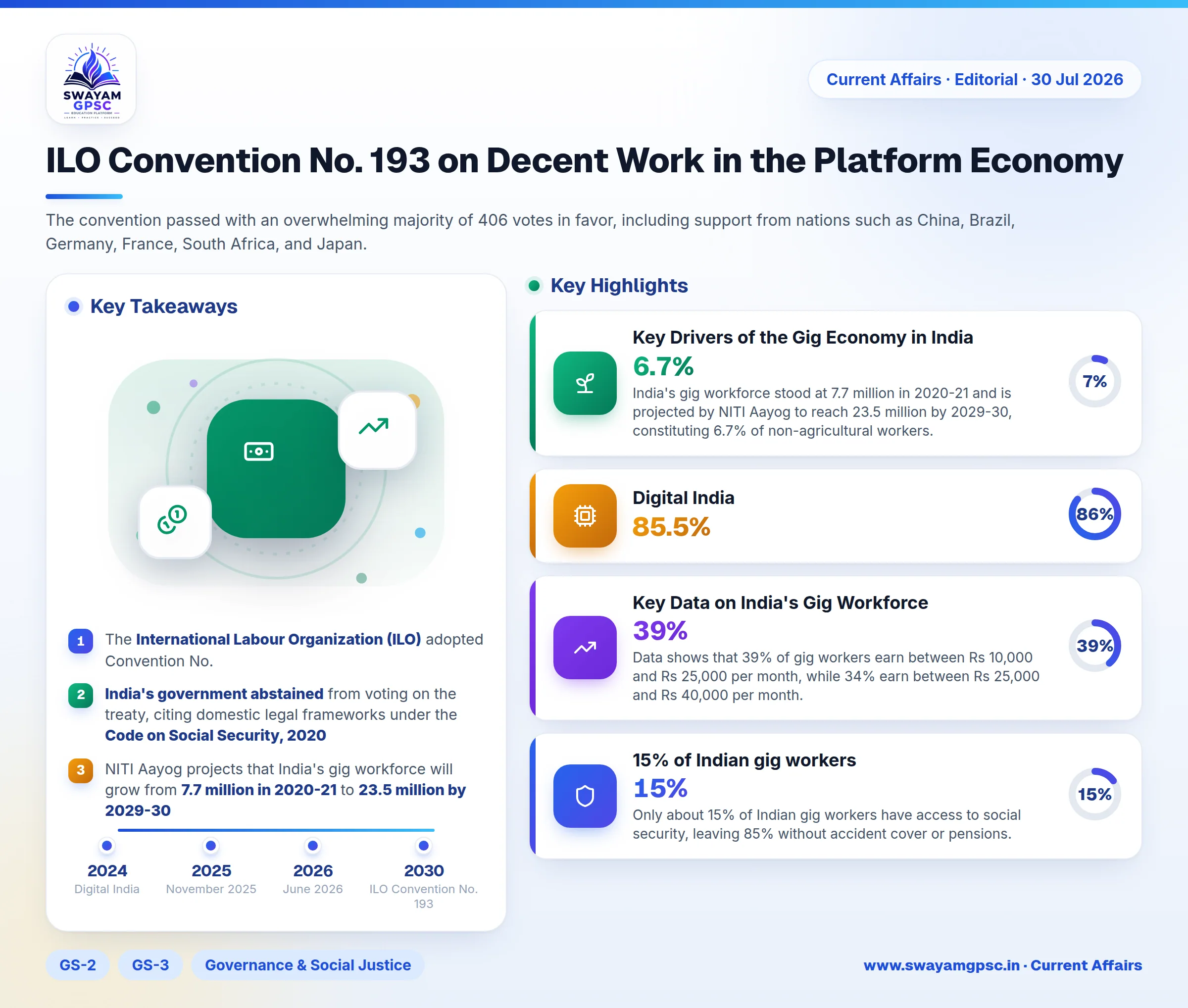
- The International Labour Organization (ILO) adopted Convention No. 193 in June 2026 with 406 votes in favor, establishing the first legally binding global standard for platform workers.
- India's government abstained from voting on the treaty, citing domestic legal frameworks under the Code on Social Security, 2020, federal structure concerns, and potential corporate compliance costs.
- NITI Aayog projects that India's gig workforce will grow from 7.7 million in 2020-21 to 23.5 million by 2029-30, representing 6.7% of non-agricultural workers.
- Although the Code on Social Security, 2020 mandates aggregators to contribute 1% to 2% of annual turnover to a social security fund, implementation rules remain un-operationalized.
- Currently, 85% of Indian gig workers lack social security coverage, while 39% earn between Rs 10,000 and Rs 25,000 per month under demanding 12-hour shifts.
Why in News
- At the 114th International Labour Conference in Geneva, the International Labour Organization (ILO) officially adopted Convention No. 193 titled Decent Work in the Platform Economy.
- The convention passed with an overwhelming majority of 406 votes in favor, including support from nations such as China, Brazil, Germany, France, South Africa, and Japan.
- This treaty serves as the world's first legally binding international instrument designed specifically for app-based gig and platform workers.
- Under the tripartite voting framework of the ILO, India's government delegates abstained, whereas both its employer and worker delegates voted in favor of the treaty.
Overview of ILO Convention No. 193
- Adopted in June 2026, ILO Convention No. 193 establishes a minimum floor of labor rights, including fair wages, social security, and workplace protections regardless of worker classification.
- The treaty guarantees fundamental rights like minimum wages, timely payments, occupational safety, and mandatory social security coverage for all platform workers.
- It introduces the first global standards on algorithmic management, requiring platforms to explain automated decision processes such as work allocation, wage determination, ratings, and account deactivations.
- The convention mandates human oversight in significant automated decisions to ensure fair treatment and prevent arbitrary account suspensions.
- Governments must classify workers based on the actual nature of their daily work rather than contractual labels, preventing companies from misclassifying employees as independent contractors.
Reasons for India's Abstention
- India's government abstained while domestic employer and worker delegates voted in favor, highlighting differing positions within the national delegation.
- Central officials argued that the Code on Social Security, 2020 already provides a comprehensive legal framework for gig and platform workers in the country.
- Under the principle of pre-conformity, India typically ratifies ILO conventions only after domestic administrative frameworks fully align with international standards.
- Because labor falls under the Concurrent List of the Indian Constitution, central authorities preferred retaining flexibility for individual states to frame their own regulations.
- Economic concerns were raised that mandatory worker reclassification and algorithmic transparency rules could increase compliance costs and discourage digital innovation.
Costs and Consequences of India's Abstention
- Abstaining signals to digital aggregators that corporate worker misclassification practices and opaque algorithmic management can continue without strict legal accountability.
- Without ratifying the treaty, Indian gig workers are deprived of an international baseline to legally challenge platform abuses in domestic courts.
- The move creates a stark disparity between platform workers in ratifying nations like China or European states and Indian workers who remain vulnerable to unregulated platform practices.
- Abstaining may appear inconsistent with India's aspiration to serve as a leader and voice for the Global South on critical economic issues.
Key Drivers of the Gig Economy in India
- India's gig workforce stood at 7.7 million in 2020-21 and is projected by NITI Aayog to reach 23.5 million by 2029-30, constituting 6.7% of non-agricultural workers.
- Digital Public Infrastructure expansion under Digital India, including 96.96 crore internet connections in 2024 and smartphone access in 85.5% of households, has enabled large-scale platform work.
- Rapid growth across e-commerce, quick commerce, ride-hailing, and food delivery platforms has created sustained consumer demand for gig workers.
- Rising urban demand for instant on-demand services has expanded opportunities across logistics, transport, and home personal services.
- High underemployment and a large semi-skilled workforce have made gig employment an easily accessible source of daily income.
- Young workers increasingly prefer flexible work schedules, freelance tasks, and multiple income streams over traditional single-employer jobs.
Key Data on India's Gig Workforce
- Data shows that 39% of gig workers earn between Rs 10,000 and Rs 25,000 per month, while 34% earn between Rs 25,000 and Rs 40,000 per month.
- Most gig workers work exhausting 12-hour shifts with self-funded fuel expenses and receive no overtime compensation.
- Only about 15% of Indian gig workers have access to social security, leaving 85% without accident cover or pensions.
- On a global scale, the World Bank estimates that between 154 million and 435 million people earn their living through digital platforms.
India's Domestic Legal Framework and State Initiatives
- Enforced in November 2025, the Code on Social Security, 2020 was among the first national laws to legally define gig workers, platform workers, and aggregators.
- The central law directs aggregators to contribute 1% to 2% of annual turnover, capped at 5% of worker payouts, toward a dedicated social security fund.
- In practice, the central framework remains un-operationalized because authorities have not specified clear benefit amounts or eligibility criteria.
- State governments have taken the lead, with Rajasthan enacting the Platform-Based Gig Workers Act in 2023 to create mandatory registration and transaction fees.
- States like Karnataka and Telangana have drafted dedicated welfare board bills to provide accident cover, health benefits, and grievance redressal.
Challenges and Targeted Measures
- Platforms treat gig workers as independent contractors, denying them statutory minimum wages, paid leave, and regulated working hours.
- Governments should enact dedicated gig worker rights legislation that recognizes an intermediate employment category with guaranteed minimum wages and collective bargaining rights.
- Platforms use opaque algorithms for task allocation, pricing, ratings, and account deactivations without human oversight.
- Regulators must mandate algorithmic transparency by requiring platforms to disclose automated decision rules and provide human review before account deactivations.
- Welfare schemes under the Code on Social Security, 2020 remain non-operational due to delays in notifying implementation details.
- Officials must operationalize the social security fund by enforcing aggregator contributions and linking benefits through the e-Shram Portal.
- Worker earnings fluctuate heavily due to dynamic pricing models, changing platform incentives, and demand uncertainty.
- Authorities should introduce minimum earnings standards through statutory floor wages and transparent surge pricing regulations.
- Gig workers face severe occupational risks without receiving accident insurance, health coverage, or extreme weather protections.
- Platforms must provide mandatory employer-funded health and accident insurance along with climate-resilient safety standards.
- Women gig workers face safety hazards and doorstep harassment without adequate protection mechanisms.
- Platforms must implement safety protocols including verified customer profiles, panic buttons, emergency helplines, and strict complaint resolution.
- A large portion of the gig workforce remains informal and unregistered in official state databases.
- Governments should enforce universal registration on the e-Shram Portal linked to Universal Account Numbers (UAN) for portable benefits.
Way Forward
- Central authorities must immediately notify specific benefit structures and contribution rules to operationalize the Code on Social Security, 2020.
- Regulators should enforce algorithmic transparency by requiring platforms to provide written explanations for suspensions and pay deductions.
- Platforms must establish a mandatory human-in-the-loop requirement for all major decisions affecting worker accounts and penalizations.
- Policy makers should align state-level welfare board models with central frameworks to guarantee portable benefits across state borders.
- India should progressively incorporate core standards of ILO Convention No. 193 into domestic law to prepare for eventual ratification.
Conclusion
- India requires a balanced regulatory framework that protects platform worker rights without harming digital innovation and business growth.
- Operationalizing social security funds, enforcing algorithmic transparency, and aligning with ILO Convention No. 193 principles will build a fair platform economy for 2.35 crore workers by 2030.