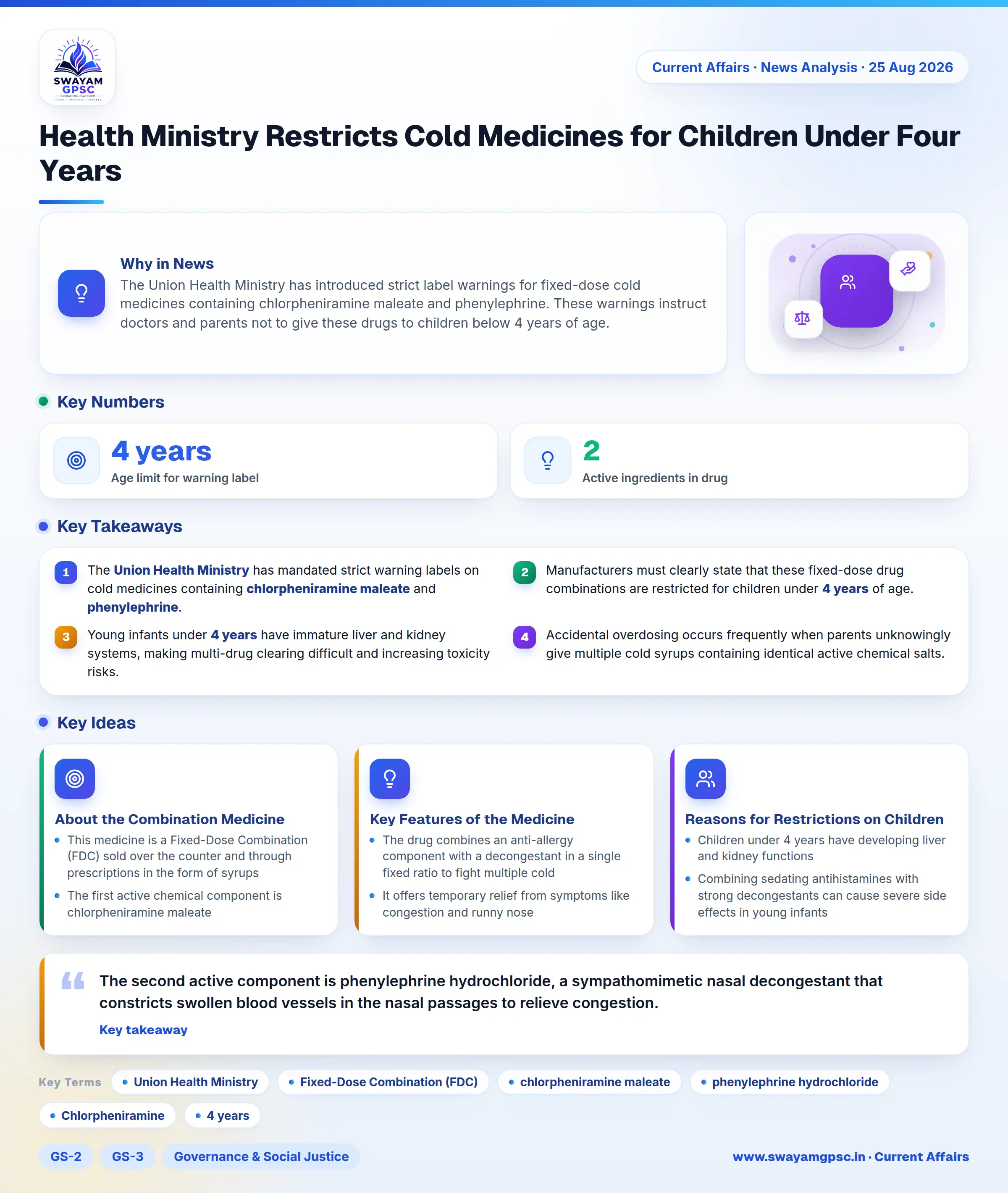
Health Ministry Restricts Cold Medicines for Children Under Four Years
#GS-2 #GS-3 #Governance & Social Justice #Health #Science & Technology #Current Events #National #Fixed-Dose Combinations #Pharmaceutical Safety
Key takeaways
- The Union Health Ministry has mandated strict warning labels on cold medicines containing chlorpheniramine maleate and phenylephrine.
- Manufacturers must clearly state that these fixed-dose drug combinations are restricted for children under 4 years of age.
- Young infants under 4 years have immature liver and kidney systems, making multi-drug clearing difficult and increasing toxicity risks.
- Accidental overdosing occurs frequently when parents unknowingly give multiple cold syrups containing identical active chemical salts.
- Medical experts recommend using non-drug treatments such as saline nasal drops and proper hydration for young children experiencing viral colds.
Why in News
- The Union Health Ministry has introduced strict label warnings for fixed-dose cold medicines containing chlorpheniramine maleate and phenylephrine. These warnings instruct doctors and parents not to give these drugs to children below 4 years of age.
About the Combination Medicine
- This medicine is a Fixed-Dose Combination (FDC) sold over the counter and through prescriptions in the form of syrups, drops, and tablets to treat cold symptoms and allergies.
- The first active chemical component is chlorpheniramine maleate, a first-generation antihistamine that blocks H1 receptors to curb sneezing, runny nose, and watery eyes.
- The second active component is phenylephrine hydrochloride, a sympathomimetic nasal decongestant that constricts swollen blood vessels in the nasal passages to relieve congestion.
Key Features of the Medicine
- The drug combines an anti-allergy component with a decongestant in a single fixed ratio to fight multiple cold symptoms simultaneously.
- It offers temporary relief from symptoms like congestion and runny nose, but it does not cure or shorten the underlying viral infection.
- Chlorpheniramine crosses the blood-brain barrier causing sedation or drowsiness, while phenylephrine constricts blood vessels and can elevate blood pressure and heart rate.
- Pharmaceutical companies widely market this combination in liquid pediatric formulations such as multi-ingredient cold syrups and oral drops.
Reasons for Restrictions on Children Under Four
- Children under 4 years have developing liver and kidney functions, which makes it hard for their bodies to break down multi-drug formulations and significantly raises toxicity risks.
- Combining sedating antihistamines with strong decongestants can cause severe side effects in young infants, including rapid heart rate, seizures, and unusual agitation.
- Parents often inadvertently give children multiple over-the-counter syrups at once without realizing that different brands contain the exact same active chemical salts.
- Global pediatric guidelines emphasize that viral colds clear up naturally and recommend safe non-drug methods like saline nasal drops and adequate hydration instead.