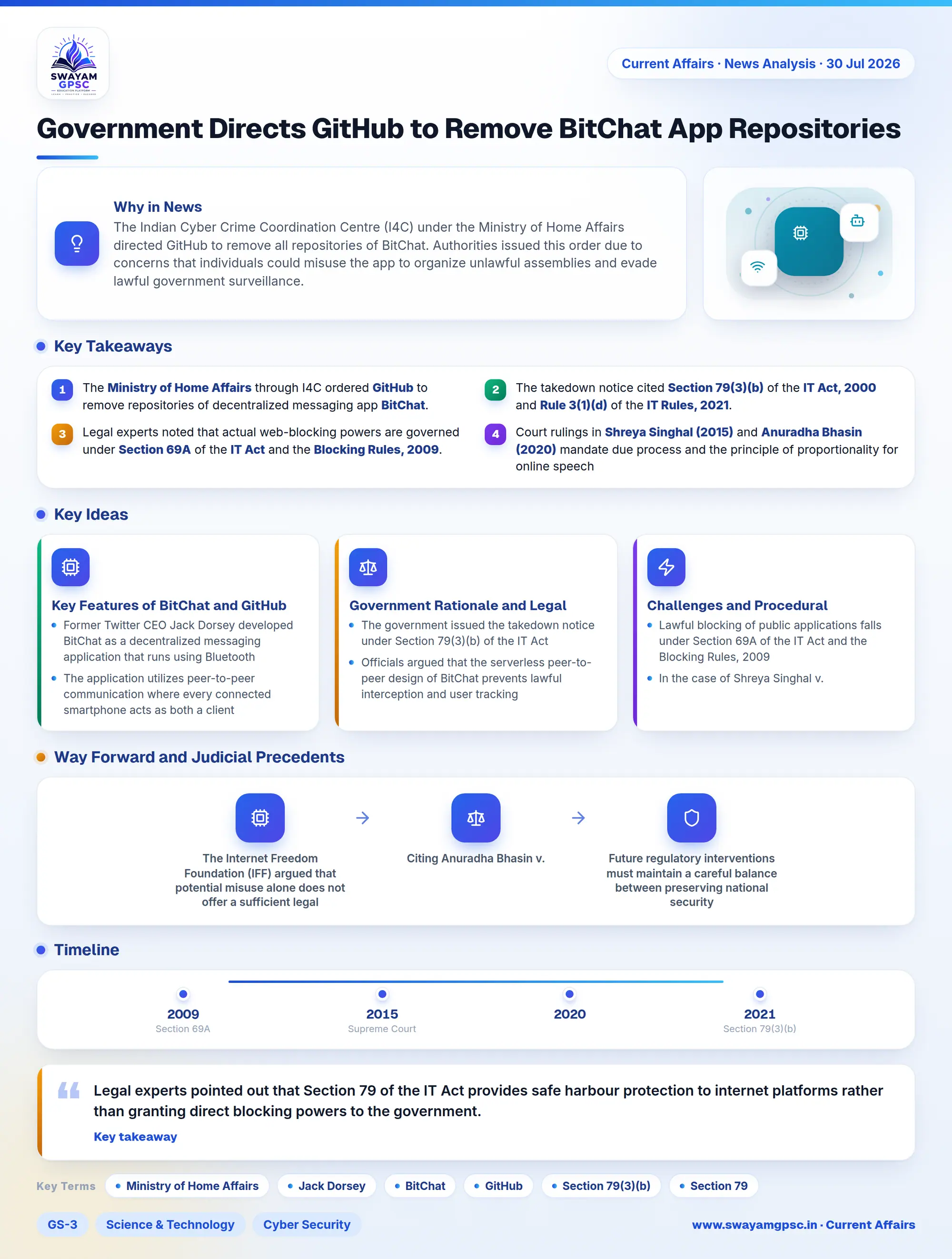
Government Directs GitHub to Remove BitChat App Repositories
#GS-3 #Science & Technology #Cyber Security #ICT #GS-2 #Indian Polity & Constitution #Judiciary #Current Events #National
Key takeaways
- The Ministry of Home Affairs through I4C ordered GitHub to remove repositories of decentralized messaging app BitChat.
- The takedown notice cited Section 79(3)(b) of the IT Act, 2000 and Rule 3(1)(d) of the IT Rules, 2021.
- Legal experts noted that actual web-blocking powers are governed under Section 69A of the IT Act and the Blocking Rules, 2009.
- Court rulings in Shreya Singhal (2015) and Anuradha Bhasin (2020) mandate due process and the principle of proportionality for online speech bans.
Why in News
- The Indian Cyber Crime Coordination Centre (I4C) under the Ministry of Home Affairs directed GitHub to remove all repositories of BitChat.
- Authorities issued this order due to concerns that individuals could misuse the app to organize unlawful assemblies and evade lawful government surveillance.
Key Features of BitChat and GitHub
- Former Twitter CEO Jack Dorsey developed BitChat as a decentralized messaging application that runs using Bluetooth mesh technology without needing internet, servers, SIM cards, or phone numbers.
- The application utilizes peer-to-peer communication where every connected smartphone acts as both a client and a server to expand the messaging network.
- Engineers designed BitChat to resist official censorship and surveillance while providing communication independence during internet shutdowns, natural disasters, and poor network conditions.
- The platform GitHub operates as a global cloud service where software developers store, manage, share, and collaborate on source code using tools like repositories and version control.
Government Rationale and Legal Provisions
- The government issued the takedown notice under Section 79(3)(b) of the IT Act, 2000 along with Rule 3(1)(d) of the IT Rules, 2021.
- Officials argued that the serverless peer-to-peer design of BitChat prevents lawful interception and user tracking, which enables people to bypass official internet shutdowns and coordinate activities threatening public safety.
- The open-source design of the software limits state enforcement because removing code from GitHub does not stop people who already installed the application from using it.
Challenges and Procedural Discrepancies
- Legal experts pointed out that Section 79 of the IT Act provides safe harbour protection to internet platforms rather than granting direct blocking powers to the government.
- Lawful blocking of public applications falls under Section 69A of the IT Act and the Blocking Rules, 2009, which require official hearings and written justifications.
- In the case of Shreya Singhal v. Union of India (2015), the Supreme Court established that internet platforms must remove content only upon a valid court order or official government directive issued through due process.
Way Forward and Judicial Precedents
- The Internet Freedom Foundation (IFF) argued that potential misuse alone does not offer a sufficient legal reason to ban a digital tool without identifying specific illegal content.
- Citing Anuradha Bhasin v. Union of India (2020), rights advocates noted that restrictions on digital speech must meet the legal test of proportionality by being necessary and limited in time and scope.
- Future regulatory interventions must maintain a careful balance between preserving national security and protecting constitutional speech under Article 19(1)(a).