FCRA Regulations and National Security Concerns in India
#GS-2 #Governance & Social Justice #NGOs & SHGs #Regulatory Bodies #Good Governance #National Security #Foreign Contribution (Regulation) Act
Key takeaways
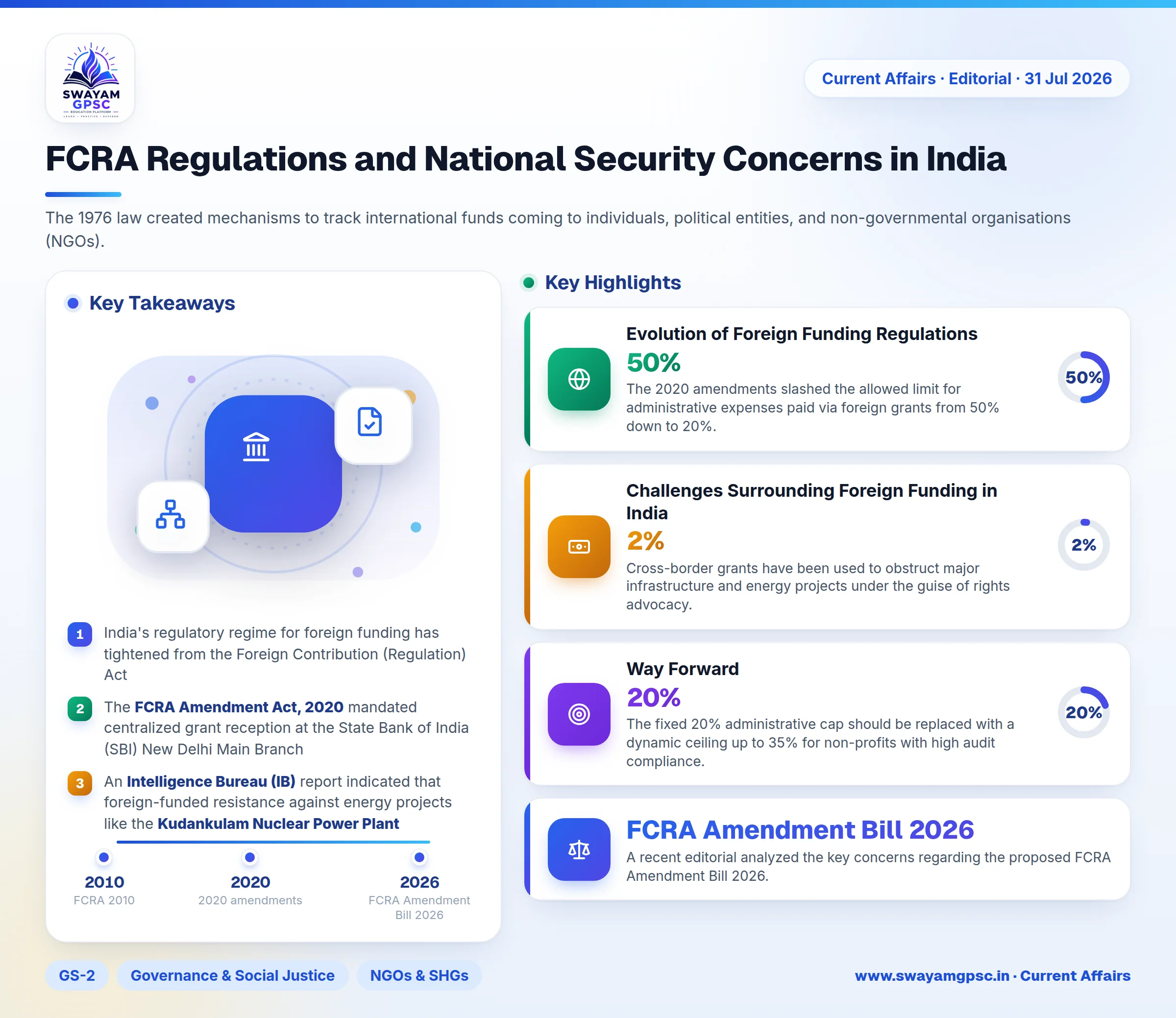
- India's regulatory regime for foreign funding has tightened from the Foreign Contribution (Regulation) Act, 1976 to the FCRA 2010 and subsequent amendments to curb financial crimes and protect national security.
- The FCRA Amendment Act, 2020 mandated centralized grant reception at the State Bank of India (SBI) New Delhi Main Branch, banned sub-granting, and capped administrative expenses at 20%.
- An Intelligence Bureau (IB) report indicated that foreign-funded resistance against energy projects like the Kudankulam Nuclear Power Plant reduced India's annual GDP growth by 2% to 3%.
- Key proposed solutions include a dual-track risk-based system, blockchain-backed financial tracking, and flexible administrative caps up to 35% for compliant organizations.
Why in News
- A recent editorial analyzed the key concerns regarding the proposed FCRA Amendment Bill 2026.
- The discussion focuses on compliance burdens for civil society groups, asset-vesting rules, and balancing national security with non-profit autonomy.
- Policymakers must ensure state oversight does not stifle legitimate humanitarian work and democratic participation.
Evolution of Foreign Funding Regulations
- India enacted the Foreign Contribution (Regulation) Act, 1976 during the Emergency to stop foreign interference in domestic politics and social affairs.
- The 1976 law created mechanisms to track international funds coming to individuals, political entities, and non-governmental organisations (NGOs).
- A major 1984 amendment made government permission or prior registration mandatory for entities regularly receiving foreign donations.
- Parliament repealed the older law and passed the FCRA 2010 to manage complex financial tools and international grant networks.
- The FCRA 2010 replaced permanent registration with a mandatory renewal requirement every 5 years.
- The 2010 act explicitly prohibited using foreign contributions for activities considered harmful to national interests.
- The 2020 amendments mandated that all initial foreign funds must land in a single designated account at the State Bank of India (SBI) New Delhi Main Branch.
- The 2020 updates strictly banned sub-granting, preventing registered NGOs from transferring foreign funds to other local entities.
- The 2020 amendments slashed the allowed limit for administrative expenses paid via foreign grants from 50% down to 20%.
- Verification using Aadhaar or passport details was made compulsory for all key office-bearers and trustees in 2020.
- The proposed FCRA Amendment Bill 2026 introduces rules where assets of cancelled or lapsed licenses vest with a Designated Authority.
- The 2026 Bill enforces tighter geographic tracking of grants and expands legal liability for key non-profit functionaries.
- The 2026 Bill shifts minor operational errors from prison sentences toward structured administrative fines and compounding fees.
Challenges Surrounding Foreign Funding in India
- Unregulated foreign money can be used by external entities to sway domestic policies and fund anti-government agendas. An Intelligence Bureau (IB) report showed how foreign funds fueled resistance against the Kudankulam Nuclear Power Plant in Tamil Nadu.
- Cross-border grants have been used to obstruct major infrastructure and energy projects under the guise of rights advocacy. The IB report on foreign-funded NGOs noted that coordinated blockades reduced annual GDP growth by 2% to 3%.
- Apex non-profits previously used multi-layered sub-granting to pass funds downstream to unmonitored groups, masking the money trail. The Ministry of Home Affairs (MHA) requested a CBI inquiry into Oxfam India for transferring funds to the Centre for Policy Research.
- Foreign money is sometimes routed secretly to shape public opinion and interfere with political processes. The Ministry of Home Affairs (MHA) cancelled the registration of Greenpeace India because its protest campaigns harmed state economic interests.
- Certain foreign contributions to religious or cultural groups have been tied to illegal conversions and demographic shifts. The FCRA Bill 2026 prohibits using foreign grants for activities that promote conversions or incite communal disharmony.
- Charitable organizations can be exploited as channels for hawala transactions, tax evasion, and terror financing. International watchdogs like the Financial Action Task Force (FATF) recommend risk-based monitoring, leading India to centralize foreign funding accounts at SBI New Delhi.
- Foreign grants often foster astro-turfing, creating fake grassroots movements that reflect foreign donor priorities rather than local needs. Donors push niche agendas like climate litigation while ignoring basic healthcare and local sanitation demands.
- Organizations previously diverted foreign funds to high executive salaries, foreign trips, and high overheads instead of direct field work. The FCRA Amendment Act, 2020 slashed administrative limits from 50% down to 20% to ensure 80% reaches field welfare.
Way Forward
- India should adopt a dual-track system that simplifies grants for basic social work while enforcing Enhanced Scrutiny in sensitive border areas.
- Authorities should replace total sub-granting bans with blockchain-backed or API-driven real-time tracking portals to monitor downstream funding safely.
- The fixed 20% administrative cap should be replaced with a dynamic ceiling up to 35% for non-profits with high audit compliance.
- Establishing an independent Foreign Funding Ombudsman outside the Ministry of Home Affairs will ensure fair hearings and 30 to 60-day appeal windows before freezing assets.
- Lawmakers should create statutory safe harbor clauses to protect international academic and scientific research, similar to Australia's Foreign Influence Transparency Scheme.
- Statutes must clearly define vague phrases like activities detrimental to the national interest to protect genuine public policy debate from arbitrary enforcement.
Conclusion
- Maintaining a proper balance between national security priorities and civil society independence is critical for a healthy democracy.
- A transparent and risk-based regulatory system will protect national sovereignty while allowing legitimate social and academic work to flourish.