FCRA Amendment Bill 2026 and Civil Society Organizations
#GS-2 #Governance & Social Justice #NGOs & SHGs #Indian Polity & Constitution #Executive #Foreign Contribution Regulation Act #Civil Society Organisations
Key takeaways
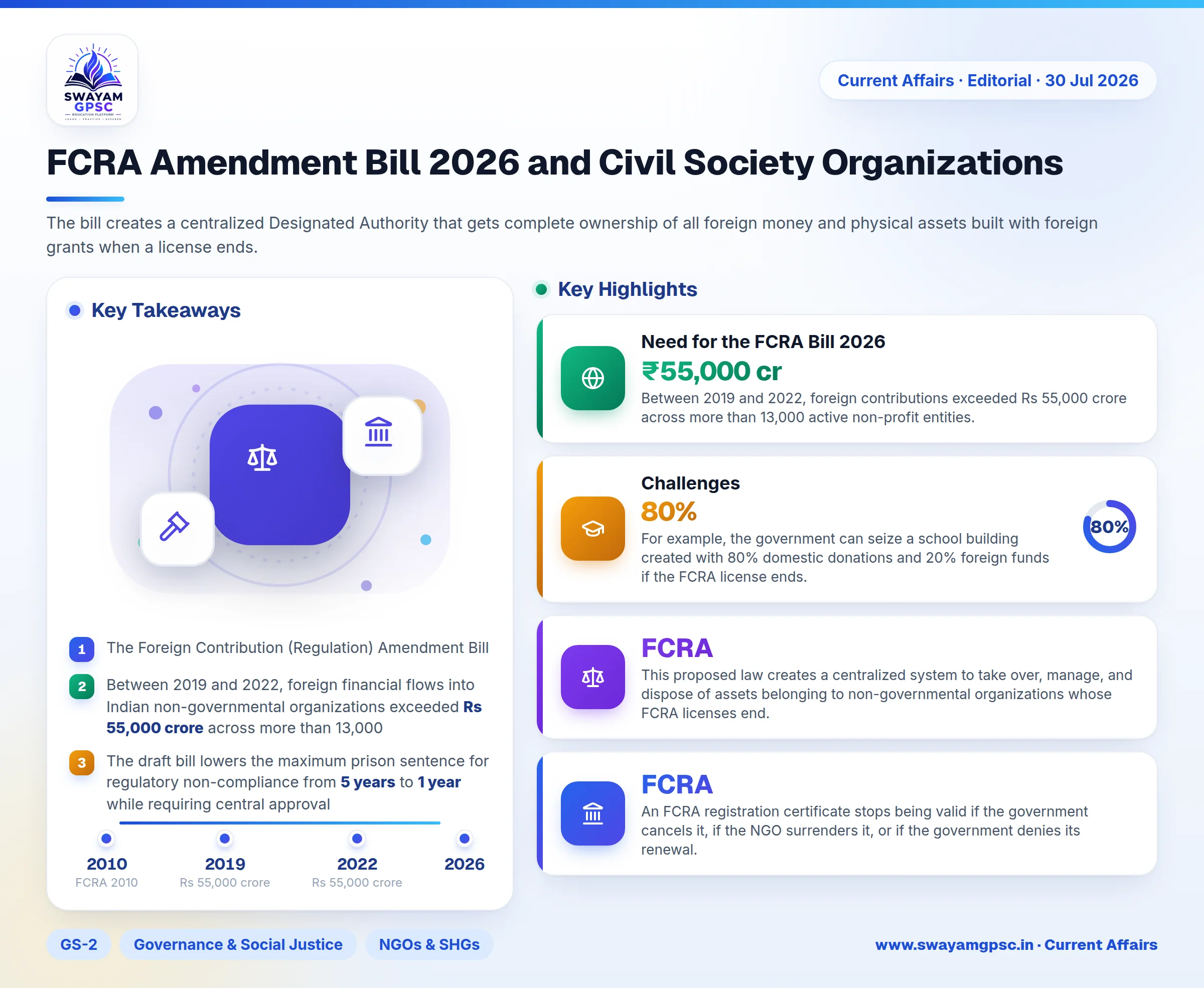
- The Foreign Contribution (Regulation) Amendment Bill, 2026 creates a centralized Designated Authority to take over and sell physical assets of non-profits whose foreign funding licenses end.
- Between 2019 and 2022, foreign financial flows into Indian non-governmental organizations exceeded Rs 55,000 crore across more than 13,000 active bodies.
- The draft bill lowers the maximum prison sentence for regulatory non-compliance from 5 years to 1 year while requiring central approval before initiating criminal probes.
- Under the proposed provisions, non-profits face the seizure of properties even if foreign grants accounted for only 20% of total construction costs.
Why in News
- The central government listed the Foreign Contribution (Regulation) Amendment Bill, 2026 for discussion during the Monsoon Session of Parliament.
- This proposed law creates a centralized system to take over, manage, and dispose of assets belonging to non-governmental organizations whose FCRA licenses end.
Key Features of the FCRA Bill 2026
- An FCRA registration certificate stops being valid if the government cancels it, if the NGO surrenders it, or if the government denies its renewal.
- The bill creates a centralized Designated Authority that gets complete ownership of all foreign money and physical assets built with foreign grants when a license ends.
- The government can transfer these seized assets to public agencies or auction them, placing all proceeds into the Consolidated Fund of India (CFI).
- If a seized property includes a place of worship, the government must assign its management to a special body while protecting its religious character.
- Key organizational leaders like directors and trustees face personal legal liability for violations unless they prove they exercised due diligence.
- The draft law reduces the maximum prison term for statutory violations from 5 years to 1 year and requires central approval before police start criminal probes.
Need for the FCRA Bill 2026
- The law aims to stop organizations from using foreign funds for illegal activities that harm national security, cause communal conflicts, or force religious conversions.
- It sets up a clear legal procedure to take control of abandoned assets like schools or health centers built with foreign grants after an NGO closes down.
- The framework improves financial transparency by making sure authorities can track every foreign donation entering the domestic voluntary sector.
- It regulates foreign financial inflows to ensure non-profits work toward national development goals instead of foreign agendas.
- Between 2019 and 2022, foreign contributions exceeded Rs 55,000 crore across more than 13,000 active non-profit entities.
- The bill fills a legal gap in the FCRA 2010 Act concerning who owns physical properties after an organization loses its foreign funding license.
Challenges
- Organizations that voluntarily stop their FCRA licenses to rely only on domestic funding will permanently lose all past physical assets built with foreign money.
- For example, a rural hospital constructed decades ago using foreign funds could face immediate seizure if the managing trust stops its FCRA registration.
- Non-profits cannot easily exit the foreign funding system because they must keep renewing licenses continuously to protect their existing physical buildings.
- The government can seize properties built using mixed funding, even if foreign donations covered only a small portion of total construction costs.
- For example, the government can seize a school building created with 80% domestic donations and 20% foreign funds if the FCRA license ends.
- Vague legal terms like public interest give officials broad powers to cancel licenses without giving non-profits a fair hearing or a clear court appeal process.
- Unfounded complaints against minority educational trusts could lead to fast property seizures before proper judicial checks take place.
Way Forward
- Parliament should modify the bill so the government seizes only the specific percentage of an asset that foreign funds actually covered.
- The law must create a clear exit path so non-profits can move to domestic funding without losing properties built lawfully in past years.
- The framework should give non-profits a legal right to appeal license cancellations directly in the High Court before state authorities seize any property.
- Lawmakers must replace broad phrases like public interest with exact legal definitions to prevent arbitrary administrative actions against non-profits.
- The government should add clear protections for social assets like schools and clinics to ensure local communities continue receiving public services without interruption.
Conclusion
- Forcing civil society groups to surrender past physical assets prevents them from switching to local funding sources and hurts social welfare work.
- India needs to balance national security requirements with fair appeal procedures and proportional property rules to build a self-reliant voluntary sector.