Empowering Women Across the Life Cycle: Key Schemes and Progress
#GS-1 #Indian Society #Women #Social Justice #Vulnerable Sections #GS-2 #Governance & Social Justice #Government Policies & Interventions #Health #Education #Current Events #National
Key takeaways
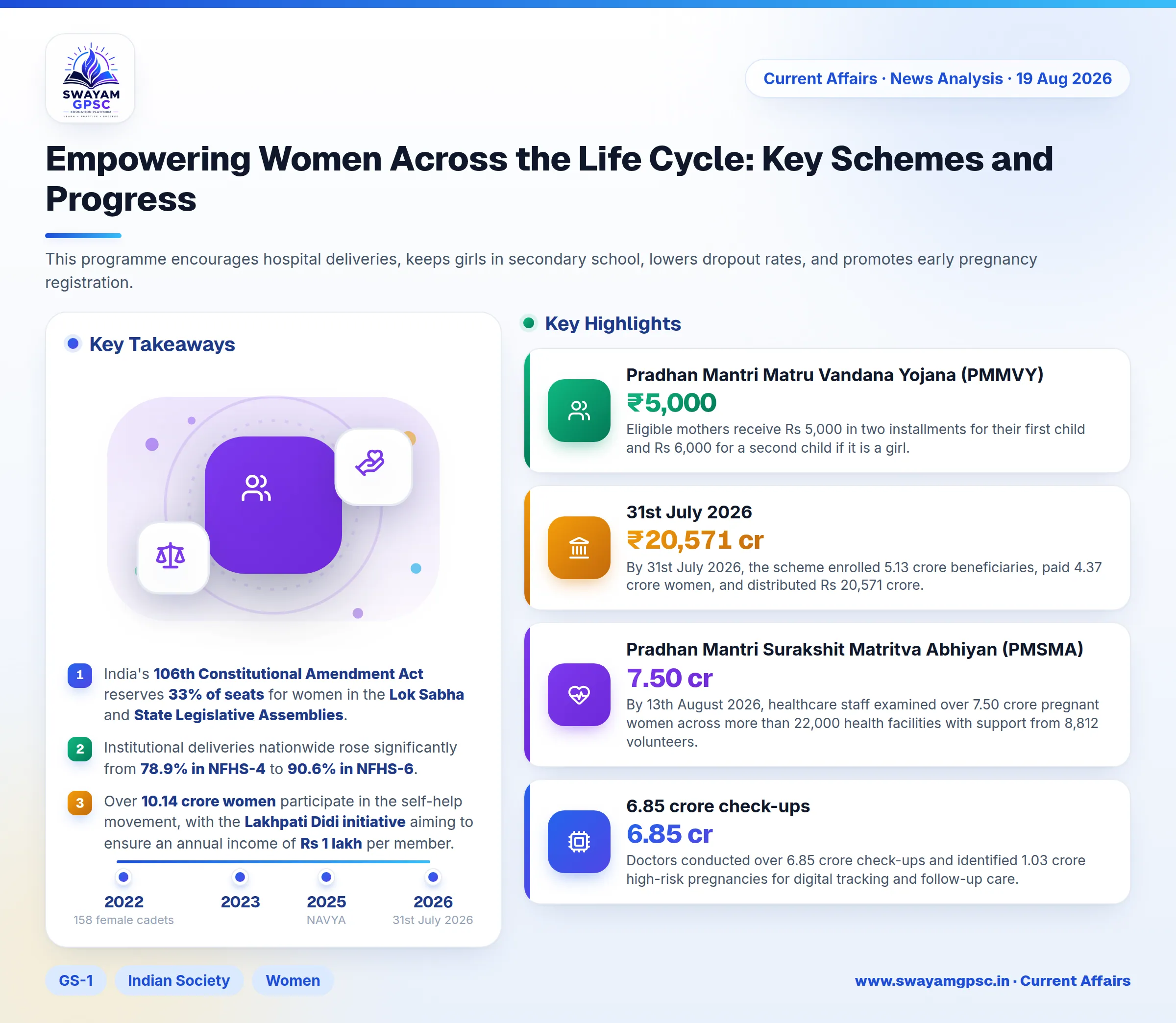
- India's 106th Constitutional Amendment Act reserves 33% of seats for women in the Lok Sabha and State Legislative Assemblies.
- Institutional deliveries nationwide rose significantly from 78.9% in NFHS-4 to 90.6% in NFHS-6.
- Over 10.14 crore women participate in the self-help movement, with the Lakhpati Didi initiative aiming to ensure an annual income of Rs 1 lakh per member.
- Women hold 32.68 crore Jan Dhan accounts and receive two-thirds of all MUDRA loans, boosting financial inclusion and entrepreneurship.
Why in News?
- As India celebrates its 80th Independence Day, the government highlighted the essential role of Nari Shakti in national development.
- The government is supporting women at every life stage through policies covering health, education, skilling, finance, safety, and leadership.
Beti Bachao Beti Padhao (BBBP)
- The Beti Bachao Beti Padhao scheme addresses the declining sex ratio and works to empower girls throughout their lives.
- This programme encourages hospital deliveries, keeps girls in secondary school, lowers dropout rates, and promotes early pregnancy registration.
- According to NFHS-5 (2019-21), India recorded 1,020 females per 1,000 males, up from 943 females per 1,000 males in Census 2011.
Pradhan Mantri Matru Vandana Yojana (PMMVY)
- Under PMMVY, the government gives direct cash transfers to pregnant and breastfeeding mothers to improve health and nutrition.
- Eligible mothers receive Rs 5,000 in two installments for their first child and Rs 6,000 for a second child if it is a girl.
- By 31st July 2026, the scheme enrolled 5.13 crore beneficiaries, paid 4.37 crore women, and distributed Rs 20,571 crore.
Pradhan Mantri Surakshit Matritva Abhiyan (PMSMA)
- The PMSMA program offers free health check-ups for pregnant women at government centers on the 9th of every month.
- By 13th August 2026, healthcare staff examined over 7.50 crore pregnant women across more than 22,000 health facilities with support from 8,812 volunteers.
- Doctors conducted over 6.85 crore check-ups and identified 1.03 crore high-risk pregnancies for digital tracking and follow-up care.
Janani Shishu Suraksha Karyakram (JSSK)
- The JSSK scheme gives pregnant women free hospital deliveries, including C-sections, along with free medicines, transport, diagnostics, blood, and food.
- In FY 2024-25, the scheme helped more than 1.99 crore pregnant women and 16.85 lakh sick infants.
- Since 2014-15, JSSK has provided free healthcare services to over 18.05 crore beneficiaries.
Improvement in Maternal Health Outcomes
- First-trimester pregnancy check-ups rose from 58.6% in NFHS-4 (2015-16) to 76.2% in NFHS-6 (2023-24).
- The proportion of women completing four or more prenatal check-ups grew from 51.2% in NFHS-4 to 65.2% in NFHS-6.
- Hospital deliveries increased significantly across the country from 78.9% in NFHS-4 to 90.6% in NFHS-6.
NEP 2020 and Gender-Inclusive Education
- The Gender Inclusion Fund under NEP 2020 provides focused resources to support disadvantaged girls throughout their school years.
- Flexible study options help reduce school dropouts and assist female students in moving smoothly from school to college.
- Students can choose multidisciplinary subjects, giving girls greater freedom to pursue their chosen fields of study.
Samagra Shiksha and Kasturba Gandhi Balika Vidyalayas
- In 2025-26, India's school network included 14.67 lakh schools, 1.02 crore teachers, and 24.72 crore students.
- Total girl student enrolment in schools reached 11.96 crore in 2025-26, showing strong female participation in formal education.
- Enrolment in residential Kasturba Gandhi Balika Vidyalayas grew from 6.07 lakh in 2020-21 to 7.58 lakh in 2025-26.
Scholarships and Financial Support
- The Central Sector Scholarship scheme reserves 50% of its scholarships for talented girls from low-income families.
- The National PG Scholarship offers Rs 1.5 lakh every year to selected post-graduate students, helping 3,000 women annually.
- The AICTE PRAGATI Scholarship has offered 10,000 scholarships each year since 2014-15, helping nearly 36,000 girls by 2024-25.
- Female student enrolment in higher education grew from 1.57 crore in 2014-15 to 2.18 crore in 2022-23, adding over 60.32 lakh women.
Women in STEM and Higher Education
- Launched in December 2019, the Vigyan Jyoti scheme helped over 1.12 lakh girls in Classes 9 to 12 across 300 districts by March 2026.
- Adding extra seats for female students in IITs and NITs increased women's enrolment from under 10% to over 20%.
- Women earned over 53% of UGC NET-JRF fellowships in STEM subjects during 2024-25, showing higher participation in advanced scientific research.
Pradhan Mantri Kaushal Vikas Yojana
- The PMKVY offers short vocational training aligned with industry needs, where women represent nearly 45% of total trainees.
- The program trained 19.85 lakh candidates under PMKVY 1.0, 1.10 crore under 2.0, 7.37 lakh under 3.0, and certified over 19.36 lakh candidates under 4.0.
Vocational Training for Young Adolescent Girls (NAVYA)
- Launched in 2025, the NAVYA initiative trains girls aged 16 to 18 years in emerging digital skills like cybersecurity and AI tools.
- By June 2026, the scheme had trained around 1,060 girls across 27 aspirational and North-Eastern districts in 19 States.
Ayushman Bharat
- The AB-PMJAY scheme provides free hospital treatment, creating over 45.5 crore Ayushman Cards by 12th August 2026.
- Women received 22.48 crore Ayushman Cards and accounted for more than 5.25 crore hospital admissions under the scheme.
- More than 1.86 lakh Ayushman Arogya Mandirs deliver primary healthcare, maternal care, and preventive health services.
- Under the Ayushman Bharat Digital Mission, healthcare providers digitally linked over 110 crore health records.
- Women created around 49.72% of all ABHA health accounts by August 2026, showing strong adoption of digital health records.
Saksham Anganwadi and POSHAN 2.0
- Mission Saksham Anganwadi and POSHAN 2.0 combine nutritional aid with early childhood care to combat malnutrition effectively.
- By 31st July 2026, the initiative supported 8.94 crore people, including 64.46 lakh pregnant women, 45.44 lakh lactating mothers, and 15.68 lakh adolescent girls.
- The government upgraded around 1.29 lakh Anganwadi Centres into modern Saksham Anganwadis over the past five years.
- A workforce of 13.31 lakh Anganwadi Workers delivers ground-level nutrition and early child education services.
Mission Indradhanush and Women's Preventive Healthcare
- By 18th March 2026, health workers registered 11.87 crore children and 3.96 crore pregnant women on the U-WIN portal for digital tracking.
- Vaccination drives protected 5.46 crore children and 1.32 crore pregnant women against preventable infectious diseases.
- Doctors screened around 8.73 crore women for cervical cancer by 17th February 2026.
- The government launched a nationwide HPV vaccination campaign on 28th February 2026 for 1.2 crore 14-year-old girls across all States and UTs.
- By 15th July 2026, around 52.10 lakh girls received the HPV vaccine to protect against cervical cancer.
Sukanya Samriddhi Yojana
- The Sukanya Samriddhi Yojana allows parents to start savings accounts for girl children with Rs 250, offering an 8.2% interest rate and tax savings under Section 80C.
- Parents can withdraw funds partially for higher education and marriage expenses, encouraging long-term financial planning for girls.
- Total deposits under this savings scheme passed Rs 3.33 lakh crore by December 2025.
DAY-NRLM and Self-Help Group Ecosystem
- The DAY-NRLM network built self-help groups across 7,627 blocks, guided by 1.51 crore community resource workers.
- Self-help groups obtained over Rs 12.18 lakh crore in bank loans by February 2026, assisted by 50,548 trained Bank Sakhis.
- The Start-up Village Entrepreneurship Programme supported 4.32 lakh rural enterprises by June 2026, creating opportunities for women entrepreneurs.
Lakhpati Didi Initiative
- The Lakhpati Didi initiative empowers self-help group members to earn a steady yearly income of at least Rs 1 lakh.
- By 31st March 2026, the program expanded across 34 States and UTs, reaching 10.14 crore women in 94.31 lakh self-help groups.
- The initiative relies on 6,611 Master Trainers and 4.09 lakh Community Resource Persons to mentor potential beneficiaries.
Pradhan Mantri Jan Dhan Yojana
- The government opened 58.90 crore Jan Dhan bank accounts nationwide by 12th August 2026.
- Women own 32.68 crore Jan Dhan accounts, giving them direct access to formal banking and digital financial services.
Pradhan Mantri MUDRA Yojana
- Banks approved over 57.79 crore MUDRA loans worth Rs 40.07 lakh crore by 8th April 2026.
- Women business owners secured two-thirds of all MUDRA loans, boosting small-scale female entrepreneurship across India.
PM SVANidhi
- The PM SVANidhi scheme provides affordable working capital loans to 78.25 lakh street vendors.
- Women make up 46% of all beneficiaries under PM SVANidhi, aiding female micro-traders in urban areas.
NaMo Drone Didi Yojana
- The NaMo Drone Didi Yojana trains self-help group women to fly drones for spraying liquid fertilizers and pesticides on crops.
- The government allocated Rs 1,261 crore to distribute 15,000 drones to women self-help groups between 2023-24 and 2025-26.
- Authorities handed over 1,094 drones to female self-help groups, including 500 drones under the NaMo Drone Didi program.
Womaniya on GeM
- Over 2.1 lakh women-led enterprises registered on the Government e-Marketplace, completing 13.7 lakh orders in FY 2025-26.
- Women-led MSMEs won contracts valued at Rs 28,000 crore on GeM, marking a 27.60% growth over the previous year.
Self-Help Entrepreneur Mart (SHE-Mart)
- Announced in Union Budget 2026-27, the SHE-Mart scheme aims to support 1 crore women in establishing and running enterprises.
- This platform helps women scale up sustainable businesses, building long-term financial independence and market reach.
Mission Shakti
- Mission Shakti operates two wings: Sambal for safety and protection, and Samarthya for empowerment and skill support.
- A national network of One Stop Centres and 642 Nari Adalats offers counseling, legal guidance, and dispute resolution for women.
- The Women Helpline (181) assisted over 1.05 crore women by July 2026, linking directly with the Emergency Response Support System (112).
- The SHe-Box portal offers a central online system for women to register complaints about workplace sexual harassment.
Pradhan Mantri Awas Yojana
- The government launched PMAY-Urban in 2015 and PMAY-Gramin in 2016 to build durable housing with basic amenities for families.
- Under PMAY-Gramin, authorities assigned 96.06 lakh houses (24.73% of the total) exclusively to female heads of household by August 2026.
- Under PMAY-U 2.0, authorities approved 1.25 crore houses, allocating 1 crore houses directly to female owners.
Growing Electoral Participation and Representation
- Women accounted for 47.15 crore out of 96.88 crore voters on India's electoral rolls by February 2026.
- Around 14.5 lakh women hold positions as elected leaders in local governance, comprising 46% of total Panchayat representatives.
Nari Shakti Vandan Adhiniyam
- The 106th Constitutional Amendment Act passed the Nari Shakti Vandan Adhiniyam, 2023 to reserve seats for women in legislatures.
- This law provides 33% reservation for women in the Lok Sabha, State Legislative Assemblies, and the Delhi Legislative Assembly.
- The reservation provisions will take effect following the census delimitation process, increasing female legislative representation.
Women in the National Defence Academy
- In 2025, the first batch of 17 female cadets graduated from the National Defence Academy, opening new avenues in military leadership.
- By early 2026, a total of 158 female cadets joined the National Defence Academy since initial admissions opened in 2022.
Conclusion
- Empowering women remains essential for achieving a developed nation.
- India's women-focused policies have expanded beyond traditional welfare into holistic empowerment across healthcare, education, skilling, housing, and governance.