Deepening Inclusive Development in Rural India
#GS-2 #Governance & Social Justice #Poverty #Education #Health #Good Governance #National #GS-3 #Economy #Infrastructure #Employment #GS-1 #Indian Society #Vulnerable Sections #Women
Key takeaways
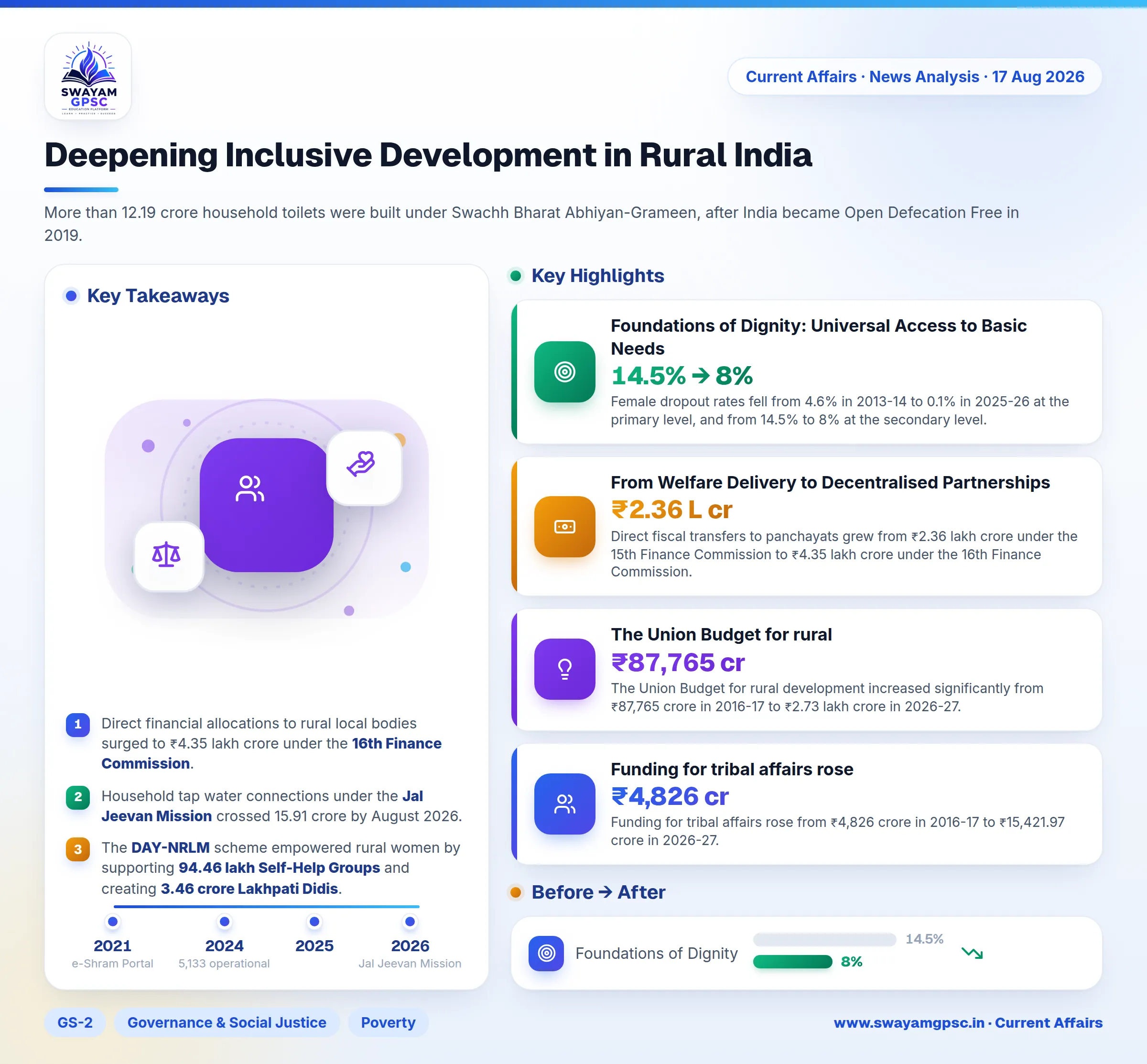
- Direct financial allocations to rural local bodies surged to ₹4.35 lakh crore under the 16th Finance Commission.
- Household tap water connections under the Jal Jeevan Mission crossed 15.91 crore by August 2026.
- The DAY-NRLM scheme empowered rural women by supporting 94.46 lakh Self-Help Groups and creating 3.46 crore Lakhpati Didis.
- The newly enacted Viksit Bharat-Guarantee for Rozgar and Ajeevika Mission (Gramin) Act, 2025 guarantees 125 days of rural wage employment.
- Targeted programs like PM-JUGA bring together 17 Ministries to deliver essential housing, water, and infrastructure in tribal habitations.
Why in News
- On India's 80th Independence Day, the government highlighted key initiatives that empower rural and tribal communities through basic services, skills, education, and financial security.
From Welfare Delivery to Decentralised Partnerships
- Direct fiscal transfers to panchayats grew from ₹2.36 lakh crore under the 15th Finance Commission to ₹4.35 lakh crore under the 16th Finance Commission.
- The Union Budget for rural development increased significantly from ₹87,765 crore in 2016-17 to ₹2.73 lakh crore in 2026-27.
- Funding for tribal affairs rose from ₹4,826 crore in 2016-17 to ₹15,421.97 crore in 2026-27.
Foundations of Dignity: Universal Access to Basic Needs
- Under the Jal Jeevan Mission, household tap-water coverage expanded from 3.23 crore in August 2019 to over 15.91 crore by August 2026.
- Around 2.89 lakh villages reported achieving 100 percent household tap-water coverage under the Har Ghar Jal campaign by August 2026.
- More than 12.19 crore household toilets were built under Swachh Bharat Abhiyan-Grameen, after India became Open Defecation Free in 2019.
- Over 1,288 GOBARdhan biogas plants were functional by August 2026, up from just 14 plants in FY 2018-19.
- The Pradhan Mantri Ujjwala Yojana provided over 10.57 crore LPG connections to adult women from poor households by August 2026.
- Total LPG connections across India grew from 14.52 crore in 2014 to 33.39 crore in 2026.
- The SAUBHAGYA scheme achieved 100 percent willing household electrification across the country by March 2019.
- Under the Deendayal Upadhyaya Gram Jyoti Yojana, 100 percent village electrification was achieved by 2025.
- Authorities issued over 45.51 crore Ayushman Cards under Ayushman Bharat by August 2026.
- Citizens created around 96.43 crore ABHA accounts by August 2026 to maintain digital health records.
- More than 1.86 lakh Ayushman Arogya Mandirs were functional by August 2026 to deliver primary healthcare.
- The Pradhan Mantri Garib Kalyan Anna Yojana delivers free foodgrains to over 81.35 crore beneficiaries.
- About 99.8% of Fair Price Shops were automated for Aadhaar verification under the Public Distribution System by July 2026.
- All States and Union Territories digitised 100 percent of their ration cards by July 2026.
- Over 221 crore portability transactions occurred under One Nation One Ration Card by July 2026.
- Under Samagra Shiksha Abhiyan, authorities upgraded 4,073 schools and launched 1.49 lakh ICT initiatives between 2018 and 2026.
- Functional girls' sanitation facilities reached 97.3% of schools across the nation.
- Female dropout rates fell from 4.6% in 2013-14 to 0.1% in 2025-26 at the primary level, and from 14.5% to 8% at the secondary level.
- The Constitution (103rd Amendment) Act, 2019 enabled 10 percent reservation for Economically Weaker Sections in education and jobs.
- The Gross Enrolment Ratio reached 89.4 at the primary level and 81.5 at the secondary level in 2025-26.
- Under Beti Bachao Beti Padhao, secondary school enrolment for girls rose from 75.5% in 2014-15 to 83.4% in 2025-26.
- Sanctioned Kasturba Gandhi Balika Vidyalayas increased from 3,609 in 2014-15 to 5,639 in 2024-25, with 5,133 operational.
- Student enrolment in these specialized residential schools doubled from 3.52 lakh in 2014-15 to 7.11 lakh in 2024.
- The digital learning platform SWAYAM recorded over 6.5 crore enrolments by August 2026.
- The DIKSHA portal registered around 2.35 crore users by August 2026.
Building the Backbone: Infrastructure and Connectivity
- Under PMAY-G, the government sanctioned 3.91 crore houses and completed 3.13 crore houses by August 2026.
- The Pradhan Mantri Gram Sadak Yojana connected 99.6% of eligible habitations with all-weather roads by June 2026.
- Road construction under PMGSY reached 4.13 lakh km between May 2014 and August 2026, compared to 3.86 lakh km in the previous 14 years.
- The number of completed bridges under PMGSY jumped from 484 in 2000-2014 to 10,404 between 2014 and 2026.
- Around 2.19 lakh Gram Panchayats gained broadband connectivity under BharatNet by May 2026.
- Panchayats processed over ₹3.16 lakh crore in online transactions using eGramSwaraj by June 2026.
- More than 1.28 lakh Gram Panchayats adopted the AI tool SabhaSaar to summarize meeting records by June 2026.
Pathways to Prosperity: Livelihoods, Skills and Financial Security
- Under DAY-NRLM, rural women formed 94.46 lakh Self-Help Groups covering 10.19 crore households by August 2026.
- The Lakhpati Didi Initiative enabled 3.46 crore women to earn sustainable higher incomes by July 2026.
- Over 9 lakh Community Resource Persons assist rural families with farming, banking, insurance, and healthcare.
- This community network includes 50,548 Bank Sakhis, 1.91 lakh Krishi Sakhis, 2,012 Matsya Sakhis, and 1.70 lakh Pashu Sakhis.
- The Union Budget 2026-27 introduced SHE-Mart to create community-owned retail shops for 1 crore women.
- Under Deendayal Upadhyaya Grameen Kaushalya Yojana, trained youth grew from 43,038 in 2014-15 to 18.45 lakh by August 2026.
- Job placements under DDU-GKY increased from 21,446 in 2014-15 to 12.35 lakh by August 2026.
- The Pradhan Mantri Kaushal Vikas Yojana provided skill training to over 1.64 crore youth by June 2026.
- On 1 July 2026, the Viksit Bharat-Guarantee for Rozgar and Ajeevika Mission (Gramin) Act, 2025 replaced MGNREGA, guaranteeing 125 days of wage work.
- Registrations on the e-Shram Portal grew from 14.40 crore in 2021 to 31.87 crore by August 2026.
- Over 30 lakh traditional artisans registered under PM Vishwakarma by August 2026.
- By August 2026, 24.32 lakh artisans completed training and 17.70 lakh received modern toolkits.
- The PM SVANidhi scheme expanded street vendor coverage from 26.37 lakh in 2021 to 78.17 lakh by August 2026.
- The scheme disbursed ₹18,971.18 crore in loans, with women accounting for 46% of beneficiaries.
- Sanctioned loans under PM MUDRA Yojana grew from 3.49 crore in 2016 to over 59.14 crore by July 2026.
- Beneficiaries of Pradhan Mantri Jan Dhan Yojana grew from 17.9 crore in 2015 to 58.90 crore by August 2026.
- Subscribers to the National Pension System increased from 1.05 crore in 2016-17 to 2.17 crore in 2025-26.
- Enrolments in Atal Pension Yojana grew from 48.80 lakh in 2016-17 to 9.29 crore by June 2026.
- Life insurance coverage under PMJJBY reached 27.90 crore people by July 2026.
- Accident insurance coverage under PMSBY reached 58.78 crore people by July 2026.
- Over 54 lakh unorganised workers enrolled in the PM Shram Yogi Maan-dhan pension scheme by July 2026.
Accelerating Tribal Development through Integrated Interventions
- Under PM-JANMAN, authorities sanctioned 540 Van Dhan Vikas Kendras to assist 46,042 PVTG members by August 2026.
- Under PM-JVM, over 4,172 Van Dhan Vikas Kendras were approved, supporting 12.48 lakh tribal individuals.
- The PM-JUGA initiative coordinates 17 Ministries to address developmental gaps in tribal-majority villages.
- Over the last 12 years, tribal communities built 7.60 lakh houses and brought drinking water to 28,303 villages.
- Authorities electrified 59,812 tribal households and opened 657 Anganwadi Centres in tribal regions.
- The government approved 692 hostels to offer residential education to tribal students.
- Under PM-AJAY, authorities built 4.16 lakh SC houses and constructed 3.57 lakh toilets by August 2026.
- Around 17,578 villages were declared Adarsh Grams under SC welfare initiatives by August 2026.
- Operational Eklavya Model Residential Schools grew from 129 in 2014-15 to 511 by August 2026.
- Enrolment across EMRSs reached 1.68 lakh tribal students by August 2026.
- The PM-YASASVI scheme provided pre-matric scholarships to 20.61 lakh students and post-matric support to 24.53 lakh students in FY 2024-25.
- The Pre-Matric Scholarship Scheme benefited 28.99 lakh tribal students between April 2024 and August 2026.
- The National Fellowship for ST Students supported 2,961 scholars in 2025-26, with women comprising 56%.
- Under SHREYAS, about 8,571 SC students received funding to study at premier institutions like IITs and AIIMS during 2025-26.
- The NAMASTE program verified 89,915 sewer workers and 2.81 lakh waste pickers by July 2026.
- The SEED scheme spent ₹26.75 crore on education for 4,485 De-Notified Tribe students in 2025-26.
- During the same period, authorities issued 73,569 Ayushman Bharat cards to families belonging to De-Notified Tribes.
Conclusion
- India's rural development framework is moving beyond simple relief measures toward self-reliance, local governance, and lasting social empowerment.
- Integrated access to clean water, basic healthcare, digital tools, and institutional credit gives marginalized communities new economic opportunities.