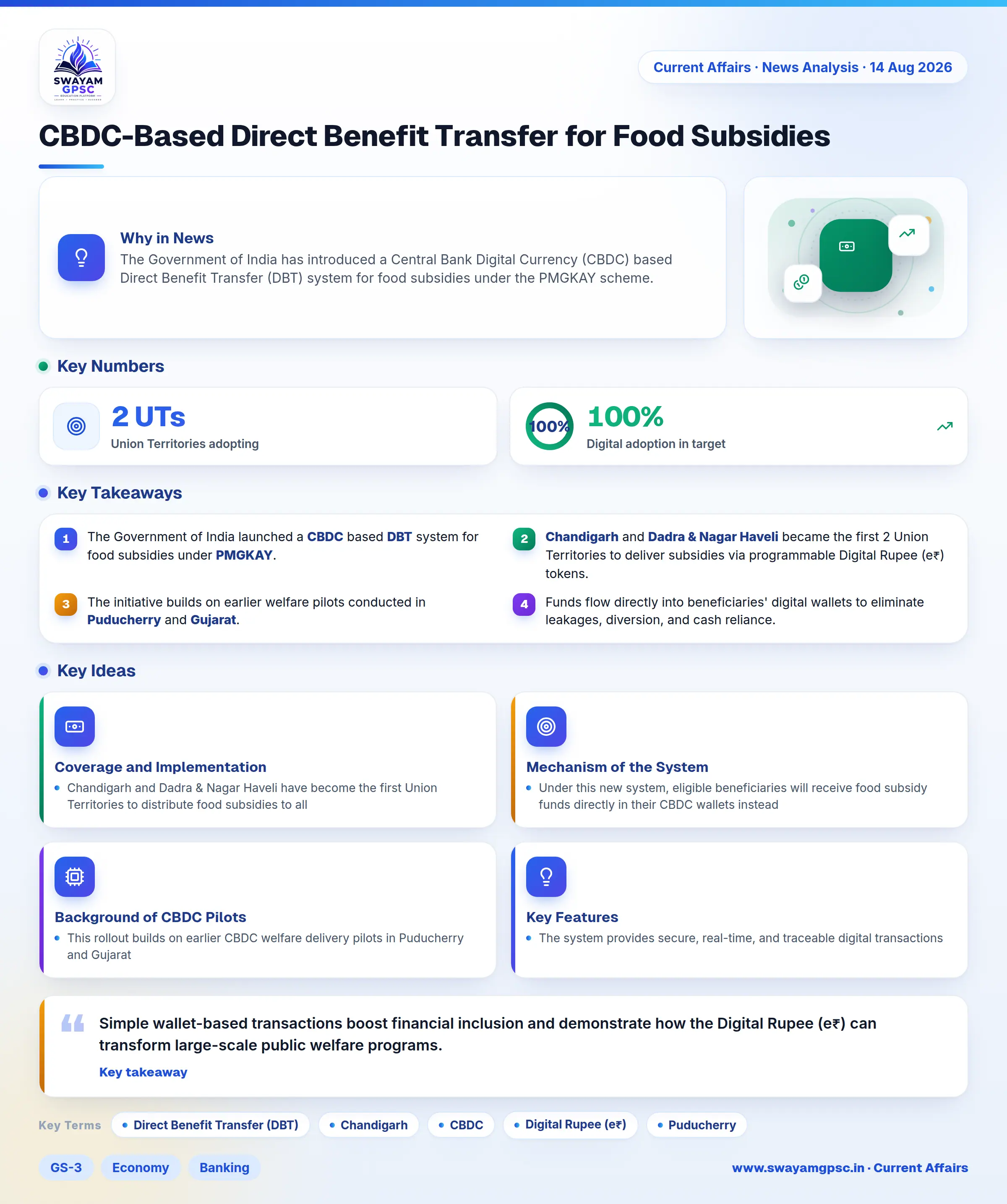
CBDC-Based Direct Benefit Transfer for Food Subsidies
#GS-3 #Economy #Banking #Food Security #GS-2 #Governance & Social Justice #E-Governance
Key takeaways
- The Government of India launched a CBDC based DBT system for food subsidies under PMGKAY.
- Chandigarh and Dadra & Nagar Haveli became the first 2 Union Territories to deliver subsidies via programmable Digital Rupee (e₹) tokens.
- The initiative builds on earlier welfare pilots conducted in Puducherry and Gujarat.
- Funds flow directly into beneficiaries' digital wallets to eliminate leakages, diversion, and cash reliance.
Why in News
- The Government of India has introduced a Central Bank Digital Currency (CBDC) based Direct Benefit Transfer (DBT) system for food subsidies under the PMGKAY scheme.
Coverage and Implementation
- Chandigarh and Dadra & Nagar Haveli have become the first Union Territories to distribute food subsidies to all eligible PMGKAY beneficiaries through programmable Digital Rupee (e₹) tokens.
Mechanism of the System
- Under this new system, eligible beneficiaries will receive food subsidy funds directly in their CBDC wallets instead of standard bank accounts.
Background of CBDC Pilots
- This rollout builds on earlier CBDC welfare delivery pilots in Puducherry and Gujarat, achieving complete digital adoption among beneficiaries in the two Union Territories.
Key Features
- The system provides secure, real-time, and traceable digital transactions, enabling authorities to monitor subsidy transfers and usage effectively.
Objectives
- The primary goal is to minimize subsidy leakages, prevent diversion, and reduce cash handling while ensuring fast and transparent benefit delivery.
Significance
- Simple wallet-based transactions boost financial inclusion and demonstrate how the Digital Rupee (e₹) can transform large-scale public welfare programs.