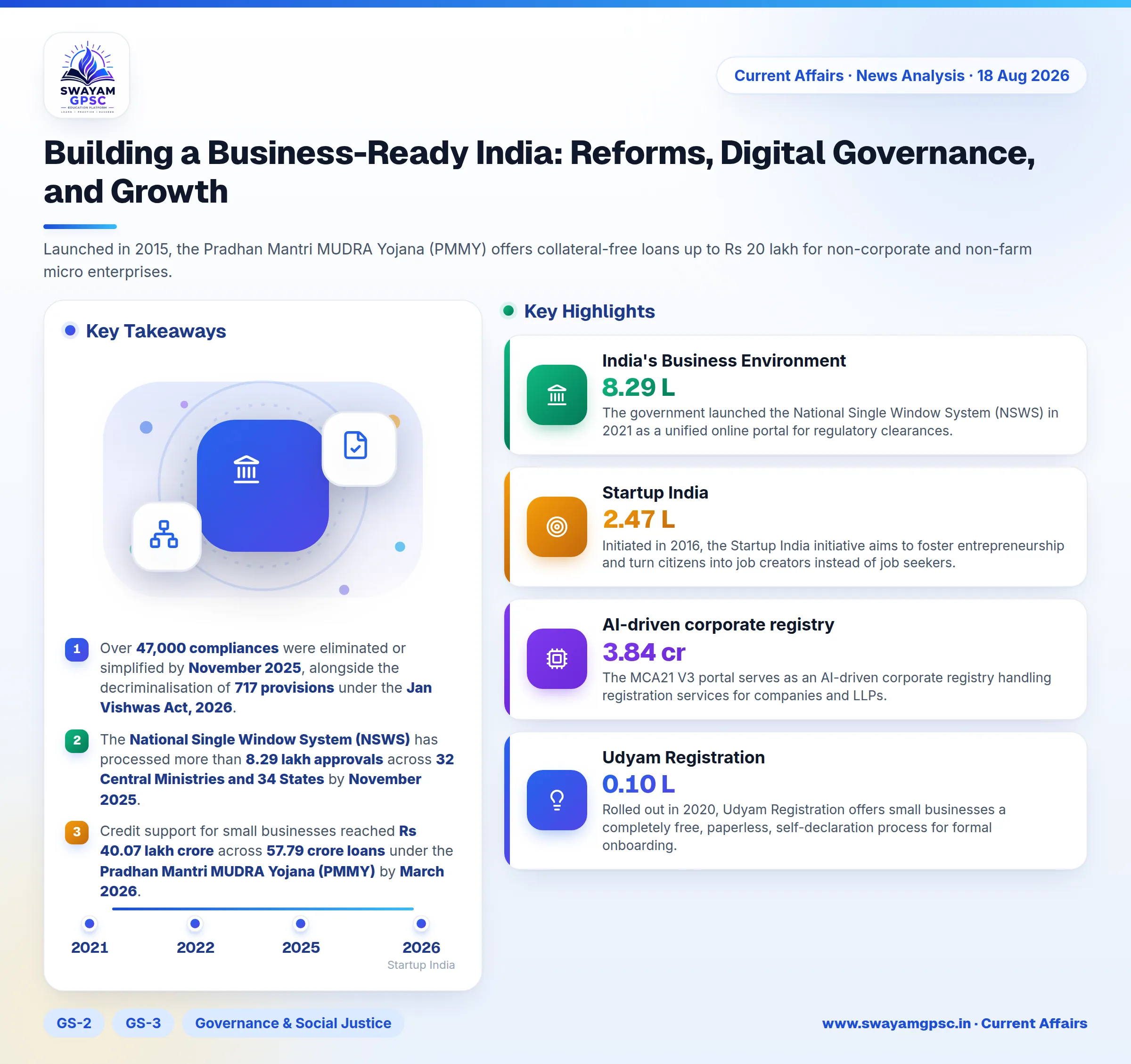
Building a Business-Ready India: Reforms, Digital Governance, and Growth
#GS-2 #GS-3 #Governance & Social Justice #E-Governance #Good Governance #Economy #Infrastructure #Banking #Current Events #National
Key takeaways
- Over 47,000 compliances were eliminated or simplified by November 2025, alongside the decriminalisation of 717 provisions under the Jan Vishwas Act, 2026.
- The National Single Window System (NSWS) has processed more than 8.29 lakh approvals across 32 Central Ministries and 34 States by November 2025.
- Credit support for small businesses reached Rs 40.07 lakh crore across 57.79 crore loans under the Pradhan Mantri MUDRA Yojana (PMMY) by March 2026.
- Public procurement through the Government e-Marketplace (GeM) exceeded Rs 20 lakh crore in cumulative transactions by August 2026, involving 25 lakh sellers.
Why in News
- During India's 80th Independence Day celebrations, the government presented key reforms designed to create a better environment for commercial enterprises. These initiatives focus on improving the Ease of Doing Business, expanding digital administration, reducing legal burdens, opening market avenues, and facilitating smooth credit availability.
India's Business Environment
- The government launched the National Single Window System (NSWS) in 2021 as a unified online portal for regulatory clearances. It consolidates approvals across 32 Central Ministries and 34 States, hosting over 686 Central and 7,498 State approvals, while granting more than 8.29 lakh clearances by November 2025.
- Initiated in 2016, the Startup India initiative aims to foster entrepreneurship and turn citizens into job creators instead of job seekers. Official DPIIT-recognised startups grew dramatically from 502 in 2016 to more than 2.47 lakh by 12th August 2026.
- Introduced in 2020, the SPICe+ Form combines 11 services across 3 Central Government Ministries into a single digital application. It streamlines 10 essential procedures including company incorporation, tax registrations, bank account creation, and local establishment licenses.
- The MCA21 V3 portal serves as an AI-driven corporate registry handling registration services for companies and LLPs. From 2021 to 2025, it processed 3.84 crore filings, approving 3.33 crore automatically through the Straight Through Process.
- Rolled out in 2020, Udyam Registration offers small businesses a completely free, paperless, self-declaration process for formal onboarding. Total registered units surged from 0.10 lakh in October 2020 to over 9.27 lakh by 13th August 2026.
- Started in 2015, the Business Reform Action Plan (BRAP) drives business environment reforms across all States and Union Territories. It enhances administrative clarity in land allocation, labor rules, tax filings, environmental clearances, and factory inspections.
Unlocking Finance for Enterprise Growth
- Launched in 2015, the Pradhan Mantri MUDRA Yojana (PMMY) offers collateral-free loans up to Rs 20 lakh for non-corporate and non-farm micro enterprises. By 27th March 2026, total disbursements reached 57.79 crore loans valued at Rs 40.07 lakh crore.
- The Credit Guarantee Scheme allows small firms to obtain bank credit up to Rs 10 crore without presenting personal guarantees or collateral assets. Through CGTMSE, total approved guarantee coverage grew to Rs 13.67 lakh crore across 1.41 crore guarantees by March 2026.
- Public sector banks introduced the Credit Assessment Model (CAM) in 2025 to evaluate enterprise loan applications using verified digital data. Between April and December 2025, banks sanctioned over 3.96 lakh MSME applications worth Rs 52,300 crore.
- The Trade Receivables Discounting System (TReDS) operates as a digital trade portal where small businesses sell unpaid invoices to financiers for immediate cash flow. This platform prevents operational delays caused by slow working-capital recovery.
- The Union Budget 2026-27 introduced credit guarantees for invoice discounting while mandating expanded use of TReDS across central public sector enterprises.
- Reflecting rapid operational growth, total invoice discounting on TReDS expanded from Rs 40,000 crore in 2021-22 to Rs 3.47 lakh crore in 2025-26.
From Compliance to Trust-Based Governance
- The Jan Vishwas (Amendment of Provisions) Act, 2026 decriminalised 717 provisions and updated 784 provisions across 79 Central Acts under 23 Ministries. This reform removes jail penalties for technical errors and fosters mutual trust between regulators and businesses.
- Government measures removed over 47,000 compliances by November 2025 to lower operating expenses for enterprises. This initiative included 16,108 simplified rules, 22,287 digitised processes, 4,458 decriminalised clauses, and the elimination of 4,270 obsolete requirements.
- First introduced in 2017, the unified tax architecture entered its GST 2.0 phase in September 2025 by rationalising duties into a streamlined two-rate structure. This restructuring minimizes operational complexity and transaction costs for businesses.
- Active business registrations under GST expanded from 60 lakh in 2017 to over 1.68 crore by 31 July 2026, demonstrating widespread economic formalisation.
- The Faceless Assessment Scheme stops direct physical contact between taxpayers and tax officials by relying on automated selection and central digital dispatch.
- Eliminating personal meetings cuts down unnecessary delays and creates a uniform, objective, and predictable tax administration system.
Expanding Markets for Indian Businesses
- Launched in 2016, the Government e-Marketplace (GeM) links commercial vendors directly with public sector buyers. By 6 August 2026, it connected 1.37 lakh buyer entities with nearly 25 lakh sellers, generating cumulative transactions exceeding Rs 20 lakh crore.
- During FY 2025-26, public departments completed over 75 lakh orders on GeM, demonstrating how public procurement has become open and accessible.
- Rolled out in 2021, PM GatiShakti uses a unified spatial platform combining 58 Ministries, 36 States and UTs, and 3,291 data layers for joint infrastructure mapping.
- By February 2026, the Network Planning Group reviewed 352 projects valued at Rs 16.10 lakh crore, sanctioning 201 projects with 167 under active construction.
- This digital mapping portal assists private firms in choosing optimal production sites, scheduling investments, and linking to transport networks early.
- Established in 2022, the Open Network for Digital Commerce (ONDC) creates an open digital trade framework that frees merchants from relying on dominant proprietary platforms.
- The network currently hosts over 7.64 lakh sellers across 616 cities, enabling small enterprises from smaller towns to trade online easily.
Strengthening India's Global Business Footprint
- Established in 2025, the Export Promotion Mission enhances national trade competitiveness by supporting small enterprises, new exporters, labor-heavy industries, and underdeveloped regions.
- By consolidating financial grants and technical guidance into one platform, the program removes export hurdles for regional companies trying to reach foreign buyers.
- The Trade Connect e-Platform offers exporters trade intelligence, commercial analytics, and direct contact details for overseas purchasers.
- By August 2026, the Trade Connect platform surpassed 20 lakh registered users while issuing more than 40 lakh Certificates of Origin.
- The Indian Customs Electronic Gateway (ICEGATE) automates duty payments, customs document filings, query settlements, and tax refunds to speed up border clearances.
- Monthly import filings on ICEGATE surged from 1.43 lakh in April 2020 to over 6.14 lakh in June 2026, highlighting rapid expansion in digital foreign trade processing.
Conclusion
- India's strategy for economic reforms has evolved from tweaking minor rules to building a reliable, predictable commercial environment. Expanding digital systems, accessible enterprise credit, open sales channels, and stable laws will help domestic firms expand operations and compete on global stages.