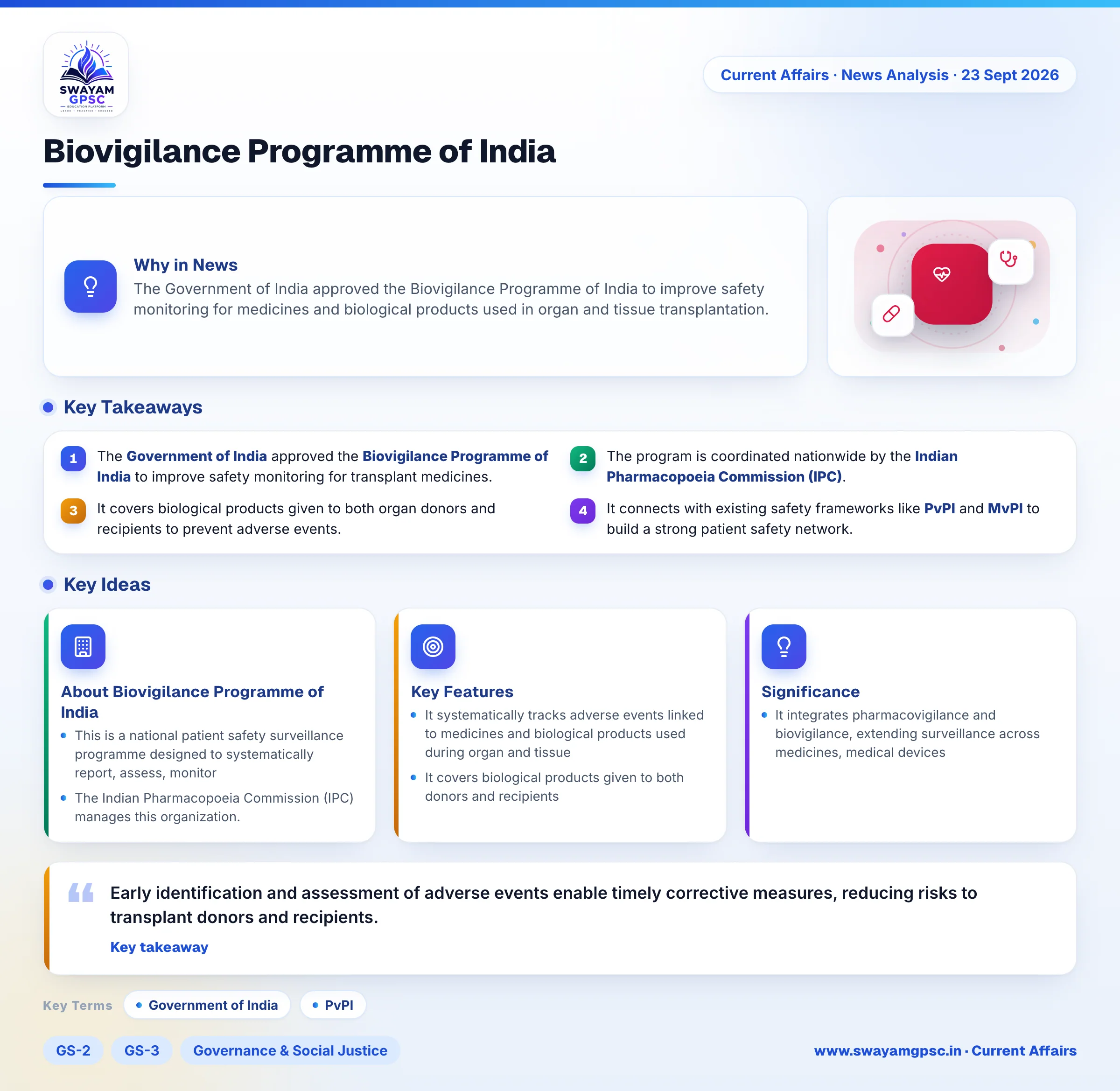
Biovigilance Programme of India
#GS-2 #GS-3 #Governance & Social Justice #Health #Science & Technology #Current Events #National #Economy
Key takeaways
- The Government of India approved the Biovigilance Programme of India to improve safety monitoring for transplant medicines.
- The program is coordinated nationwide by the Indian Pharmacopoeia Commission (IPC).
- It covers biological products given to both organ donors and recipients to prevent adverse events.
- It connects with existing safety frameworks like PvPI and MvPI to build a strong patient safety network.
Why in News
- The Government of India approved the Biovigilance Programme of India to improve safety monitoring for medicines and biological products used in organ and tissue transplantation.
About Biovigilance Programme of India
- This is a national patient safety surveillance programme designed to systematically report, assess, monitor, and prevent bad reactions linked to medicines and biological products used in transplants.
- The Indian Pharmacopoeia Commission (IPC) manages this organization.
- The main aim is to identify, assess, and prevent adverse events related to transplant products, which improves safety for both donors and recipients.
Key Features
- It systematically tracks adverse events linked to medicines and biological products used during organ and tissue transplantation, enabling timely safety interventions.
- It covers biological products given to both donors and recipients, extending safety surveillance across the entire transplantation process.
- The Indian Pharmacopoeia Commission (IPC) coordinates reporting, assessment, monitoring, and prevention of transplant related adverse events nationwide.
- It complements PvPI for adverse drug reactions and MvPI for medical device events, creating a broader and interconnected patient safety framework.
- It builds domestic capacity to collect, analyze, and generate evidence from adverse event data, supporting safer clinical practices and regulatory decisions.
Significance
- Early identification and assessment of adverse events enable timely corrective measures, reducing risks to transplant donors and recipients.
- It integrates pharmacovigilance and biovigilance, extending surveillance across medicines, medical devices, and transplant related biological products.