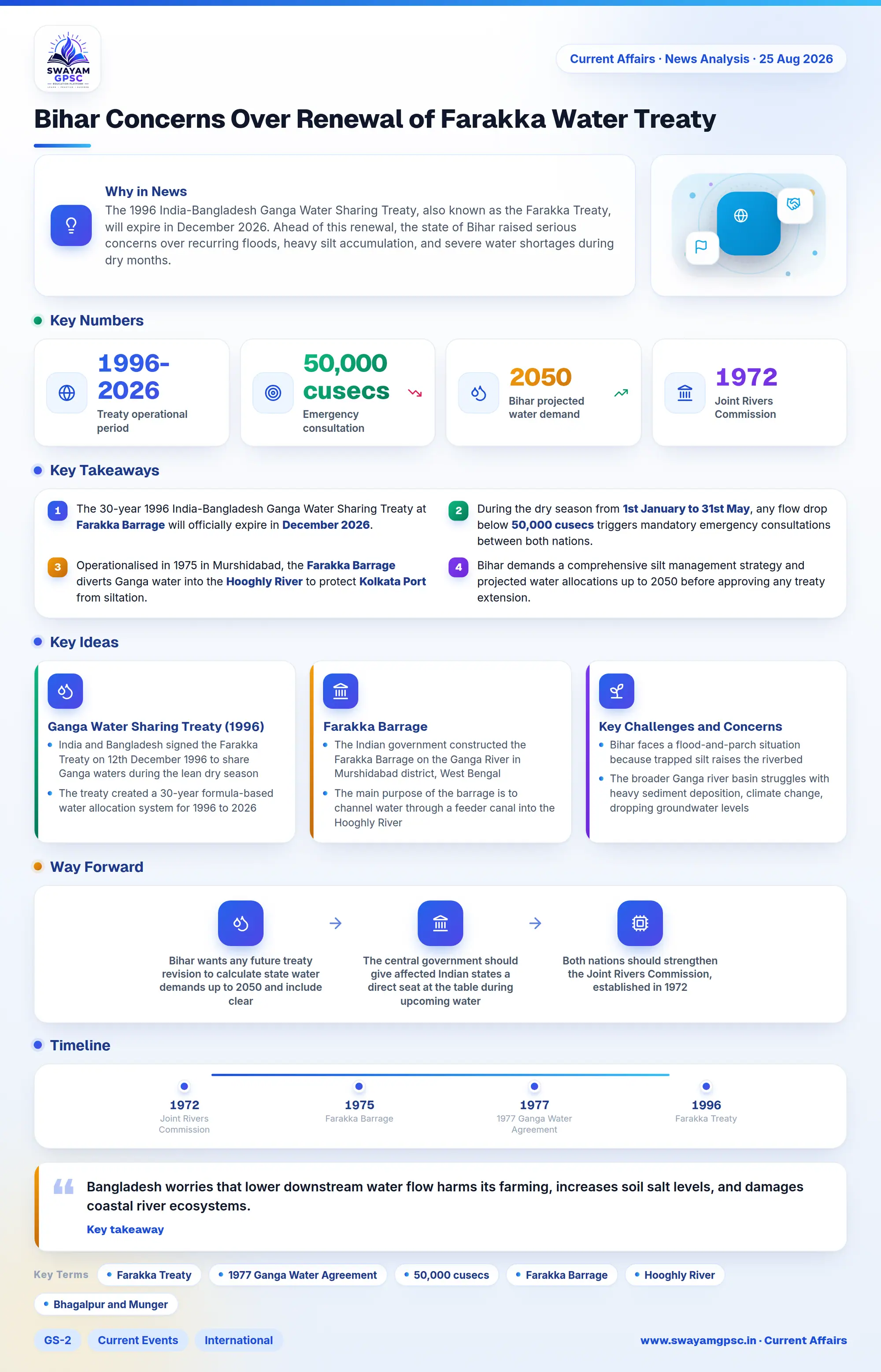
Bihar Concerns Over Renewal of Farakka Water Treaty
#GS-2 #Current Events #International #National #GS-3 #Geography #Resources #Farakka Treaty #India-Bangladesh Relations
Key takeaways
- The 30-year 1996 India-Bangladesh Ganga Water Sharing Treaty at Farakka Barrage will officially expire in December 2026.
- During the dry season from 1st January to 31st May, any flow drop below 50,000 cusecs triggers mandatory emergency consultations between both nations.
- Operationalised in 1975 in Murshidabad, the Farakka Barrage diverts Ganga water into the Hooghly River to protect Kolkata Port from siltation.
- Bihar demands a comprehensive silt management strategy and projected water allocations up to 2050 before approving any treaty extension.
Why in News
- The 1996 India-Bangladesh Ganga Water Sharing Treaty, also known as the Farakka Treaty, will expire in December 2026.
- Ahead of this renewal, the state of Bihar raised serious concerns over recurring floods, heavy silt accumulation, and severe water shortages during dry months.
Ganga Water Sharing Treaty (1996)
- India and Bangladesh signed the Farakka Treaty on 12th December 1996 to share Ganga waters during the lean dry season from 1st January to 31st May.
- The treaty created a 30-year formula-based water allocation system for 1996 to 2026, replacing the short-term 1977 Ganga Water Agreement.
- Unlike the 1977 agreement, the 1996 treaty has no minimum guaranteed water flow clause. If the river flow drops below 50,000 cusecs, both countries must enter immediate emergency talks.
Farakka Barrage
- The Indian government constructed the Farakka Barrage on the Ganga River in Murshidabad district, West Bengal, and made it operational in 1975.
- The main purpose of the barrage is to channel water through a feeder canal into the Hooghly River, flushing out silt to keep Kolkata Port navigable.
Key Challenges and Concerns
- Bangladesh worries that lower downstream water flow harms its farming, increases soil salt levels, and damages coastal river ecosystems.
- Bihar faces a flood-and-parch situation because trapped silt raises the riverbed, creating severe monsoon floods in Bhagalpur and Munger while leaving little water in dry seasons.
- The broader Ganga river basin struggles with heavy sediment deposition, climate change, dropping groundwater levels, and heavy upstream water extraction.
Way Forward
- Bihar wants any future treaty revision to calculate state water demands up to 2050 and include clear scientific plans for removing silt.
- The central government should give affected Indian states a direct seat at the table during upcoming water sharing talks with Bangladesh.
- Both nations should strengthen the Joint Rivers Commission, established in 1972, to share hydrological data and manage shared water resources effectively.