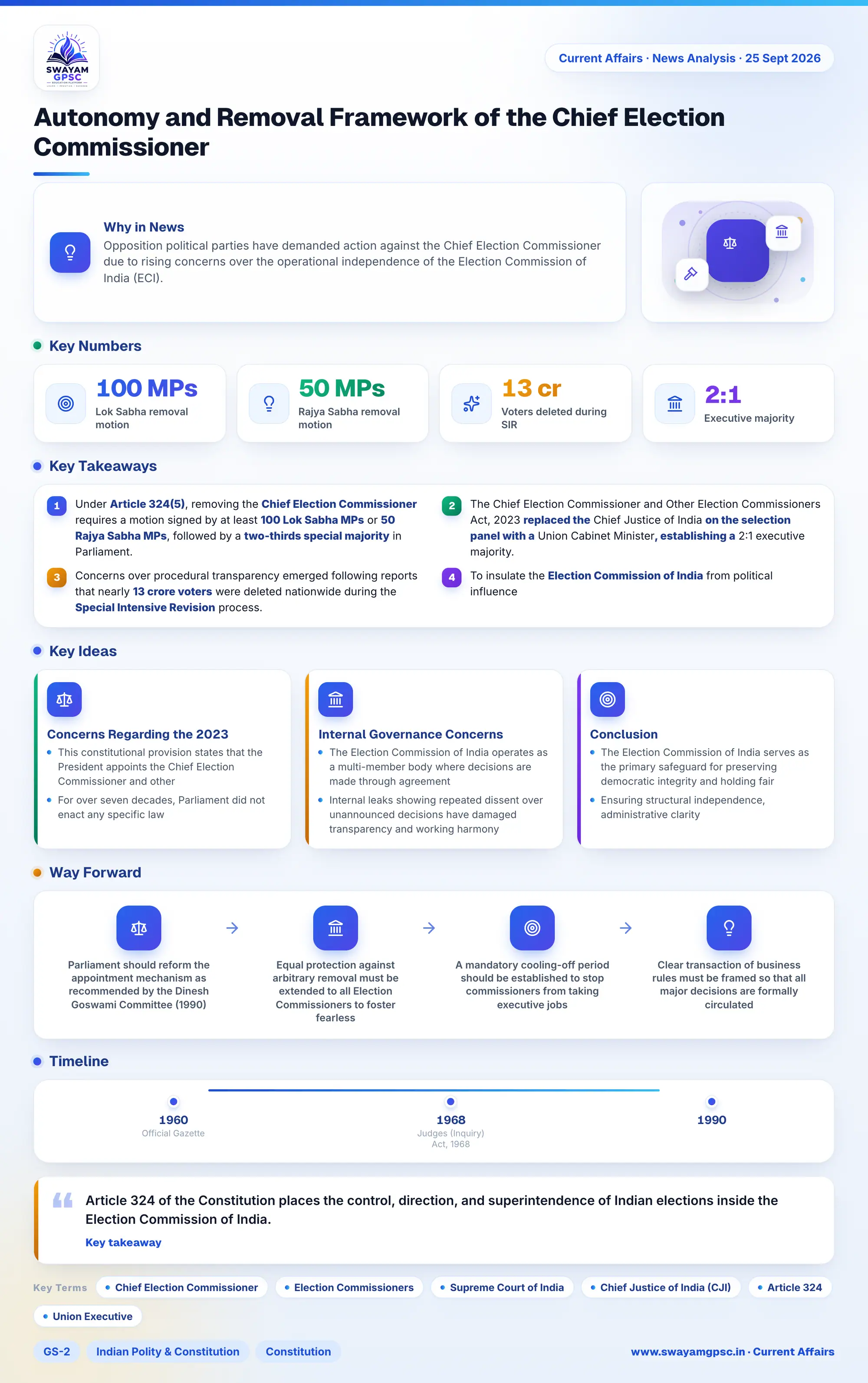
Autonomy and Removal Framework of the Chief Election Commissioner
#GS-2 #Indian Polity & Constitution #Constitution #Constitutional Bodies #Governance & Social Justice #Good Governance #Current Events #National
Key takeaways
- Under Article 324(5), removing the Chief Election Commissioner requires a motion signed by at least 100 Lok Sabha MPs or 50 Rajya Sabha MPs, followed by a two-thirds special majority in Parliament.
- The Chief Election Commissioner and Other Election Commissioners Act, 2023 replaced the Chief Justice of India on the selection panel with a Union Cabinet Minister, establishing a 2:1 executive majority.
- Concerns over procedural transparency emerged following reports that nearly 13 crore voters were deleted nationwide during the Special Intensive Revision process.
- To insulate the Election Commission of India from political influence, experts recommend charging administrative expenses on the Consolidated Fund of India and extending removal protections to all Election Commissioners.
Why in News
- Opposition political parties have demanded action against the Chief Election Commissioner due to rising concerns over the operational independence of the Election Commission of India (ECI).
- Reports revealed that two Election Commissioners formally recorded their objections against multiple decisions, even though the ECI publicly stated that all choices were unanimous.
- At the same time, the Supreme Court of India delivered a 1:1 split verdict on petitions challenging the Chief Election Commissioner and Other Election Commissioners Act, 2023.
- Following this split decision, the matter has been referred to the Chief Justice of India (CJI) to constitute an appropriate Constitution Bench.
Concerns Regarding the 2023 Appointments Act
- Article 324 of the Constitution places the control, direction, and superintendence of Indian elections inside the Election Commission of India.
- This constitutional provision states that the President appoints the Chief Election Commissioner and other commissioners based on laws made by Parliament.
- For over seven decades, Parliament did not enact any specific law, which left selection procedures under the direct control of the Union Executive.
- While the Chief Election Commissioner can only be removed like a Supreme Court judge, other Election Commissioners can be removed on the recommendation of the CEC.
- In the Anoop Baranwal v. Union of India (2023) judgment, a five-judge bench ruled that a panel of the Prime Minister, Leader of Opposition, and Chief Justice of India must make appointments until Parliament passes a law.
- Parliament subsequently enacted the Chief Election Commissioner and Other Election Commissioners Act, 2023 to create a statutory selection framework.
- This new selection committee consists of the Prime Minister, the Leader of the Opposition in Lok Sabha, and a Union Cabinet Minister nominated by the Prime Minister.
- Critics highlight that excluding the Chief Justice of India from the panel weakens public faith in the selection system.
- The inclusion of a Cabinet Minister creates a 2:1 executive majority, which makes the presence of the Opposition leader mostly symbolic.
- This dominance of the executive raises serious doubts regarding the protection of free and fair electoral processes.
- The recent judicial split emphasized that the election authority must not only remain neutral, but must also visibly appear independent to the public.
- Failing this crucial perception test risks eroding public trust in the overall electoral machinery.
Internal Governance Concerns of the ECI
- The Election Commission of India operates as a multi-member body where decisions are made through agreement or a majority vote.
- Internal leaks showing repeated dissent over unannounced decisions have damaged transparency and working harmony among members.
- During the Special Intensive Revision (SIR), administrative directives modified Form 6 without following statutory procedures.
- Under Section 28 of the Representation of the People Act, 1950, modifying rules framed under the Registration of Electors Rules, 1960 requires an Official Gazette notification.
- Updating statutory forms through administrative orders or web updates is legally invalid without proper central government notifications.
- Dissenting commissioners also objected to centralizing IT platforms like ERONet in Delhi, which deprives state officials of direct control.
- Reports indicating the deletion of nearly 13 crore voters nationwide during the revision process sparked fears of mass disenfranchisement.
- Such massive deletions without clear procedures threaten the core promise of the ECI that no voter should be left behind.
- Persistent internal disputes and improper operational methods weaken the institutional authority and credibility of the ECI.
Way Forward
- Parliament should reform the appointment mechanism as recommended by the Dinesh Goswami Committee (1990) and the Law Commission 255th Report (2015).
- Equal protection against arbitrary removal must be extended to all Election Commissioners to foster fearless decision-making.
- A mandatory cooling-off period should be established to stop commissioners from taking executive jobs immediately after retirement.
- Clear transaction of business rules must be framed so that all major decisions are formally circulated and approved by the full commission.
- Any modifications to forms under the Representation of the People Act, 1950 must strictly follow statutory legal vetting and gazette notifications.
- Systems like ERONet must be redesigned to give state and district officials operational independence and direct oversight.
- Administrative expenses of the ECI should be charged on the Consolidated Fund of India to secure financial freedom from the executive.
- An independent secretariat should be set up under dedicated service rules, similar to provisions under Article 98 and Article 146.
Conclusion
- The Election Commission of India serves as the primary safeguard for preserving democratic integrity and holding fair elections.
- Ensuring structural independence, administrative clarity, and financial freedom is vital for maintaining citizen trust in the democratic process.
Prelims in Focus: Removal Framework of the Chief Election Commissioner
- The removal mechanism for the Chief Election Commissioner is a strict constitutional process designed to prevent arbitrary executive interference.
- Under Article 324(5), the CEC can only be removed in the same manner and on the same grounds as a judge of the Supreme Court.
- Article 124(4) establishes that removal can only take place on proved misbehaviour or incapacity through a strict voting threshold.
- The investigation procedure and committee formation are regulated under the Judges (Inquiry) Act, 1968.
- Section 11(2) of the Chief Election Commissioner and Other Election Commissioners Act, 2023 statutorily reconfirms these removal grounds.
- To initiate the motion, a notice signed by at least 100 Lok Sabha MPs or 50 Rajya Sabha MPs must be submitted to the Presiding Officer.
- The Speaker or Chairman holds discretionary power to accept or reject the removal motion after preliminary scrutiny.
- If admitted, a three-member judicial committee consisting of a Supreme Court judge, a High Court Chief Justice, and a distinguished jurist investigates the charges.
- If the committee clears the official, the process ends, but if found guilty, Parliament proceeds with the removal motion.
- Both Houses must pass the motion in the same session by a special majority, requiring a majority of total membership and a two-thirds majority of members present and voting.
- Upon successful passage in both Houses, an address is presented to the President of India to issue the official removal order.
- In the history of independent India, no Chief Election Commissioner has ever been removed from office through this process.