Additive Manufacturing in India: Strategy, Applications, and Challenges
#GS-3 #Economy #Science & Technology #Infrastructure #Growth #Achievements of Indians in Science & Technology #Technology Missions #Additive Manufacturing
Key takeaways
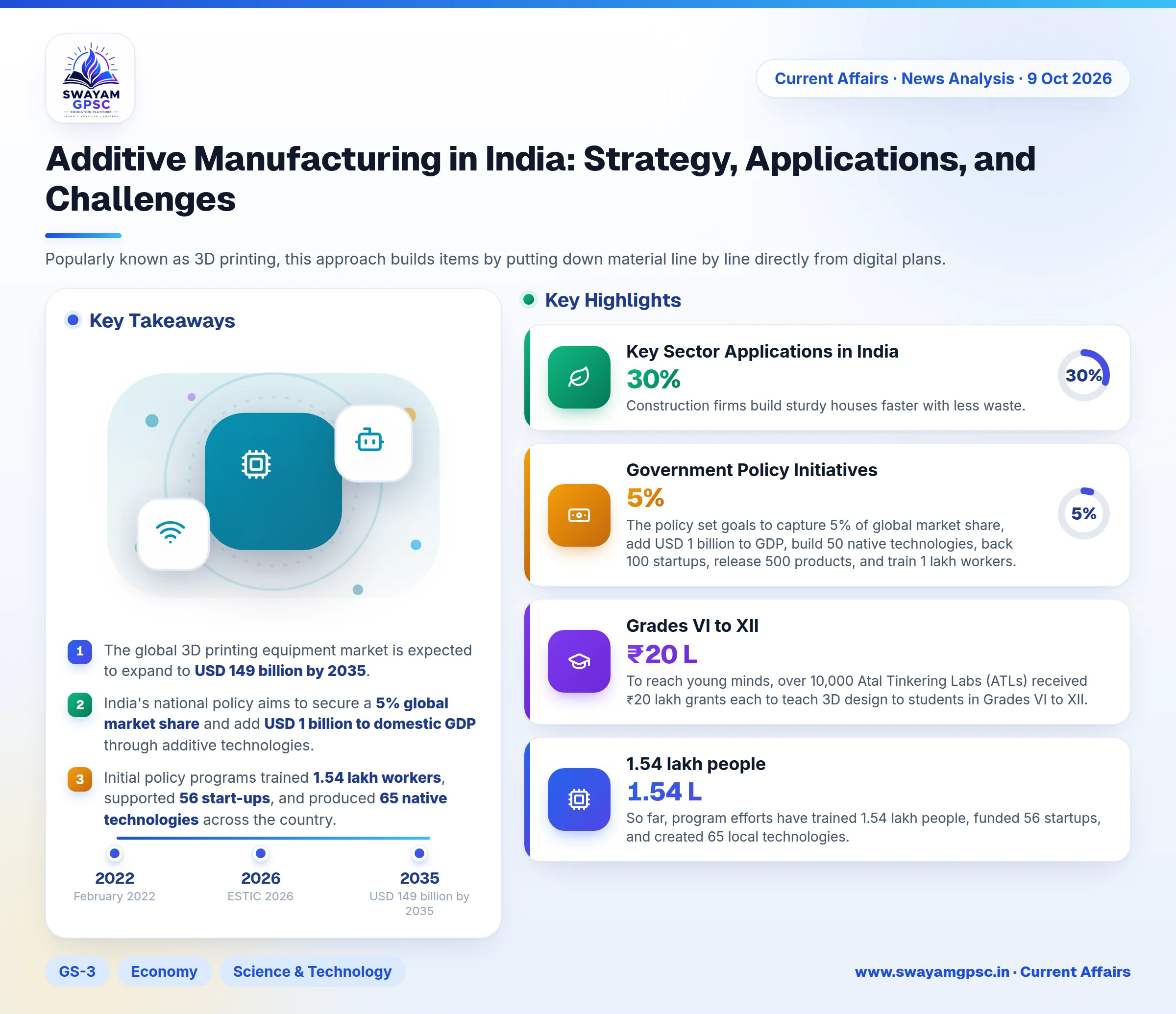
- The global 3D printing equipment market is expected to expand to USD 149 billion by 2035.
- India's national policy aims to secure a 5% global market share and add USD 1 billion to domestic GDP through additive technologies.
- Initial policy programs trained 1.54 lakh workers, supported 56 start-ups, and produced 65 native technologies across the country.
- Using 3D concrete printing cut house building costs by 30% and lowered project carbon emissions by up to 90% compared to standard cement work.
- Over 10,000 Atal Tinkering Labs were set up with ₹20 lakh grants to teach basic 3D engineering to students in Grades VI to XII.
Why in News
- India is shifting its role from using foreign technology to building its own digital innovations. The nation is now expanding its Digital Public Infrastructure (DPI) success into physical factory production.
- This shift centers on Additive Manufacturing (AM), a technology that creates physical goods straight from digital design files.
- By building strong local factory bases, this tech helps lower costly foreign reliance while helping push the Atmanirbhar Bharat and Viksit Bharat national goals.
- To build on its early successes, the Ministry of Electronics and Information Technology (MeitY) launched the National Strategy for Additive Manufacturing (NSAM) 2.0 framework.
What is Additive Manufacturing?
- Popularly known as 3D printing, this approach builds items by putting down material line by line directly from digital plans.
- It differs completely from traditional methods that shape items by cutting, carving, or melting metal in molds.
- The technique combines computing, electronics, software design, and materials science into one connected process.
- It relies heavily on tools like Computer-Aided Design (CAD), Artificial Intelligence (AI), and automated pattern recognition.
How Additive Manufacturing Works
- Designers first create a digital 3D outline using CAD software, laser scanners, or AI design systems.
- The computer turns this outline into an STL (Standard Tessellation Language) file, which covers the surface with tiny triangles.
- Special programs slice this 3D model into thousands of flat, horizontal layer plans.
- The printing unit follows these digital plans to build or fuse the item layer by layer.
- Machines use precise steps like selective laser melting or stereolithography to join metals, plastics, or living cells.
- The finished piece gets post-processing steps like heat treatment or surface sanding to meet safety standards.
Materials Used in Additive Manufacturing
- Common plastics include Acrylonitrile Butadiene Styrene (ABS), Polycarbonate (PC), and Polylactic Acid (PLA) for lightweight products.
- Makers also use water-dissolvable Polyvinyl Alcohol (PVA) to print temporary support pieces that wash away later.
- Metals range from precious items like gold and silver to tough structural choices like titanium and stainless steel.
- Specialized items use hard ceramics such as zirconia, alumina, and tricalcium phosphate.
- Engineers can print clear glass items by binding glass powder layers with strong adhesives before heating.
- Medical teams use items like calcium phosphate and zinc to help rebuild broken bones.
- Scientists are testing bio-inks made from stem cells to print functional blood vessels and living tissue structures.
Key Sector Applications in India
- Space teams use 3D printing to make lightweight, complex rocket parts. For example, startup Agnikul Cosmos flew its Agnibaan SOrTeD rocket using a single-piece printed motor.
- Defense forces use 3D printing for fast, tough building projects. The Indian Army built a two-story home in Ahmedabad in 12 weeks and placed strong concrete shelters in Ladakh.
- Medical centers print custom bone implants that fit individual patients perfectly. Startup OsteoForge works on silk implants while the Technology Development Board (TDB) funds ceramic bone grafts.
- Tech labs print delicate circuit parts directly. Experts at the Indian Institute of Science (IISc) printed custom Photonic Integrated Circuit (PIC) blocks.
- Construction firms build sturdy houses faster with less waste. Using the Kelvin 6K Pro printer, teams built 2,500 sq. ft. homes in under 30 days while cutting material costs by 30% and emissions by 90%.
- Energy experts use 3D printing methods to build specialized concrete supercapacitors for storing solar power.
Government Policy Initiatives
- MeitY launched the National Strategy for Additive Manufacturing (NSAM) in February 2022 to coordinate work between state bodies, firms, and colleges.
- The policy set goals to capture 5% of global market share, add USD 1 billion to GDP, build 50 native technologies, back 100 startups, release 500 products, and train 1 lakh workers.
- To reach young minds, over 10,000 Atal Tinkering Labs (ATLs) received ₹20 lakh grants each to teach 3D design to students in Grades VI to XII.
- So far, program efforts have trained 1.54 lakh people, funded 56 startups, and created 65 local technologies.
- The newly introduced NSAM 2.0 focuses on creating native patents, linking research centers into a shared digital network, and reducing machine costs through industrial clusters.
- National meets like the National Additive Manufacturing Symposium (NAMS) and the upcoming ESTIC 2026 event by CSIR bring leaders together to speed up local production.
Challenges
- Local printing firms depend heavily on expensive foreign raw supplies like specialized titanium powders and high-grade resins.
- Buying industrial-grade metal 3D printers requires huge upfront cash outlays, which limits small and medium businesses.
- India lacks clear local quality tests and safety standards, causing regulatory backlogs at bodies like BIS and CDSCO.
- Foreign owners control the design software, slicing programs, and internal machine codes, limiting local customization.
Way Forward
- India should expand supply schemes like SPECS to encourage local factories to make specialized metal powders and technical ceramics.
- The government should setup shared Common Facility AM Centers (CFACs) in key manufacturing hubs like Pune, Chennai, and Manesar so small firms can use advanced printers on pay-per-use rates.
- Testing groups must fast-track official quality benchmarks to verify printed parts for deep-space, medical, and structural uses.
- Researchers should connect 3D printing plans with the India Semiconductor Mission (ISM) to lower production costs for prototype computer chips.