80th Independence Day: Prime Minister Unveils Sapt Dhara Framework for Viksit Bharat 2047
#GS-2 #GS-3 #Governance & Social Justice #Government Policies & Interventions #Economy #Infrastructure #Science & Technology #Current Events #National
Key takeaways
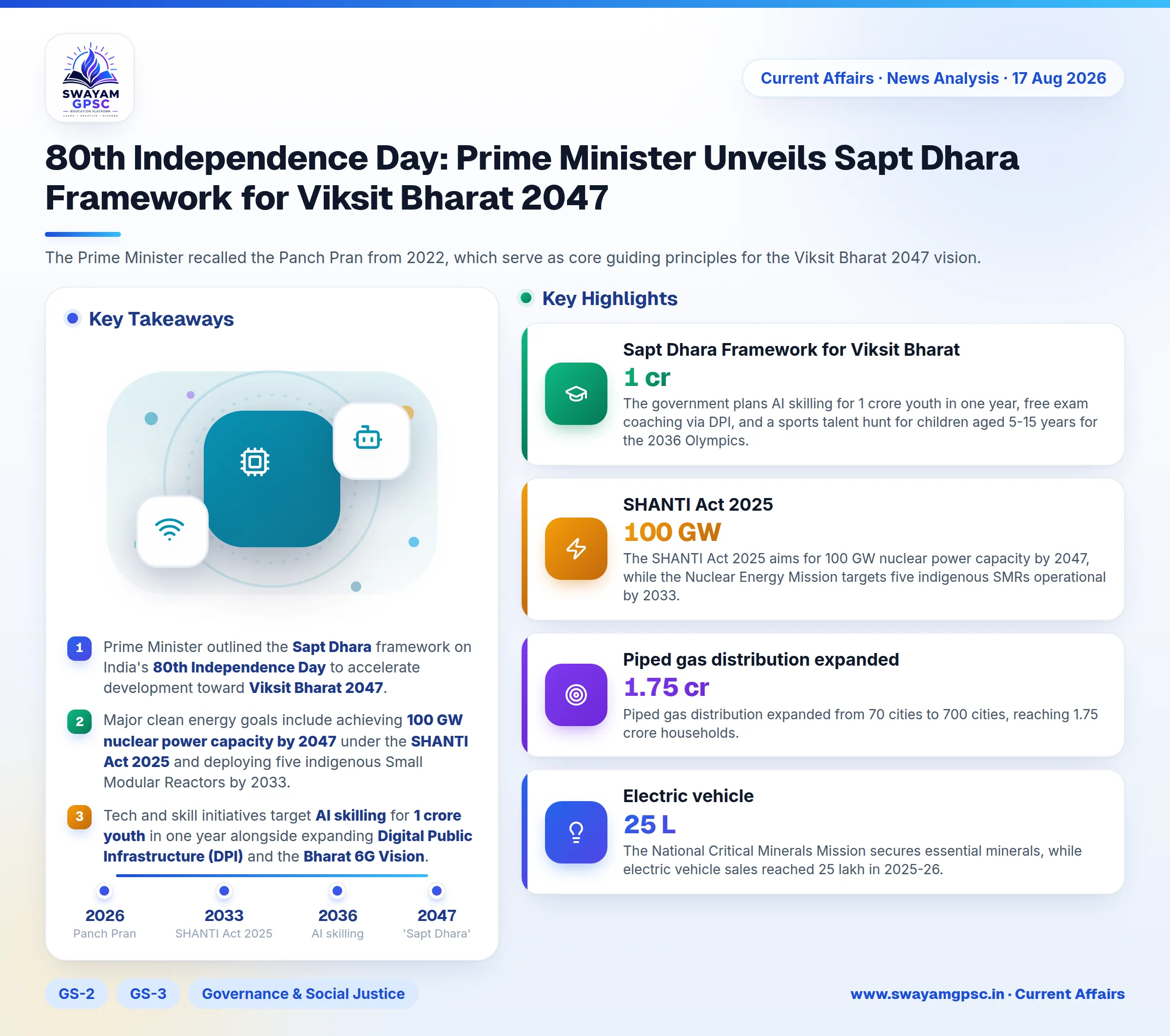
- Prime Minister outlined the Sapt Dhara framework on India's 80th Independence Day to accelerate development toward Viksit Bharat 2047.
- Major clean energy goals include achieving 100 GW nuclear power capacity by 2047 under the SHANTI Act 2025 and deploying five indigenous Small Modular Reactors by 2033.
- Tech and skill initiatives target AI skilling for 1 crore youth in one year alongside expanding Digital Public Infrastructure (DPI) and the Bharat 6G Vision.
- Infrastructure and transport achievements show a 21-fold rise in railway coach production and 25 lakh electric vehicle sales in 2025-26.
Why in News
- The Prime Minister addressed the nation from the Red Fort on India's 80th Independence Day.
- For the first time at the Red Fort, performers rendered the full version of 'Vande Mataram' to mark its 150th anniversary.
- The address introduced the 'Sapt Dhara' framework to boost national capabilities for Viksit Bharat by 2047.
- The Prime Minister recalled the Panch Pran from 2022, which serve as core guiding principles for the Viksit Bharat 2047 vision.
Sapt Dhara Framework for Viksit Bharat
- Reform Express focuses on accelerating policy, institutional, and cultural reforms over the next five to seven years.
- Under Manufacturing, India aims to build entire domestic value chains and promote zero-defect precision manufacturing.
- Programs like Make in India, Swadeshi, and Vocal for Local support the goal of Aatmanirbhar Bharat.
- India has signed Free Trade Agreements (FTAs) with nearly 40 countries since 2014 to help MSMEs access global markets.
- In Agriculture and Food Production, the focus is on food processing, chemical-free farming, and connecting farmers directly to global export markets.
- The government continues to provide affordable fertilizers like Urea and Di-ammonium Phosphate (DAP) below global market rates.
- Under Technology and Innovation, India aims to become a global hub for AI, quantum technology, robotics, space, and semiconductors.
- Key digital initiatives include Digital Public Infrastructure (DPI), Bharat 6G Vision, National Drone Policy, and Atal Tinkering Labs.
- The government plans AI skilling for 1 crore youth in one year, free exam coaching via DPI, and a sports talent hunt for children aged 5-15 years for the 2036 Olympics.
- Under Gati Shakti, the government is building high-speed rail, highways, inland waterways, and multimodal logistics systems.
- Modern railway coach production increased 21-fold, railway electrification reached near-total coverage, and India introduced its first hydrogen-powered train.
- Port development is advancing through port-led development and opportunities in the blue economy.
- Under Defence Power, India is strengthening defense self-reliance in drones, counter-drone tech, hypersonic systems, and cybersecurity through Mission Sudarshan Chakra.
- The address noted the decline of armed Naxalism, while warning against ideological threats that seek to disrupt social harmony.
- Under Green and Blue Economy, India aims for leadership in green hydrogen, renewable energy, and green mobility.
- The SHANTI Act 2025 aims for 100 GW nuclear power capacity by 2047, while the Nuclear Energy Mission targets five indigenous SMRs operational by 2033.
- Piped gas distribution expanded from 70 cities to 700 cities, reaching 1.75 crore households.
- The National Critical Minerals Mission secures essential minerals, while electric vehicle sales reached 25 lakh in 2025-26.
- Under Soft Power, India is expanding its global footprint through Yoga, Ayurveda, the Heal in India campaign, and creative industries featured at the WAVES Summit.
Panch Pran (Five Resolves) for Viksit Bharat
- The Resolve for a Developed India focuses on strong economic growth and high living standards.
- The Removal of Colonial Mindset aims to erase colonial attitudes from institutions and build national confidence.
- Pride in Heritage encourages citizens to embrace India's rich culture and traditions in a modern context.
- Unity and Integrity promotes national unity above caste, regional, and linguistic divisions.
- Sense of Duty (Kartavya) calls on citizens and leaders to make civic responsibility central to nation-building.
Panch Pran vs Sapt Dhara
- The Panch Pran originated during the 76th Independence Day in 2022, whereas Sapt Dhara was announced on the 80th Independence Day in 2026.
- Panch Pran focuses on ideological, psychological, and civic transformation through citizen participation (Jan Bhagidari).
- Sapt Dhara focuses on economic, technological, and strategic sector capacity building using a whole-of-government approach.
- Panch Pran establishes the moral foundation, while Sapt Dhara provides the strategic blueprint for Viksit Bharat 2047.
Way Forward and Conclusion
- The combination of Panch Pran and Sapt Dhara unites moral values with concrete sectoral economic strategy.
- Together, these frameworks pave the way for India to achieve its vision of Viksit Bharat by 2047.