10 Years of Government e-Marketplace (GeM)
#GS-2 #GS-3 #Governance & Social Justice #E-Governance #Economy #Infrastructure #Science & Technology #ICT #Current Events #National #Government e-Marketplace #Public Procurement
Key takeaways
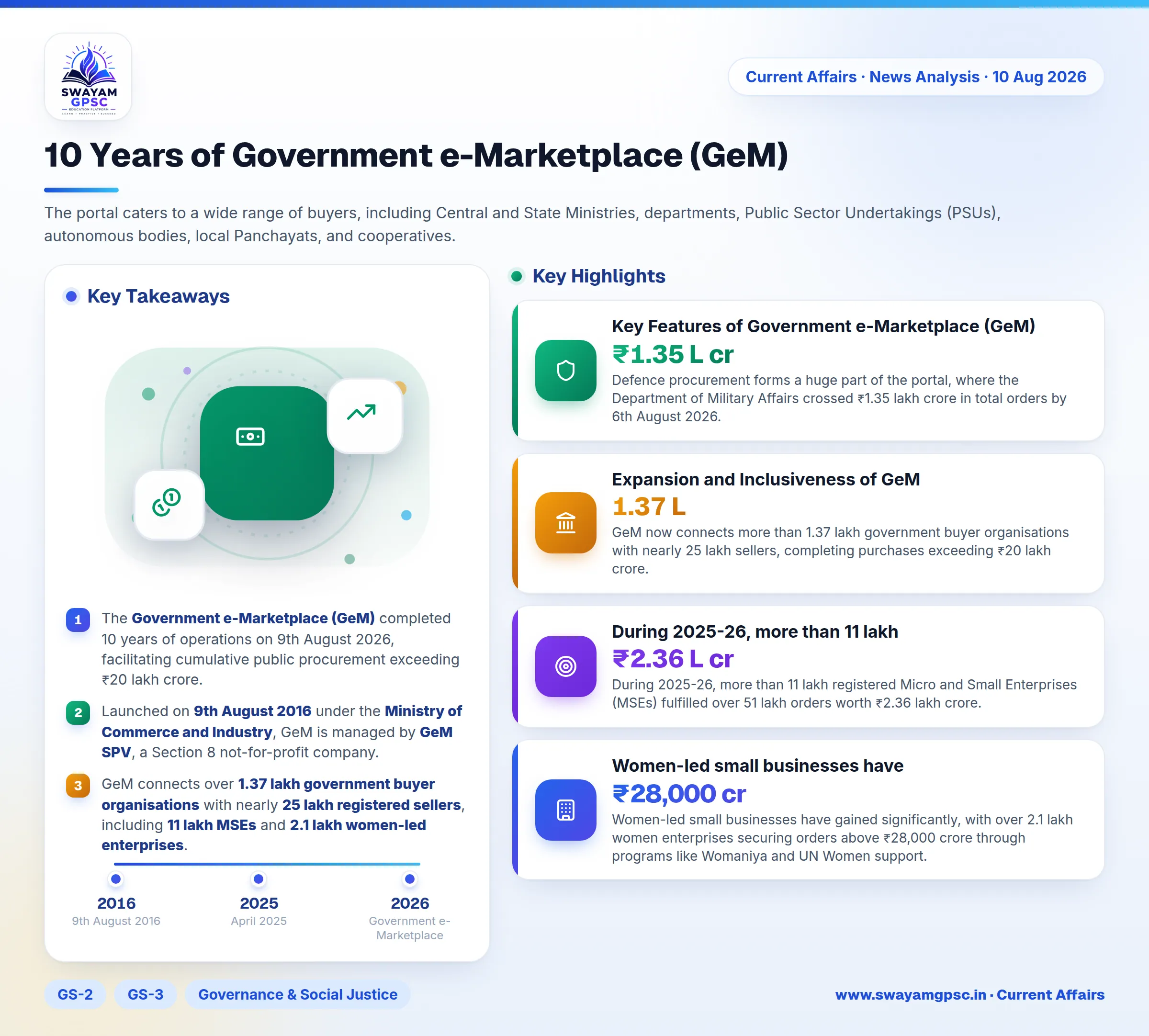
- The Government e-Marketplace (GeM) completed 10 years of operations on 9th August 2026, facilitating cumulative public procurement exceeding ₹20 lakh crore.
- Launched on 9th August 2016 under the Ministry of Commerce and Industry, GeM is managed by GeM SPV, a Section 8 not-for-profit company.
- GeM connects over 1.37 lakh government buyer organisations with nearly 25 lakh registered sellers, including 11 lakh MSEs and 2.1 lakh women-led enterprises.
- In 2025-26, small enterprises executed over 51 lakh orders worth ₹2.36 lakh crore, while startup procurement crossed ₹19,000 crore.
Why in News
- The Government e-Marketplace (GeM) completed 10 years of operations on 9th August 2026. This marks a decade of technology-driven transformation in public procurement across India.
Key Features of Government e-Marketplace (GeM)
- The Government e-Marketplace (GeM) is a single portal designed to make government purchasing paperless, cashless, contactless, transparent, and competitive.
- The system relies on modern digital tools and global purchasing practices to simplify how government offices buy goods and services.
- The portal caters to a wide range of buyers, including Central and State Ministries, departments, Public Sector Undertakings (PSUs), autonomous bodies, local Panchayats, and cooperatives.
- It digitizes the entire purchasing process from vendor registration and product listing to bidding, contract issuance, delivery tracking, and final payment.
- Buyers can choose direct purchasing, price comparison, electronic bidding, or reverse auctions, which helps reduce official discretion and boosts accountability.
- Analytical tools like the GeM Availability Report, Past Transaction Summary, and Last Purchase Price help buying officers take cost-effective decisions.
- To build a unified buying system, GeM is being connected with the Central Public Procurement Portal (CPPP), Indian Railway Electronic Procurement System (IREPS), and Defence Public Procurement Portal (DPPP).
- Defence procurement forms a huge part of the portal, where the Department of Military Affairs crossed ₹1.35 lakh crore in total orders by 6th August 2026.
Expansion and Inclusiveness of GeM
- GeM now connects more than 1.37 lakh government buyer organisations with nearly 25 lakh sellers, completing purchases exceeding ₹20 lakh crore.
- The marketplace lists over 10,660 product categories and 350 service categories, covering items like medical equipment as well as catering and transport services.
- By offering integrated payments and online contracts, GeM advances national initiatives like Digital India, Make in India, Aatmanirbhar Bharat, and Ease of Doing Business.
- Key reforms like Rate Contracts for routine orders and removing Caution Money requirements have lowered compliance burdens for small vendors.
- In April 2025, GeM tied up with IN-SPACe and Drone Federation India to facilitate government buying of space-tech and drone technologies.
- Through the GeM Sahay portal, small sole-proprietor sellers can get quick, collateral-free loans to fulfil government purchase orders without extra approvals.
- GeM collaborates with institutions like AJNIFM, CareEdge Ratings, NCGG, IIPA, and EPFO to improve policy research, vendor training, and labor compliance.
- Under a June 2026 deal with CSC-SPV, the government is opening 50 GeM Suvidha Kendras on a pilot basis to help rural vendors register and manage orders.
- During 2025-26, more than 11 lakh registered Micro and Small Enterprises (MSEs) fulfilled over 51 lakh orders worth ₹2.36 lakh crore.
- Women-led small businesses have gained significantly, with over 2.1 lakh women enterprises securing orders above ₹28,000 crore through programs like Womaniya and UN Women support.
- Orders placed with SC/ST enterprises exceeded ₹6,000 crore with a 28% growth rate, while startup procurement crossed ₹19,000 crore with a 36% annual growth.
- The SWAYATT initiative actively brings startups, women entrepreneurs, small units, and self-help groups into the public procurement ecosystem.
- Dedicated sub-platforms like Womaniya, SARAS Collection, and Startup Runway 2.0 help women, rural self-help groups, and tech startups showcase their goods directly to government buyers.
GeM Governance and Overview
- The Government e-Marketplace is a comprehensive portal created for direct government purchasing of goods and services.
- The portal officially launched its operations on 9th August 2016.
- GeM operates under the oversight of the Department of Commerce in the Ministry of Commerce and Industry.
- The portal is managed by GeM SPV, a 100 percent government-owned Section 8 not-for-profit company.